


Avere (to have): Italian grammar lesson

An interactive lesson guiding you from key takeaways to expert insights. Comes with Q&A, useful vocabulary, interactive audio, quizzes and games.

Marco ha una macchina.
Published May 22, 2020
Updated Apr 1, 2026
Written by
Italian language tutor, course author. MEng, MBA. Member of the International Association of Hyperpolyglots (HYPIA). After learning 12 languages, I can tell you that we all master languages by listening and mimicking. I couldn’t find an app to recommend to my students, so I made my own one. With my method, you’ll be speaking Italian from Lesson 1.
Reviewed by
No data was found

Key Takeaways

  • Avere is essential in Italian, used for expressing ownership, emotions, and as an auxiliary verb for compound tenses.
  • The present tense conjugation of avere includes: io ho, tu hai, lui/lei ha, noi abbiamo, voi avete, loro hanno.
  • In the past tense, the present perfect is formed with avere + past participle avuto, translating to had or have had.
  • For future tense, avere conjugates to: io avrò, tu avrai, lui/lei avrà, noi avremo, voi avrete, loro avranno.
  • It’s common to express feelings like thirst or hunger using avere, e.g., ho fame means I'm hungry.

Stefano's Insights

Play to see captions...
Ah, il verbo 'avere' in italiano, un vero protagonista! Non solo è il verbo del possesso – ho un gatto, hai una macchina – ma è anche un camaleonte linguistico. Traducendosi in 'to get', 'to hold', e tanti altri, è un verbo che si infiltra in frasi quotidiane come 'ho fame' o 'abbiamo freddo'. È pure un ausiliare per i verbi transitivi, un po' come il coltellino svizzero della lingua italiana. Ricordo quando insegnavo italiano e i miei studenti inglesi si confondevano con l'uso dell'H: 'ho' contro 'o'. Ah, la bellezza delle eccezioni! E non dimentichiamo il suo ruolo fondamentale nel passato prossimo. Insomma, 'avere' è un verbo da avere nel proprio arsenale linguistico.
Ah, the verb 'avere' in Italian, a true protagonist! Not only is it the verb of possession – I have a cat, you have a car – but it's also a linguistic chameleon. Translating to 'to get', 'to hold', and many others, it's a verb that sneaks into daily phrases like 'I am hungry' or 'we are cold'. It's also an auxiliary for transitive verbs, like the Swiss army knife of the Italian language. I remember teaching Italian and my English students getting confused with the use of 'H': 'ho' versus 'o'. Ah, the beauty of exceptions! And let's not forget its crucial role in the passato prossimo. In short, 'avere' is a verb to have in your linguistic arsenal.

Quick facts

Why is "avere" crucial in Italian?

"Avere" is essential for ownership, possession, and as an auxiliary verb for compound tenses, making it indispensable for everyday communication.

How does "avere" differ in expressing feelings compared to English?

Italians use "avere" to express states like hunger, thirst, or coldness, while English uses "to be" for similar expressions.

What role does "avere" play in the passato prossimo tense?

In passato prossimo, "avere" helps form past tenses by combining with past participles, crucial for describing completed actions.

How does "avere" help in talking about age in Italian?

Italians use "avere" to state age, literally saying they "have" a certain number of years.

Why does "avere" retain the letter 'H' in some forms?

The 'H' in forms like "hai" and "hanno" differentiates them from similar-sounding words, ensuring clarity in communication.

How does "avere" help convey possession in Italian?

"Avere" directly translates to "to have" and is used to indicate ownership of objects, making it central to discussing possessions.

What makes "avere" irregular in Italian?

"Avere" doesn't follow regular conjugation patterns, requiring unique endings, making it essential to memorize its forms for proper usage.

How do Italians express "to have a beer" differently?

Italians use "prendere" (to take) instead of "avere" for casual actions like having a beer, reflecting a different cultural approach.

What auxiliary role does "avere" play in Italian grammar?

"Avere" is one of the two auxiliary verbs, crucial for forming compound tenses with transitive verbs involving direct objects.

How does "avere" differ in future tense conjugation?

In future tense, "avere" changes to forms like "avrò" and "avremo," indicating future possession or actions, similar to "will have."

Audio images

🔊
Ho comprato un libro.
🔊
Mia sorella ha una bicicletta nuova.
🔊
Marco ha una macchina.
Learn on the go
Install the FREE Think In Italian app for faster loading, offline mode, and quick access anytime.
No registration needed. Works on all devices. Ready in 1 click and 3 seconds.

Audio lesson with 30 sentences to listen and repeat

Italian grammar video lesson

Main Article

Why is it so important the verb avere in Italian?

Avere translates to the obvious uses of ownership and possession for example, to have a sister or a cat, or a house, or a doubt, or a cold.

It can also translate in English to such things as to get, to have received a package, say, or news, and to hold a memory dear, for example.

In addition, it has a long list of daily uses beyond the obvious parallel ones in English: to be right or wrong, to be cold or scared.

It is also one of the two auxiliary verbs in Italian. The other being essere (to be).

This means that avere is also used to help conjugate transitive verbs (with a direct object) to form compound tenses.

Think of all verbs whose action has an object outside of the subject, like mangiare (to eat), baciare (to kiss), bere (to drink), vedere (to see), scrivere (to write), fare (to do), amare (to love).

However, transitive and intransitive verbs do not match exactly in English and Italian.

This makes avere one of the most important verbs in the Italian language and that’s why you should learn its conjugations in Italian.

How to conjugate avere?

Avere is not a regular verb in all tenses. Therefore, it does not have a fixed pattern nor does it have the same suffixes that are used for regular verbs.

Present tense

In English, you’re hungry. In Italian, you have hunger.

So, you need to learn the present tense of the verb avere (to have).

Here is the verb conjugation:

Present Tense
io ho
tu hai
lui/lei ha
noi abbiamo
voi avete
loro hanno

Let’s look at some simple sentences with avere meaning to have in Italian:

Io ho un gatto.

I have a cat.

Tu hai un gatto.

You have a cat.

Lui / lei / Lei ha un gatto.

He/she has a cat.

Noi abbiamo un gatto.

We have a cat.

Voi avete un gatto.

You have a cat.

Loro hanno un gatto.

They have a cat.

In Italian, you can leave out the personal pronoun in front unless you want it for emphasis or clarity.

Past tense 

The most used past tense in Italian grammar is the passato prossimo.

The present perfect tense of avere is formed by the present simple of it + its past participle: avuto.

In English it can be translated as had or have had.

Past tense
io ho avuto
tu hai avuto
lui/lei ha avuto
noi abbiamo avuto
voi avete avuto
loro hanno avuto

Ho avuto una giornata lunga.

I had a long day.

Future tense

The conjugation of the Italian future tense (futuro semplice) of avere corresponds to the English will have or going to have.

Future tense
io avrò
tu avrai
lui/lei avrà
noi avremo
voi avrete
loro avranno

Here are some examples of the future tense of avere:

Quando avrò la patente, potrò guidare

When I will have a driver’s license, I will be able to drive

Se l’esame andrà bene, entrerai all’università

If the exam goes well, you will enter university

What are the uses of avere?

There are many other instances where Italian speakers use have, instead of be. For example, you can also have thirst, sleepiness, hotness, and coldness.

Here are some more sentences:

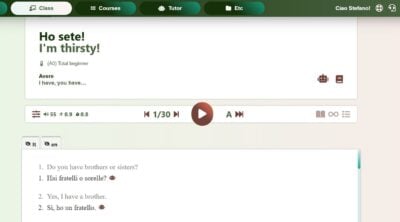
Stefano ha sete.

Stefano is thirsty.

Abbiamo freddo.

We’re cold.

I bambini hanno sonno.

The children are sleepy.

Hai caldo.

You’re hot (not sexy).

Avere can also be used for expressing hunger:

io ho fame (I’m hungry)
tu hai fame
lui/lei ha fame
noi abbiamo fame
voi avete fame
loro hanno fame


How does avere is pronunced in Italian?

As you might have noticed, there is an H.

The reason is that this verb was spelled with an H in Latin (Habere) as it still is in English, have.

As Italian evolved, it lost the use of H for most words, and, as you know, now H is always silent.

The reason avere still has H in some of its forms is purely for disambiguation.

You see, in Italian, we have the following words:

  • o (or)
  • ai (to the)
  • a (to)
  • anno (year)

And it would be very unclear if these words also meant:

  • I have
  • You have
  • He/she has
  • They have

For this reason, we kept the H in those forms but you don’t need to remember this bit of information.

What you do have to remember is which forms of the present tense have the H and which ones don’t (noi and voi are the only forms without the H).

Avere: examples

In English, you have breakfast, a bath, a shower, a nap, a cigarette, a coffee, etc.

In Italian, you don’t use avere for those things. We use it mainly to refer to possession. Remember this when you speak Italian!

Let’s take a look at some more examples of how to use avere:

Io ho un gatto.

I have a cat.

Quante macchine hai?

How many cars do you have?

Non ho amici!

I have no friends! (literally: I don’t have friends!)

Avete informazioni?

Do you guys have any information?

Avere is also needed to talk about your age as in Italian, we are not an age but we have years of age.

Ho trentadue anni.

I’m 32.

Alberto ha venti anni.

Alberto is 20.

Quanti anni hai?

How old are you?

Other Italian verbs such as  prendere (to take) or fare (to do, to make) have the meaning of to have in English:

Prendo una birra!

I’ll have a beer!

Faccio il bagno!

I’ll have a bath!

Facciamo colazione!

Let’s have breakfast!

Learn more about Italian verb conjugation here.

Key Terms and Concepts

Verb Avere

Avere is crucial in Italian as it denotes possession and is used as an auxiliary for transitive verbs in compound tenses.

Present tense of Avere

The present tense forms are: io ho, tu hai, lui/lei ha, noi abbiamo, voi avete, loro hanno.

Past tense of Avere

The passato prossimo is formed with the present of avere and its past participle avuto. It translates to 'had' in English.

Future tense of Avere

Avere in the future tense (futuro semplice) is used as: io avrò, tu avrai, lui/lei avrà, etc.

Uses of Avere

It is used for possession, age, emotional and physical states in Italian, e.g., avere fame (to be hungry), avere sete (to be thirsty).

Test your knowledge in 10 quick questions

Words

sorellasister
gattocat
casahouse
raffreddorecold
ausiliareauxiliary
transitivotransitive
famehunger
setethirst
freddocold
anniyears

Phrases

ho un caneI have a dog
avere fameto be hungry
ho freddoI am cold
abbiamo una casawe have a house
hai una sorella?do you have a sister?
avere seteto be thirsty
ho trent'anniI am thirty years old
avere sonnoto be sleepy
avere un gattoto have a cat
avere bisogno dito need

Sentences

Ho una sorella e un gatto.

I have a sister and a cat.

Abbiamo comprato una nuova casa.

We have bought a new house.

Hai freddo? Vuoi una coperta?

Are you cold? Do you want a blanket?

Hai mangiato?

Have you eaten?

Ho trentadue anni.

I am 32 years old.

Match the Phrases

Memory game

Flip the cards to find matching pairs!

Crossword

Across
Down
Answers

FAQs

What is the verb "avere"?

Avere in Italian is used to indicate ownership or possession and is the translation of the verb to have in English.

How do you know if the auxiliary verb is "essere" or "avere" in Italian?

When the main verb is followed by a direct object and an answer to the question "what or who?" you use avere and essere when it is not.

Is "avere" a regular or irregular verb?

Avere is an irregular verb so it doesn’t follow a fixed pattern nor does it have the same suffixes that are used for regular verbs.

think in italian reddit

The comments section has moved to the Think In Italian Reddit community. Join today!

Italian word of the day
consegnare
Non potremo consegnare in tempo.
We will not be able to deliver it in time.

What's new

stefano lodola italian teacher (1)
30 Free Courses to Get You Started ($40 Value)
italian audio lesson preview
italian audio reading preview
italian ai tutor preview
"I've tried other apps like Babbel and Memrise. None made me fluent or made me feel like I was making much meaningful progress in learning a language."
testimonial 2
Ecem Topcu
Aug 7, 2025