
Essere (to be) in the Present Tense: Italian Grammar Lesson

An interactive lesson guiding you from key takeaways to expert insights. Comes with Q&A, useful vocabulary, interactive audio, quizzes and games.

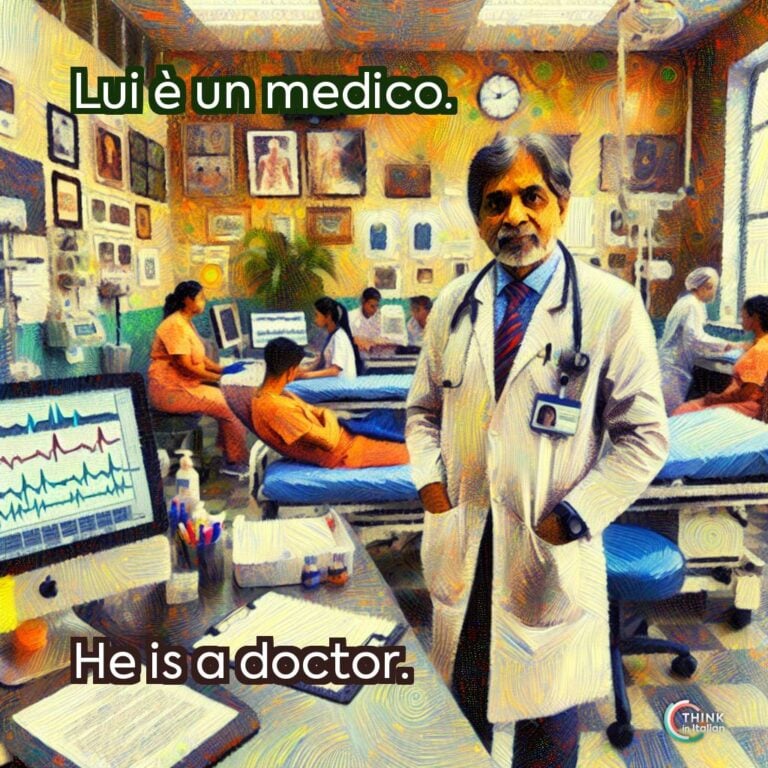
Lui è un medico.
Lui è un medico.
Lui è un medico.
Published May 17, 2020
Updated Mar 27, 2026
Written by
Italian language tutor, course author. MEng, MBA. Member of the International Association of Hyperpolyglots (HYPIA). After learning 12 languages, I can tell you that we all master languages by listening and mimicking. I couldn’t find an app to recommend to my students, so I made my own one. With my method, you’ll be speaking Italian from Lesson 1.
Reviewed by
No data was found

Key Takeaways

  • Essere means "to be" in Italian and is essential for constructing sentences and expressing identity.
  • Essere is an irregular verb, requiring memorization of its forms in various tenses, especially the present tense.
  • In the present tense, essere conjugates as: io sono, tu sei, lui/lei è, etc.
  • Use essere to describe characteristics, indicate origin, and express possession in Italian sentences.
  • Personal pronouns are often omitted in Italian as the verb conjugation indicates the subject clearly.

Stefano's Insights

Play to see captions...
Ah, il verbo "essere"! È il pane quotidiano di chiunque impari l'italiano, come il caffè al mattino per noi italiani. Essere è un verbo irregolare e un ausiliare fondamentale per creare tempi composti. Pensate a "Io sono" come al vostro nuovo miglior amico. Si usa per descrivere, indicare l'origine o la nazionalità, e persino per parlare di possesso. Ricordo i miei primi giorni di insegnamento: un'allieva mi disse "Io sono felice" dopo aver imparato il verbo. Era un piccolo traguardo, ma il suo sorriso mi ha fatto capire l'importanza di iniziare dalle basi. E ora, siete pronti a tuffarvi in questo mondo linguistico! Non abbiate paura di sbagliare, perché l'italiano è una lingua che ama essere vissuta.
Ah, the verb "essere"! It's the daily bread of anyone learning Italian, like morning coffee for us Italians. Essere is an irregular and auxiliary verb essential for creating compound tenses. Think of "Io sono" as your new best friend. It's used to describe, indicate origin or nationality, and even to talk about possession. I remember my early teaching days: a student told me "Io sono felice" after learning the verb. It was a small milestone, but her smile made me realize the importance of starting with the basics. And now, you're ready to dive into this linguistic world! Don't be afraid to make mistakes, because Italian is a language that loves to be lived.

Quick facts

Why is "essere" crucial for learning Italian?

"Essere" is essential because it’s one of the most common verbs and is used to form compound tenses, which are vital for expressing various actions in Italian.

What is an auxiliary verb in Italian?

An auxiliary verb, like "essere," helps form compound tenses, conveying grammatical nuances such as tense, aspect, and modality, critical for mastering Italian verb conjugation.

How irregular is the verb "essere"?

"Essere" is highly irregular, requiring memorization of its various forms across all verb tenses, unlike regular Italian verbs.

How many moods does the Italian verbal system have?

Italian verbs operate in four moods: indicative, subjunctive, conditional, and imperative, each with multiple tenses to express different actions and states.

What are the simple and compound tenses in the indicative mood?

The indicative mood includes eight tenses: four simple (present, imperfect, future, past definite) and four compound (present perfect, past perfect, future perfect, past anterior).

How does Italian verb conjugation differ from English?

Italian verbs have specific conjugations for each person, eliminating the need for explicit personal pronouns, unlike English where pronouns are necessary for clarity.

When is "essere" used for descriptions?

"Essere" is used to describe characteristics like color, personality, and size, often followed by adjectives, e.g., "Mia sorella è simpatica" (My sister is fun).

How does "essere" indicate origin?

To state origin, "essere" is used with "di," e.g., "Io sono di Milano" (I am from Milan), specifying where someone or something is from.

How is nationality expressed with "essere"?

Nationality is expressed by combining "essere" with a nationality adjective, e.g., "Luca è francese" (Luca is French), blending origin and description.

How does "essere" function in possession contexts?

"Essere" indicates possession by specifying ownership, e.g., "Questo cane è di Lucia" (This dog is Lucia's), showing who an object belongs to.

Audio images

🔊
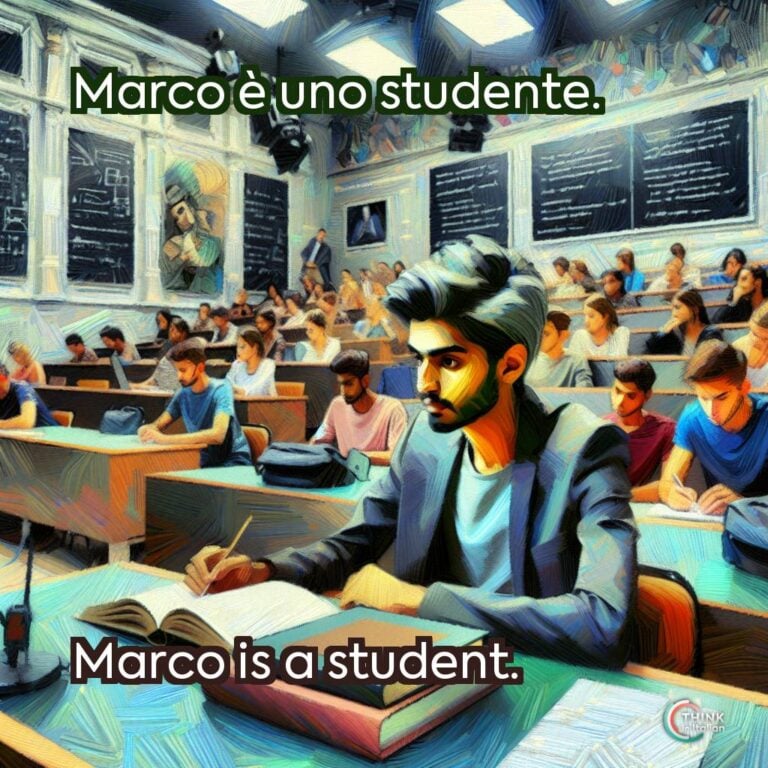
Marco è uno studente.
🔊
Lui è un ingegnere.
🔊
Lui è un medico.
Learn on the go
Install the FREE Think In Italian app for faster loading, offline mode, and quick access anytime.
No registration needed. Works on all devices. Ready in 1 click and 3 seconds.

Audio lesson with 30 sentences to listen and repeat

Italian grammar video lesson

Stefano's video lesson

Main Article

The Verb “Essere” in Italian

Essere: Meaning

Essere, o non essere, questo è il dilemma.”

Do you recognize this phrase? It’s the translation of Hamlet’s “To be or not to be, that is the question”. So you are guessing right: essere is the verb “to be” in Italian.

Essere: Grammar

Learning the verbessere is essential if you want to learn Italian because it is one of the most common verbs, together with avere and fare.

Essere is an auxiliary verb, also called helping verbs because they help create compound verbs, that is, those verbs that are composed of more than one verb. An example of an English compound verb is the present perfect “I have done”.

Auxiliary verbs convey grammatical information like tense, aspect, and modality, therefore it is crucial that every language learner properly learns how to use them in their target language.

Essere is the Italian most irregular verb, which means that you’ll have to memorize all of its forms in al verb tenses. But don’t worry—once you understand how compound tenses are made, you’ll be halfway there.

To be in Italian: Conjugation

Italian Verbs

Let me first start with a quick overview of Italian verbal system. Italian has four moods: indicative, subjunctive, conditional, and imperative. Each of these moods has different tenses, like present, past, or future.

What is relevant for this grammar lesson is the indicative mood. In Italian, it is composed of eight tenses: four simple tenses, and four compound tenses. The indicative mood in Italian is used to express certainty that an action happened or that it will happen.

Essere: Conjugation

As mentioned before, essere is an irregular verb, this means that you can’t apply the rules of regular verbs when conjugating it, but you have to learn it by heart.

Let me first show you how you can conjugate the irregular verb essere in the present tense:

Io sono I am
Tu sei You are
Lui/lei è He/she is
Noi siamo We are
Voi siete You are
Loro sono They are

In Italian, unlike in English, it is not mandatory that we explicitly use personal pronouns (io, tu, etc.) when conjugating a verb. This is because, as you might have noticed already, Italian has a specific conjugation for each person, so there is no need to specify further information as to who the subject is.

Examples:

A: Sei inglese?
B: Are you English?

A: No, sono scozzese.
B: No, I’m Scottish.

Learn more about Italian verb conjugation.

When to use “Essere”?

The verb essere in Italian is used in three main contexts:

  • To describe someone/something
  • To talk about someone’s origin/nationality
  • To indicate possession

This makes essere the most used verb in Italian. Let me now give you some context to use essere in Italian.

General Descriptions

We use essere to describe people, objects, and places. When we describe something or someone we usually talk about their characteristics, like color, personality, age, shape, size, etc.

This is why, in this case, the verb essere is usually followed by an adjective, like in the examples below:

Mia sorella è simpatica.

My sister is fun.

Quel fiore è rosa.

That flower is pink.

Origin

When we want to say where a person is from or what an object belongs to, we use the following structure essere + di. For example:

Io sono di Milano.

I am from Milan.

Il dottore è di Bologna.

The doctor is from Bologna.

Questa chiave è della mia auto.

This key is my car’s.

Nationality

A nice mix of the two previous uses, is when we want to talk about the country of origin of someone or something. In this case we are saying where a person is from, but we are using an adjective to describe their origin, therefore we use essere + nationality.

Luca è francese.

Luca is French.

A: Di dove sei?
B: Sono tedesco.

A: Where are you from?
B: I’m German.

Possession

Also very similar to the contextual use of “origin” related to objects. In fact, we can use the verb essere to talk about possessions.

Questo cane è di Lucia.

This dog is Lucia’s.

Questa borsa è mia.

This bag is mine.

Sei Pronto/a!

You are ready! Now it’s you turn to study, practice, and learn Italian. Check out the free preview of the first 10 lessons of the course and get ready to speak Italian with us. Now, your next step it to learn the difference between Essere and Stare.

Do you have no one to practice  your Italian with? No worries! Practice with our Italian AI-Tutor. You can engage in unlimited, beginner, intermediate or advanced conversations, based on your level.

While you chat, your Italian AI Tutor will provide you with detailed, real-time feedback. Also, the translation tool will allow you to switch between English and Italian language during the entire conversation.

This is your first step towards a magical Italian learning path!

Key Terms and Concepts

Essere

Essere is the Italian verb 'to be.' It is highly irregular and essential for forming compound tenses in Italian.

Indicative Mood

The indicative mood in Italian expresses certainty that an action happens or will happen. It includes eight tenses: four simple and four compound.

Present Tense Conjugation

The present tense conjugation of essere is: io sono, tu sei, lui/lei è, noi siamo, voi siete, loro sono.

Use of Essere

Essere is used to describe, indicate origin/nationality, and denote possession. Examples include describing people or objects, stating origin, and indicating ownership.

Personal Pronouns

In Italian, personal pronouns are often omitted in sentences because verb conjugations indicate the subject, such as io, tu, lui/lei.

Test your knowledge in 10 quick questions

Words

sonoI am
seiyou are
èhe/she is
siamowe are
sieteyou (plural) are
lorothey are
nazionalitànationality
origineorigin
possessopossession
aggettivoadjective

Phrases

essereto be
io sonoI am
tu seiyou are
lui/lei èhe/she is
noi siamowe are
voi sieteyou are (plural)
loro sonothey are
nazionalitànationality
originiorigin
possessopossession

Sentences

Io sono felice oggi.

I am happy today.

Tu sei di Roma?

Are you from Rome?

Lui è un insegnante.

He is a teacher.

Noi siamo italiani.

We are Italian.

Questa macchina è di Maria.

This car is Maria's.

Match the Phrases

Memory game

Flip the cards to find matching pairs!

Crossword

Across
Down
Answers

FAQs

How do you conjugate the verb essere in the present tense?

Essere is an auxiliary verb, meaning it is used to create other verbal tenses. Essere is also irregular, so you'll need to memorize all of its forms.

Is essere the verb to be?

Essere, and its conjugation are fundamental parts of Italian grammar. The most common word in the language has the meanings of "to be," "to exist," and "to be from somewhere" when used with the preposition di. Its applications match those of English.

What verbs can be combined with essere in Italian?

Intransitive verbs that take the auxiliary essere are the verbs of movement, reflexive verbs, pronominal verbs, and impersonal verbs.

think in italian reddit

The comments section has moved to the Think In Italian Reddit community. Join today!

Italian word of the day
consegnare
Non potremo consegnare in tempo.
We will not be able to deliver it in time.

What's new

stefano lodola italian teacher (1)
30 Free Courses to Get You Started ($40 Value)
italian audio lesson preview
italian audio reading preview
italian ai tutor preview
"I've tried other apps like Babbel and Memrise. None made me fluent or made me feel like I was making much meaningful progress in learning a language."
testimonial 2
Ecem Topcu
Aug 7, 2025