

Bellissimo – The Superlative: Italian Grammar Lesson

An interactive lesson guiding you from key takeaways to expert insights. Comes with Q&A, useful vocabulary, interactive audio, quizzes and games.

Quel palazzo è altissimo.
Published Dec 22, 2020
Updated Jun 3, 2026
Reviewed by
Italian language tutor, course author. MEng, MBA. Member of the International Association of Hyperpolyglots (HYPIA). After learning 12 languages, I can tell you that we all master languages by listening and mimicking. I couldn’t find an app to recommend to my students, so I made my own one. With my method, you’ll be speaking Italian from Lesson 1.
Written by
No data was found

Key Takeaways

  • The superlativo expresses the highest degree of a quality in Italian, with two main types: superlativo relativo and superlativo assoluto.
  • Superlativo Assoluto can be formed in two ways: the analytic form using the suffix -issimo and the synthetic form using adverbs like molto.
  • Irregular forms exist for some adjectives, such as buono becoming ottimo instead of buonissimo.
  • Certain adjectives cannot take comparative or superlative forms, including geographical adjectives and those indicating an extreme quality.
  • Using prefixes like super- or ultra- can also create superlativo assoluto in informal contexts.

Stefano's Insights

Play to see captions...
Ah, il superlativo assoluto, una delle meraviglie della lingua italiana! Non solo puoi trasformare un semplice 'bello' in 'bellissimo', ma puoi anche usare avverbi come 'molto' o prefissi come 'super' per enfatizzare ulteriormente. E non dimentichiamo le forme irregolari, come 'ottimo' per 'buonissimo'. Tuttavia, ci sono eccezioni: non puoi rendere 'italiano' più italiano di così! Ricordo quando cercavo di spiegare a uno studente americano perché non poteva dire 'italianissimo'. Era confuso quanto me quando cercavo di capire il football americano. Ah, le gioie dell'insegnamento delle lingue!
Ah, the absolute superlative, one of the wonders of the Italian language! Not only can you turn a simple 'bello' into 'bellissimo', but you can also use adverbs like 'molto' or prefixes like 'super' for extra emphasis. And let's not forget the irregular forms, like 'ottimo' for 'buonissimo'. However, there are exceptions: you can't make 'italiano' more Italian than it is! I remember trying to explain to an American student why they couldn't say 'italianissimo'. They were as confused as I was trying to understand American football. Ah, the joys of teaching languages!

Quick facts

How do you form the superlativo assoluto in Italian?

Add –ISSIMO/A/I/E to the adjective's stem or use adverbs like "molto" or prefixes like "super-".

What's an example of using an adverb to form the superlativo assoluto?

"Il russo è una lingua davvero difficile" means "Russian is a really difficult language."

Can you give an example of using a prefix for superlativo assoluto?

"Quel film è strabello!" translates to "That movie is super good!"

What are some irregular forms of the superlativo assoluto for "buono"?

"Buono" becomes "ottimo" rather than "buonissimo" in its irregular superlativo assoluto form.

How does "grande" change in its irregular superlativo assoluto form?

"Grande" changes to "massimo" instead of "grandissimo."

Why can't some adjectives use comparative or superlative forms?

Adjectives describing geography, ethnicity, or extreme qualities don't allow gradation, e.g., "italiano" or "straordinario."

Can you use suffix-altered adjectives in the superlativo assoluto?

No, adjectives altered with suffixes like –etto, –occio, or –ino cannot form superlatives, e.g., "bellino."

What's an example of superlativo assoluto using an irregular form?

"Queste lasagne sono ottime" means "This lasagna is excellent," using the irregular form "ottime."

How would you express extreme dissatisfaction using a prefix?

"Sono arcistufa dei suoi rimproveri" translates to "I am so fed up with his reprimands," using the prefix "arci-."

What's a superlativo assoluto example highlighting elegance?

"Lucia è sempre elegantissima" means "Lucia is always very elegant," using "elegantissima."

Audio images

🔊
Questo compito è facilissimo.
🔊
Quel ristorante è superbuono!
🔊
Questo dolce è superbuono!
🔊
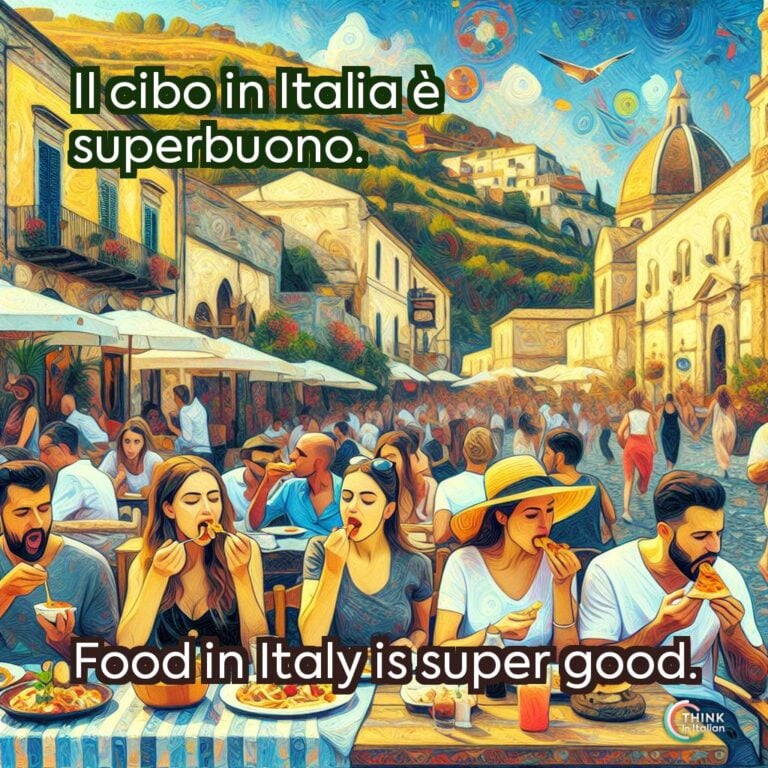
Il cibo in Italia è superbuono.
🔊
Quel palazzo è altissimo.
🔊
Questo gelato è straordinario.
Learn on the go
Install the FREE Think In Italian app for faster loading, offline mode, and quick access anytime.
No registration needed. Works on all devices. Ready in 1 click and 3 seconds.

Audio lesson with 30 sentences to listen and repeat

Italian grammar video lesson

Main Article

What is “Superlativo” in Italian

In Italian, the superlativo (superlative) is a grammatical form that is used to express the highest degree of a quality, either in an absolute sense or in comparison to others. Based on this distinction, you can find two types of superlatives in Italian:

  1. Superlativo Relativo(Relative Superlative): used to indicate that something has the most or least of a quality in general or compared to a group. It is formed with the definite article followed by più (most)/meno (least), and the adjective.

Luca è il più alto (della classe).

Luca is the tallest (in the class).

  1. Superlativo Assoluto (Absolute Superlative): it expresses an extreme degree of a quality without comparison to others. It is formed by adding the suffix -issimo to the adjective’s stem.

Questo film è bellissimo.

This movie is very beautiful.

In this article, I will focus on the second type of superlativo. I will show you how to form it, when to use it, and how.

Superlativo Assoluto

How to Form “Superlativo Assoluto” in Italian

In the previous section I already mentioned how to form the Italian superlativo assoluto, but you should know that there actually exist two ways to form it. In linguistics, they are called the synthetic form and the analytic form.

  • Analytic form: obtained by simply removing the last letter from the adjective and adding the suffix –issimo.

Notice that, since you are dealing with an adjective, the suffix -issimo must change according to the gender and the number of the noun you are referring to, therefore resulting in:

Singular Plural
Masculine -issimo -issimi
Feminine -issima -issime

Let me show you some examples: conosciuto -> conosciutissim*elegante -> elegantissim*alto -> altissim*

  • Synthetic form: obtained by adding an adverb before the adjective. These adverbs can be molto (very), davvero (really), decisamente (definitely), estremamente (extremely), etc.

Il russo è una lingua davvero difficile.

Russian is a really difficult language.

Siamo state estremamente fortunate a trovare questa offerta

We were extremely lucky to find his offer.

Bonus form! You can also create superlativo assoluto in Italian by adding a prefix to the adjective, without even a space. These prefixes can be: super-, arci-, ultra-, stra-, iper-, etc. This structure is used in informal and spoken language.

Quel film è strabello!

That movie is super good!

Sono arcistufa dei suoi rimproveri.

I am so fed up with his reprimands.

Notice that all these forms are absolutely interchangeable!

“Superlativo Assoluto”: Irregularities

Irregular Forms

As for the superlativo relativo, some adjectives have two forms of the superlativo assoluto: one is regular, as we saw until now, while the other is irregular. Let me show you what these forms are:


Adjective  Regular Superlativo Assoluto Irregular Superlativo Assoluto Translation
Buono Buonissimo Ottimo Excellent
Cattivo Cattivissimo Pessimo Terrible
Grande Grandissimo Massimo Maximum
Piccolo Piccolissimo Minimo Minimal

Questa lasagna è ottima.

This lasagna is excellent.

In questo bar il caffè è pessimo.

Coffee is really bad in this café.

Exceptions

There are some adjectives with which you cannot use the comparative or superlative forms of adjectives. These are adjectives that do not allow a grade or level of intensity, such as:

  • Geographical or ethnical adjectives: italiano (Italian), francese (French), cinese (Chinese)
  • Altered words: namely those that have suffixes like –etto, –one, –ino, –etto etc.
  • Adjectives that already indicate an extreme quality: straordinario (extraordinary), magnifico (wonderful), terribile (terrible), etc.

Key Terms and Concepts

Superlativo

The superlativo is used to express the highest degree of a quality, either in an absolute sense or in comparison to others.

Superlativo Relativo

This denotes something having the most or least of a quality compared to a group. It involves the definite article, più/meno, and an adjective.

Superlativo Assoluto

Used to express an extreme degree of quality without comparison to others. Formed by adding the suffix -issimo to the adjective's stem.

Analytic Form

Formed by adding -issimo to the adjective, adjusting for gender and number. Example: conosciuto becomes conosciutissimo.

Synthetic Form

Constructed by placing an adverb before the adjective. Common adverbs include molto, davvero, decisamente, and estremamente.

Irregular Superlatives

Certain adjectives have irregular superlativo assoluto forms like buono to ottimo and grande to massimo.

Test your knowledge in 10 quick questions

Words

bellissimovery beautiful
davveroreally
moltovery
supersuper
straextra
ottimoexcellent
grandissimovery large
piccolissimovery small
difficilissimovery difficult
facilissimovery easy

Phrases

bellissimovery beautiful
davvero interessantetruly interesting
stradivertentesuper fun
molto facilevery easy
ottimoexcellent
supervelocesuper fast
straordinarioextraordinary
davvero complicatotruly complicated
molto importantevery important
superbosuperb

Sentences

La pizza di Napoli è buonissima.

The pizza from Naples is very good.

Questo film è davvero interessante.

This film is really interesting.

Il parco è strabello in primavera.

The park is absolutely beautiful in spring.

Il ristorante ha un servizio ottimo.

The restaurant has excellent service.

L'insegnante di italiano è molto paziente.

The Italian teacher is very patient.

Match the Phrases

Memory game

Flip the cards to find matching pairs!

Crossword

Across
Down
Answers

FAQs

What is superlativo assoluto?

The superlative form of an adjective is the one that expresses which of more than two items has the most extreme or highest degree of the quality that is expressed by the adjective.

What does superlativo relativo mean?

In Italian, the 'Superlativo Relativo' is used to describe an object or person that has the most or least amount of a particular quality in comparison to other objects or people.

think in italian reddit

The comments section has moved to the Think In Italian Reddit community. Join today!

Italian word of the day
potrai
Posso andare in bagno? Potrai andarci dopo la lezione.
Can I go to the bathroom? You can go after class.

What's new

stefano lodola italian teacher (1)
30 Free Courses to Get You Started ($40 Value)
italian audio lesson preview
italian audio reading preview
italian ai tutor preview
"I've tried other apps like Babbel and Memrise. None made me fluent or made me feel like I was making much meaningful progress in learning a language."
testimonial 2
Ecem Topcu
Aug 7, 2025