

How to say “Until”: Italian Grammar Lesson

An interactive lesson guiding you from key takeaways to expert insights. Comes with Q&A, useful vocabulary, interactive audio, quizzes and games.

Rimango qui finché non finisce la lezione.
Published Sep 23, 2021
Updated Oct 20, 2025
Reviewed by
Italian language tutor, course author. MEng, MBA. Member of the International Association of Hyperpolyglots (HYPIA). After learning 12 languages, I can tell you that we all master languages by listening and mimicking. I couldn’t find an app to recommend to my students, so I made my own one. With my method, you’ll be speaking Italian from Lesson 1.
Written by
No data was found

Key Takeaways

  • The most common translation for "until" in Italian is fino a, used for specific times and locations.
  • For expressing how long something lasts, use fino a quando, which translates to "until when" in English.
  • When introducing conditions, finché is used, often paired with non to indicate something hasn't occurred yet.
  • To express a range of time or location, utilize da... fino a, meaning "from... until," marking clear starting and ending points.
  • A formal alternative to fino a is sino a, which is more common in writing than in conversation.

Stefano's Insights

Play to see captions...
Ah, il magico mondo di "finché" e "finché non"! Quante volte ho visto studenti confusi da questa piccola parola! "Finché" può essere tradotto come "as long as" o "while", a seconda del contesto. Ma attenzione! Quando aggiungiamo "non", la frase cambia drasticamente, significando "until". Ricordo una volta, durante una lezione, uno studente disse: "Finché non ho mangiato, ero felice" pensando di dire "As long as I hadn't eaten, I was happy", ma in realtà stava dicendo "I was happy until I ate". Le risate! Ricordate: il "non" in "finché non" non è una vera negazione, è solo un trucco linguistico. Ecco, tutto chiaro? Ora non vi resta che praticare!
Ah, the magical world of "finché" and "finché non"! How many times have I seen students confused by this little word! "Finché" can be translated as "as long as" or "while", depending on the context. But beware! When we add "non", the sentence changes drastically, meaning "until". I remember once, during a lesson, a student said: "Finché non ho mangiato, ero felice" thinking he was saying "As long as I hadn't eaten, I was happy", but in reality, he was saying "I was happy until I ate". The laughs! Remember: the "non" in "finché non" is not a real negation, it's just a linguistic trick. There, all clear? Now all that's left is to practice!

Quick facts

What does "finché" translate to in English?

"Finché" translates to "as long as," both abstractly and in a time-related sense.

How can "finché" be used in a sentence?

"Puoi rimanere finché vuoi" translates to "You can stay as long as you want."

Can "finché" be translated to "while" in some contexts?

Yes, for example, "Finché nevica, è meglio non uscire" means "While it snows, it is best not to go out."

What does the expression "finché non" mean?

"Finché non" means "until" in Italian, despite the "non" not indicating a true negation.

How does the "non" in "finché non" affect translation?

The "non" is a false negative and should not be translated, simplifying the use of the expression.

How would you translate "Abbiamo aspettato finché non sono usciti"?

This translates to "We waited until they went out."

What's the difference between "finché" and "finché non"?

"Finché" means "as long as" or "while," but "finché non" means "until," changing the sentence's meaning significantly.

How does "finché non" alter the meaning of a sentence?

"Sono stata bene finché non ho lavorato da casa" means "I was fine until I worked from home," implying a negative change.

Can "finché non" be used to describe ongoing actions?

Yes, "Non posso uscire finché non finisco di studiare" means "I can't go out until I finish studying."

What is an example of "finché" signifying hope?

"Finché c’è vita, c’è speranza" translates to "While there's life, there's hope."

Audio images

🔊
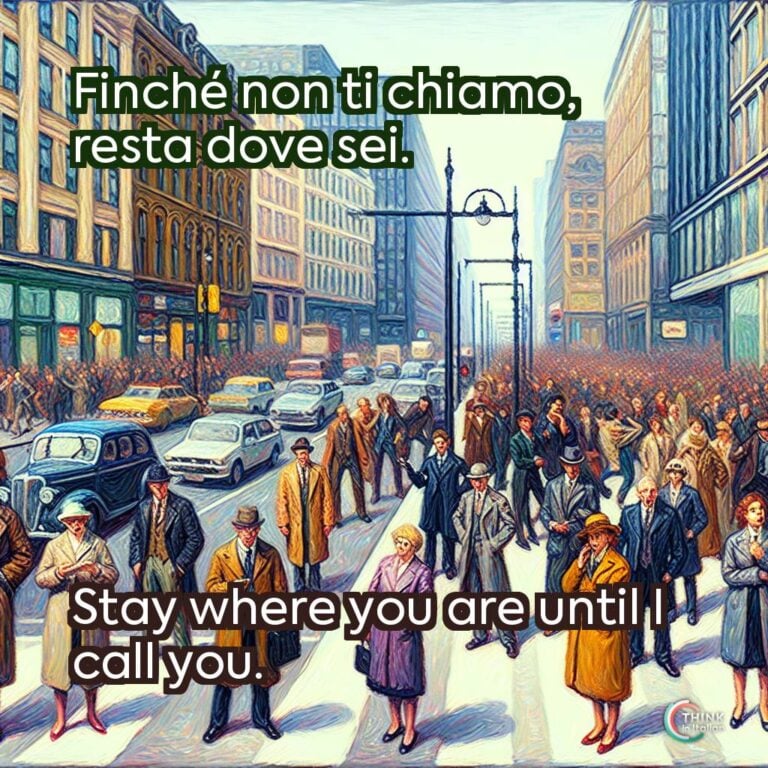
Finché non ti chiamo, resta dove sei.
🔊
Continuiamo a camminare finché non vediamo il tramonto.
🔊
Rimango qui finché non finisce la lezione.
Learn on the go
Install the FREE Think In Italian app for faster loading, offline mode, and quick access anytime.
No registration needed. Works on all devices. Ready in 1 click and 3 seconds.

Audio lesson with 30 sentences to listen and repeat

Italian grammar video lesson

Main Article

“Until” in Italian

The word “until” plays a vital role in any language, as it allows to express time limits, deadlines, or the end point of an action or event.

In Italian, “until” can be translated in different ways depending on the context, each tailored to specific sentence structures, timeframes, or conditions.

These variations reflect subtle differences in meaning, allowing speakers to be precise in describing how long something lasts, up to what point an action continues, or what conditions must be met for an event to occur.

Here, I will give you an overview of all its possible translations, with examples, and contextual use.

How to say “Until” in Italian

“Fino a” for Time and Location

The most common translation of “until” in Italian is fino a, used to refer both to a specific time and time expressions, and location and physical places. For example:

Lavoro fino a mezzogiorno.

I work until noon.

Camminiamo fino al parco.

We walk until the park.

Notice the second example: remember that whenever you are dealing with a preposition – in this case the preposition a – and this is followed by a definite article, you must combine them together to form preposizione articolata.

Make sure you know how to say the time in Italian to use fino a with temporal expressions!

“Fino a Quando” for Actions and Time Limits

When you want to refer to how long something will last or when something will stop happening, fino a quando is more precise.

It is the Italian equivalent of saying “until when” in English. However, notice that when quando is used as a conjunction, as in this case – it is a conjunction because it links two sentences together – it introduces an entire new clause.

Aspetterò fino a quando non tornerai.

I’ll wait until you come back.

Fino a quando vuoi restare?

Until when do you want to stay?

Also notice that fino a quando is frequently followed by a double negative with non, which is a characteristic feature of the language but does not alter the meaning.

A more formal alternative of fino a is sino a, which has the same exact meaning and use. The only difference is that it is less often found in conversation, and is more limited to writing.

Resterò sino a domani.

I’ll stay until tomorrow.

“Finché” for Conditions

When until introduces a condition that must be fulfilled before something else can happen, in Italian we use finché. This phrase is often paired with non to refer to an action or state that hasn’t yet occurred.

Non smetterò finché non avrò finito.

I won’t stop until I’m done.

Aspetterò qui finché non arriverai.

I’ll wait here until you arrive.

Just like fino a quando, finché is often accompanied by a double negative. When used with this meaning, it is very similar to saying “as long as” in Italian.

“Da… fino a” for Ranges

When you want to express a range of time or location, you can use the phrase da… fino a, which literally translates to “from… until“.

This construction marks the starting and ending points of an action, and gives a clearer sense of the timeframe or distance involved, for instance:

Lavoro da lunedì fino a venerdì.

I work from Monday until Friday.

Camminiamo da qui fino al centro.

We walk from here until downtown.

Key Terms and Concepts

Fino a

A common translation for 'until' in Italian, used for both time and location. It indicates a specific end point for actions or distances.

Fino a quando

Used to specify how long an action will last or when it will cease. It translates to 'until when' in English and often introduces a clause.

Finché

Indicates a condition that must be fulfilled before something else can happen. Often used with non in Italian sentences.

Sino a

A formal alternative to fino a, offering the same meaning but primarily found in written Italian, less common in casual speech.

Da... fino a

A phrase denoting a range of time or location, translating to 'from... until.' It marks both the starting and ending points of an action.

Test your knowledge in 10 quick questions

Words

finchéas long as
nonnot (false negative in this context)
mentrewhile
fino auntil
tempotime
condizionecondition
aspettareto wait
ritornoreturn
durataduration
momentomoment

Phrases

finchéas long as
finché nonuntil
mentrewhile
quandowhen
prima dibefore
dopoafter
duranteduring
fino aup to
da quandosince
nel frattempoin the meantime

Sentences

Finché non arriva, non possiamo iniziare la riunione.

Until he arrives, we can't start the meeting.

Aspetto qui finché non torni.

I'll wait here until you return.

Finché c'è sole, possiamo continuare a lavorare nel giardino.

As long as there's sunshine, we can keep working in the garden.

Non puoi partire finché non hai finito i compiti.

You can't leave until you've finished your homework.

Finché non trova un lavoro, vivrà con i suoi genitori.

Until he finds a job, he'll live with his parents.

Match the Phrases

Memory game

Flip the cards to find matching pairs!

Crossword

Across
Down
Answers

FAQs

What does finché means?

It can be translated in English as "while" or "as long as".

What does finché non means?

Finché non means "until" and the non is a false negative and it needs not to be translated.

think in italian reddit

The comments section has moved to the Think In Italian Reddit community. Join today!

Italian word of the day
d’oliva
È finito l’olio d’oliva. Dovremo comprarne ancora.
We ran out of olive oil. We’ll have to buy some more.

What's new

stefano lodola italian teacher (1)
30 Free Courses to Get You Started ($40 Value)
italian audio lesson preview
italian audio reading preview
italian ai tutor preview
"I've tried other apps like Babbel and Memrise. None made me fluent or made me feel like I was making much meaningful progress in learning a language."
testimonial 2
Ecem Topcu
Aug 7, 2025