How to Tell the Time: Italian Grammar Lesson

An interactive lesson guiding you from key takeaways to expert insights. Comes with Q&A, useful vocabulary, interactive audio, quizzes and games.

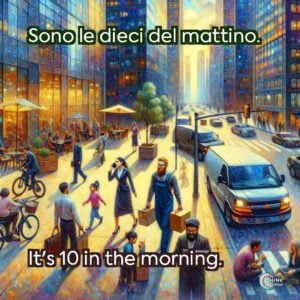
Sono le dieci del mattino.
Published May 17, 2021
Updated Jul 19, 2025
Reviewed by
Italian language tutor, course author. MEng, MBA. Member of the International Association of Hyperpolyglots (HYPIA). After learning 12 languages, I can tell you that we all master languages by listening and mimicking. I couldn’t find an app to recommend to my students, so I made my own one. With my method, you’ll be speaking Italian from Lesson 1.
Written by
No data was found

Key Takeaways

  • To ask for the time in Italian, use che ore sono? or che ora è?.
  • To express the time, use the structure Sono le [ora] for most hours, except for una, mezzogiorno, and mezzanotte.
  • When adding minutes, use e (and) for minutes 0-30, and meno (minus) for minutes 31-59.
  • Common expressions for specific minutes include un quarto for a quarter and mezza for half an hour.
  • Specify AM or PM contextually with phrases like di mattina (in the morning) or di sera (in the evening).
  • Useful phrases for scheduling include A che ora...? (At what time...?) and adverbs like quasi (almost) for precise time descriptions.

Stefano's Insights

Play to see captions...
Ah, il tempo! In italiano parliamo di 'ore' e non di 'tempo'. Che ora è? Che ore sono? Entrambe corrette. Per l'una, mezzogiorno e mezzanotte usiamo 'è', altrimenti 'sono'. Non ci preoccupiamo troppo di AM e PM, a meno che non sia formale. E i minuti? Facile: e cinque, e dieci, meno un quarto... Insomma, puoi dire 'sono le undici e cinquanta' o 'dodici meno dieci'. Entrambi vanno bene. Ricordo quando ho chiesto l'ora a Napoli e mi hanno risposto con un bel 'sono le due e un quarto del pomeriggio'. Ah, la precisione italiana!
Ah, time! In Italian, we talk about 'hours' not 'time'. What time is it? Both 'Che ora è?' and 'Che ore sono?' are correct. Use 'è' for one, noon, and midnight, otherwise 'sono'. We don't fuss much over AM and PM unless it's formal. Minutes? Easy: e cinque, e dieci, meno un quarto... You can say 'sono le undici e cinquanta' or 'dodici meno dieci'. Both are fine. I remember asking for the time in Naples and being told 'sono le due e un quarto del pomeriggio'. Ah, Italian precision!

Quick facts

How do Italians typically ask for the time?

Italians use "Che ora è?" or "Che ore sono?" to ask for the time, which literally translates to "What hour is it?" or "What hours are they?"

What phrase is used to ask "at what time" in Italian?

The phrase "A che ora" is used to ask "at what time" in Italian, such as in "A che ora vai a scuola?" meaning "At what time do you go to school?"

When do Italians use the singular form of "è" for time?

Italians use the singular form "è" for 1 AM, 1 PM, midday (mezzogiorno), and midnight (mezzanotte).

How do Italians specify the time of day without using AM or PM?

Italians often specify the time of day using phrases like "del mattino" (in the morning), "del pomeriggio" (in the afternoon), "di sera" (in the evening), and "di notte" (in the night).

What is the Italian way of saying "It’s 1:30"?

Italians say "È l’una e mezza" to mean "It’s 1:30," without specifying AM or PM, relying on context instead.

How is the 24-hour format used in Italy?

In formal contexts or writing, Italians use the 24-hour format, such as saying "Sono le 17" for 5 PM or "Sono le 21" for 9 PM.

How do Italians express times like 5:40 or 5:45?

For times like 5:40, Italians say "Sono le sei meno venti" and for 5:45, "Sono le sei meno un quarto," using a subtractive method.

Can you give an example of telling time both ways in Italian?

Sure, "Sono le undici e cinquanta" (11:50) and "Sono le dodici meno dieci" (ten to twelve) are both correct ways to express the same time.

How do Italians refer to 5:15 and 5:30?

Italians say "Sono le cinque e un quarto" for 5:15 and "Sono le cinque e mezza" for 5:30, using "un quarto" for a quarter past and "mezza" for half past.

What makes asking about time in Italian unique compared to English?

Unlike English, Italians talk about "hours" rather than "time" when asking or telling the time, and they rarely use AM or PM, relying more on context.

Audio images

🔊
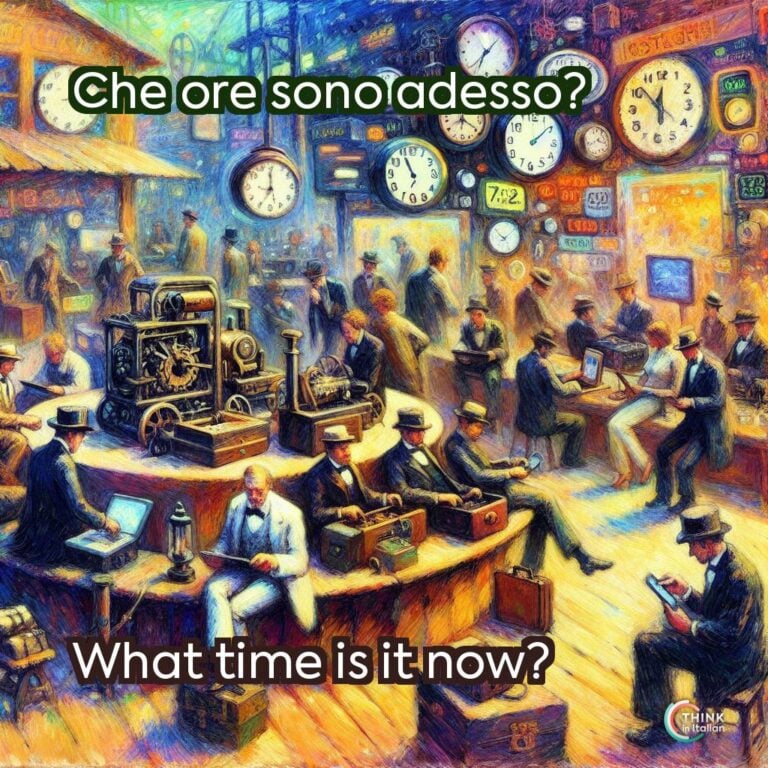
Che ore sono adesso?
🔊
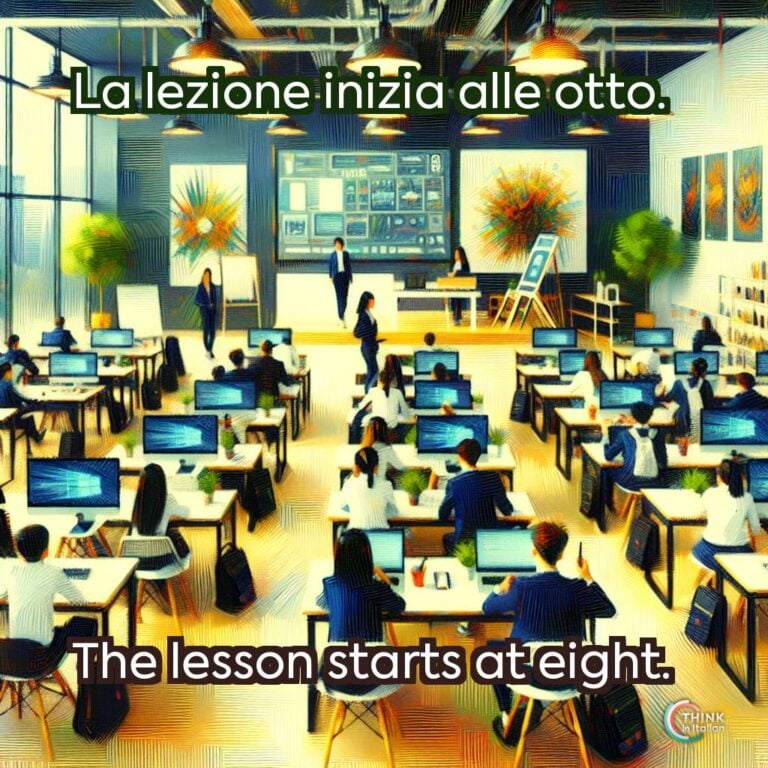
La lezione inizia alle otto.
🔊
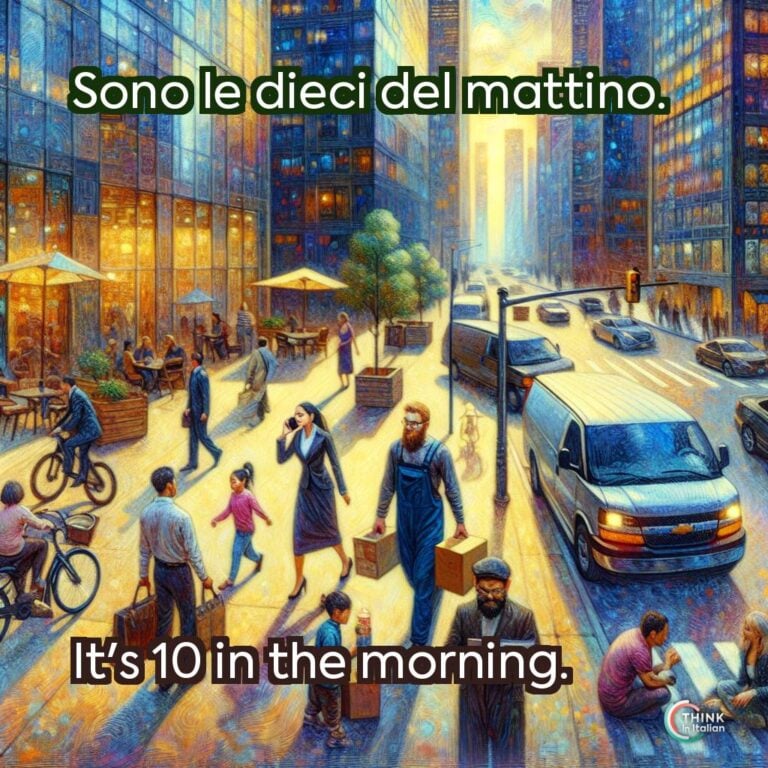
Sono le dieci del mattino.
Learn on the go
Install the FREE Think In Italian app for faster loading, offline mode, and quick access anytime.
No registration needed. Works on all devices. Ready in 1 click and 3 seconds.

Audio lesson with 30 sentences to listen and repeat

Italian grammar video lesson

Main Article

How to Tell the Time in Italian

The most common phrases you’ll hear when asking for the time in Italy are che ore sono? or che ora è? (what time is it?). The former uses the plural noun ore (hours) while the latter uses the singular ora, but both are used interchangeably.

Do you know the Italian numbers already? Then you’re ready to answer these questions by using the following structure:

Sono le [ora].

It’s [hour].

We normally conjugate the verb essere (to be) in the third person plural because most of the hours are plural. The exception to this rule is for una (one), mezzogiorno (midday) and mezzanotte (midnight) where you use the singular form:

Sono le 17.

It’s 17.

È l’una.

It’s 1:00.

The contraction of the definite article la to l’ before una occurs because una begins with a vowel. For all other hours, we use the plural article le.

How to Express the Time in Italian

Add Minutes to Your Time Expression

Now that you’ve got the hours down, let me explain you how to add minutes. Just like in English, imagine you have to split the clock in two halves: from zero to 30 minutes and from 31 minutes to the whole hour.

In Italian, when the minutes are in the first half of the clock, we use the conjunction e (and) to link the hour with the minutes, as in:

Sono le due e cinque.

It’s 2:05. (lit: it’s two and five)

Sono le tre e venti.

It’s 3:20. (lit: it’s three and twenty)

If the minutes are in the second part of the clock, you can choose: either you keep on adding them as I showed you before, or you count backward to the next hour using the word meno (minus):

Sono le sei e cinquanta.

It’s 6:50. (lit. it’s six and fifty).

Sono le quattro meno dieci.

It’s 3:50. (lit: it’s four minus ten).

Sono le sette meno un quarto.

It’s 6:45. (it’s seven minus a quarter).

Quarter-Hours and Half-Hours

As you might have noticed from the previous example, we do have some expressions to indicate specific amounts of minutes, just like in English.

In the sentence I wrote before, un quarto refers to “a quarter” of an hour, just like the English expression. Another fixed expression is mezza or mezzo to say “half”:

Sono le sei e un quarto.

It’s 6:15.

Sono le nove e mezza.

It’s 9:30.

AM and PM in Italian

Unlike in English, we rarely use “AM” and “PM”. Instead, we rely on context to clarify whether a time is in the morning, afternoon, or evening. To specify this, you can simply add one of the following phrases after the time:

  • Di mattina – In the morning
  • Del pomeriggio – In the afternoon
  • Di sera – In the evening
  • Di notte – At night

Let me show you some examples:

Sono le otto di mattina.

It’s 8:00 in the morning.

Sono le otto di sera.

It’s 8:00 in the evening.

È l’una di notte.

It’s 1:00 at night.

Telling the Time in Real Life

There are some further expressions I want you to know to properly master the time in Italian.

For example, if you want to set appointments or be informed about when events will take place, save this phrase:

A che ora…?

At what time…?

And then enrich it the way you need to. Here I’ll give you some practical examples:

A che ora parte il treno?

What time does the train leave?

A che ora arrivi?

What time are you arriving?

Another important word is the adverb quasi (almost). It is used exactly like its English counterpart, therefore you can say something like:

È quasi mezzogiorno.

It’s almost noon.

Finally, it’s useful to familiarize yourself with some common expressions related to time. These phrases can help you describe more nuanced situations involving time:

  • In anticipo – Early
  • In ritardo – Late
  • Puntuale – On time
  • Prima – Before
  • Dopo – After

Use them in sentences like these:

Siamo in anticipo di dieci minuti.

We’re ten minutes early.

Il treno è in ritardo di mezz’ora.

The train half hour is late.

Key Terms and Concepts

Che ore sono? / Che ora è?

Common ways to ask for the time in Italian. The phrase uses either the plural ore or singular ora, both meaning 'hour'.

Plural vs. Singular Time Expression

Sono le is used for most hours (plural), while È l’una, mezzogiorno, and mezzanotte use the singular form.

Time Conjunction e and meno

E links hours and minutes for the first half of the clock, whereas meno is used to count backward after 30 minutes.

Quarter-Hours and Half-Hours

Expressions like un quarto and mezza indicate 15 minutes past or half-past an hour, respectively.

AM and PM Alternatives

Instead of 'AM' and 'PM', Italians use context phrases like di mattina, di pomeriggio, and di sera to indicate different times of the day.

Common Time-related Expressions

Terms like in anticipo (early), in ritardo (late), and puntuale (on time) describe punctuality and timekeeping.

Test your knowledge in 10 quick questions

Words

orologioclock
minutominute
orahour
secondosecond
mattinamorning
pomeriggioafternoon
seraevening
nottenight
mezzogiornomidday
mezzanottemidnight

Phrases

mezzogiornonoon
mezzanottemidnight
del mattinoin the morning
del pomeriggioin the afternoon
di serain the evening
di notteat night
meno un quartoa quarter to
e mezzaand a half
e tre quartiand three quarters
della settimanaof the week

Sentences

Che ora è?

What time is it?

Sono le due del pomeriggio.

It's two in the afternoon.

È mezzanotte.

It's midnight.

Sono le sette e un quarto di sera.

It's a quarter past seven in the evening.

È l'una e mezzo del mattino.

It's half past one in the morning.

Match the Phrases

Memory game

Flip the cards to find matching pairs!

Crossword

Across
Down
Answers

FAQs

How to use useful questions for telling time?

When we talk about time in Italian we talk about hours so we can use either the singular or the plural.

How to answer questions about time?

We use the singular form "è" only when we talk about 1 AM or 1 PM and we we use the plural form "sono" for the rest.

think in italian reddit

The comments section has moved to the Think In Italian Reddit community. Join today!

Italian word of the day
consegnare
Non potremo consegnare in tempo.
We will not be able to deliver it in time.

What's new

stefano lodola italian teacher (1)
30 Free Courses to Get You Started ($40 Value)
italian audio lesson preview
italian audio reading preview
italian ai tutor preview
"I've tried other apps like Babbel and Memrise. None made me fluent or made me feel like I was making much meaningful progress in learning a language."
testimonial 2
Ecem Topcu
Aug 7, 2025