How to Say “Before” and “After”: Italian Grammar Lesson

An interactive lesson guiding you from key takeaways to expert insights. Comes with Q&A, useful vocabulary, interactive audio, quizzes and games.

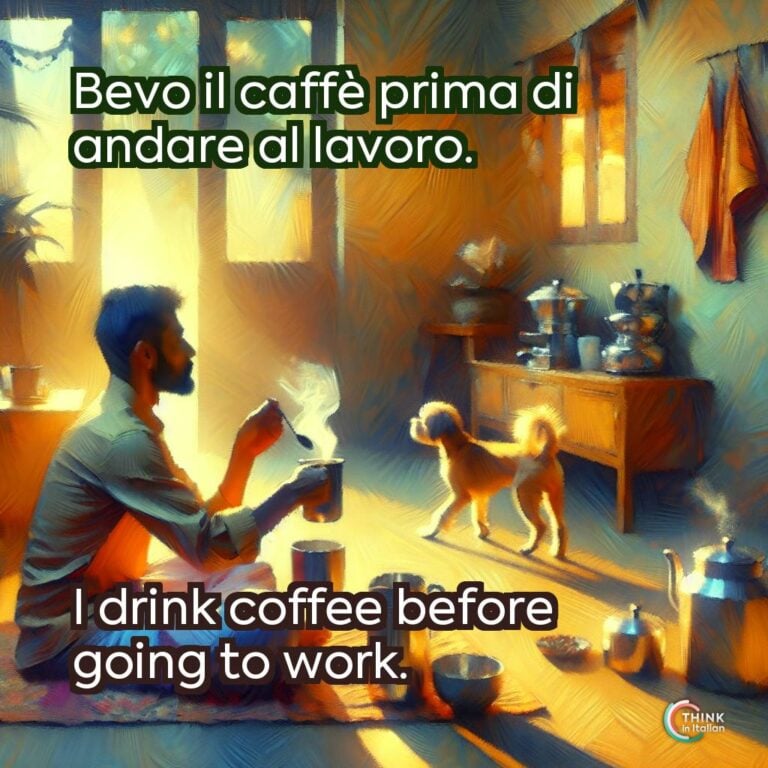
Bevo il caffè prima di andare al lavoro.
Published Apr 27, 2021
Updated Jun 24, 2025
Written by
Italian language tutor, course author. MEng, MBA. Member of the International Association of Hyperpolyglots (HYPIA). After learning 12 languages, I can tell you that we all master languages by listening and mimicking. I couldn’t find an app to recommend to my students, so I made my own one. With my method, you’ll be speaking Italian from Lesson 1.
Reviewed by
No data was found

Key Takeaways

  • Prima means "before" or "earlier" and can function as both an adverb and an adjective.
  • Dopo translates to "after" or "later" and is used to indicate the sequence of events.
  • Use prima che with the subjunctive mood to introduce temporal clauses, e.g., "Voglio partire prima che faccia buio."
  • Combine dopo che with the indicative mood to describe events following another, e.g., "Dopo che finisci, metti tutto a posto."
  • Use prima di with infinitive verbs or nouns, while dopo di is used solely with personal pronouns.

Stefano's Insights

Play to see captions...
Ah, i meravigliosi mondi di 'prima' e 'dopo'! Queste due paroline, apparentemente innocue, sono in realtà delle vere e proprie acrobate linguistiche in italiano. 'Prima' e 'dopo' possono essere adverbi, preposizioni, e persino congiunzioni, a seconda del contesto. Ricordo quando, da giovane studente di lingue, cercavo di capire perché 'prima che' richiedesse il congiuntivo e 'dopo che' no. È come se la lingua italiana volesse tenerti sempre sulle spine! Ma non temete, con un po' di pratica, diventeranno i vostri migliori alleati per raccontare storie e pianificare avventure. E chi non ama una buona avventura linguistica?
Ah, the wonderful worlds of 'prima' and 'dopo'! These seemingly innocent little words are actually linguistic acrobats in Italian. 'Prima' and 'dopo' can be adverbs, prepositions, and even conjunctions, depending on the context. I remember, as a young language student, trying to figure out why 'prima che' required the subjunctive and 'dopo che' did not. It's as if the Italian language wants to keep you on your toes! But fear not, with a bit of practice, they'll become your best allies for storytelling and planning adventures. And who doesn't love a good linguistic adventure?

Quick facts

How is "prima" used as an adverb in Italian?

"Prima" means "earlier" or "before," often without specifying what it precedes, e.g., "voglio partire prima" (I want to leave earlier).

Can "prima" function as an adjective?

Yes, "prima" can mean "the first," as in "la prima volta" (the first time).

How does "prima" express urgency?

The phrase "prima possibile" means "as soon as possible," indicating urgency.

How does "dopo" function as a preposition?

"Dopo" discusses events following another, e.g., "Dopo la lezione, vado al parco" (After the lesson, I go to the park).

How is "dopo" used with past infinitive verbs?

It can be used with past infinitive verbs, as in "Dopo essere andato in banca, ho pranzato" (After having gone to the bank, I had lunch).

What does "dopo" mean as an adverb?

As an adverb, "dopo" means "afterwards" or "later," e.g., "Ora non posso, ci vediamo dopo" (Now I can't, see you later).

How is "prima che" used with the subjunctive mood?

"Prima che" introduces a temporal clause requiring the subjunctive mood, e.g., "Voglio partire prima che faccia buio" (I want to leave before it gets dark).

When is "prima di" used?

"Prima di" is used with an infinitive verb or before nouns/pronouns, e.g., "Pettinati prima di uscire" (Brush your hair before you go out).

Does "dopo che" require the subjunctive mood?

No, "dopo che" uses the indicative mood and varies by verb tense, e.g., "Dopo che finisci metti tutto a posto" (After you finish, put everything back in order).

How is "dopo di" used with pronouns?

"Dopo di" is used with personal pronouns, e.g., "Io sono entrata dopo di loro" (I went in after them).

Audio images

🔊
Ci vediamo prima della cena.
🔊
Prima di mangiare, devo lavarmi le mani.
🔊
Devo finire il lavoro prima di cenare.
🔊
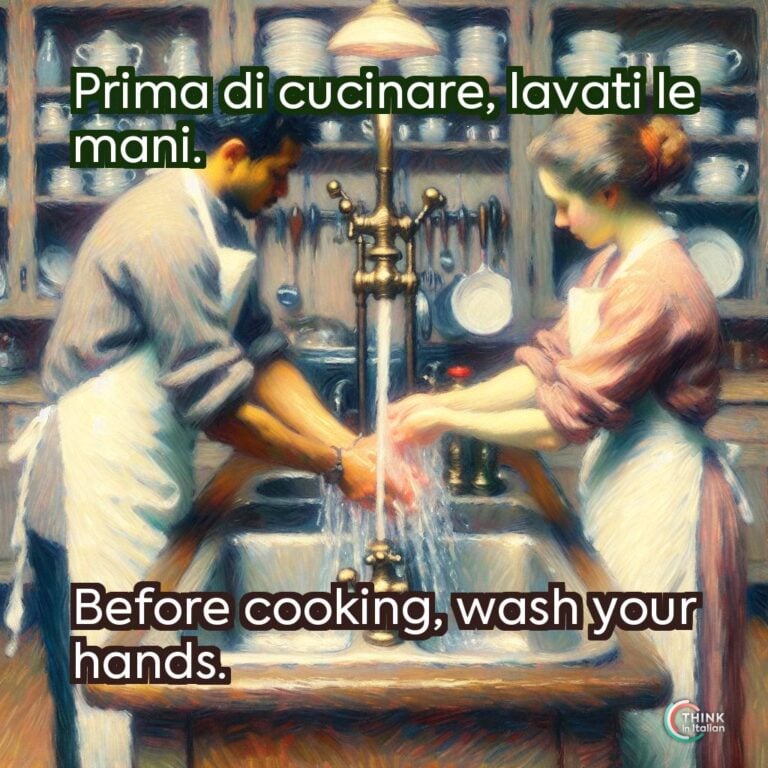
Prima di cucinare, lavati le mani.
🔊
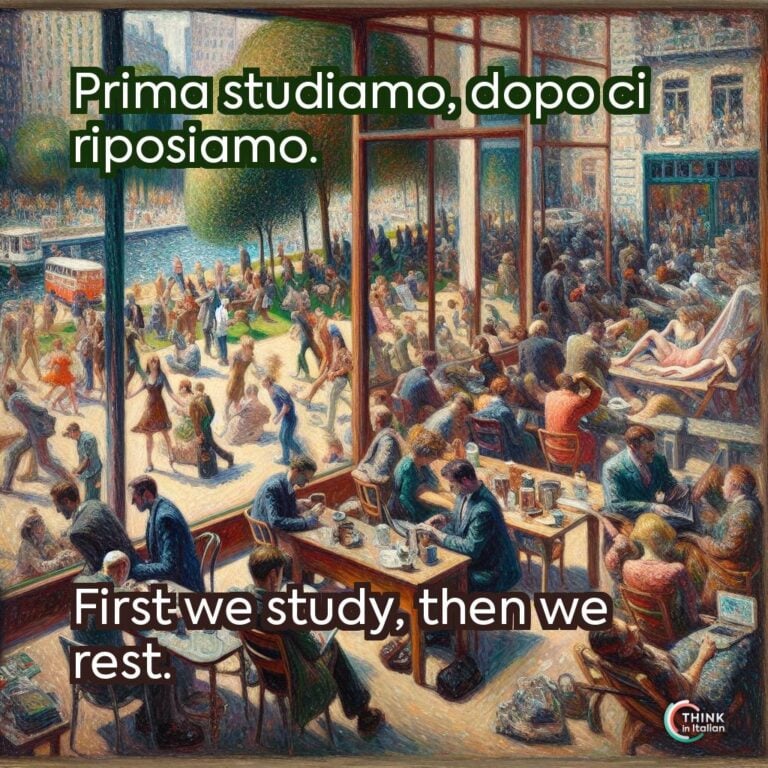
Prima studiamo, dopo ci riposiamo.
🔊
Bevo il caffè prima di andare al lavoro.
Learn on the go
Install the FREE Think In Italian app for faster loading, offline mode, and quick access anytime.
No registration needed. Works on all devices. Ready in 1 click and 3 seconds.

Audio lesson with 30 sentences to listen and repeat

Italian grammar video lesson

Main Article

Before and After in Italian

One of the first things you need to learn when studying a foreign language is how to talk about events in time. To do so, in English we use the words before and after, which, in Italian, are translated into prima and dopo.

Both prima and dopo are adverbs in Italian, but they also play other grammatical roles depending on the context.

They are relatively simple to understand and translate, but they can become tricky if you do not know which prepositions and verb tenses to use with them.

Also, as you might imagine, they are very commonly used, for discussing sequences of events, making plans, or describing routines in Italian. Therefore, you should really understand how to use them!

“Prima” and “Dopo” in Italian

“Prima” in Italian

In Italian, prima is a versatile word primarily used to indicate temporal sequences. It can be used either alone or in combination with function words, but here I want to show you its original meaning when it is not linked to anything else:

  1. As an adverb: On its own it means “earlier” or “before.” It can be used to refer to something occurring at an earlier time, often without needing to specify what it is preceding. For example, voglio partire prima (I want to leave earlier).
  2. As an adjective : It can also be used an adjective with the meaning of “the first”, used in phrases like la prima volta (the first time).
  3. Other uses: It is also used in expressions such as prima possibile (as soon as possible).

“Dopo” in Italian

Just like prima, dopo is a versatile preposition that primarily indicates temporal succession. It’s used to express the sequence of events or actions in time and can as well be used in combination with other function words. Here I listed some examples of its use alone:

  • As a particular preposition: It is most commonly used to discuss events that occur following another event. For example:

Dopo la lezione, vado al parco.

After the lesson, I go to the park.

    • It behaves as a preposition, but grammatically it is not. In this context, it can also be used directly with a verb in the past infinitive, as in:

Dopo essere andato in banca, ho pranzato.

After having gone to the bank, I had lunch.

  • As an adverb: When used as an adverb, it means “afterwards” or “later.” For example:

Ora non posso, ci vediamo dopo.

Now I can’t, see you later.

  • Other uses: In comparisons, it can be used metaphorically to mean “next in line” or “secondly” such as in ranking or ordering scenarios. For example:

Dopo Maria, lei è la studentessa più brava.

After Maria, she is the best student.

Combination with Function Words

“Prima che” and “Prima di”

As I mentioned before, prima can be used in combination with other functional words. Specifically, either with the conjunction che or with the preposition di and all its derivates del, dello, della, dei, degli, delle.

Let me now explain them separately:

Voglio partire prima che faccia buio.

I want to leave before it gets dark.

Prima che tu esca, voglio dirti una cosa.

Before you go out, I want to tell you something.

Spero di arrivare prima che inizi a nevicare.

I hope I can get there before it starts snowing.

  • Prima di, instead, must be used with an infinitive verb, or it must precede nouns or pronouns. When it is used in these structures, “prima” is grammatically classified as a conjunction because it links two – or more – sentences together.

Remember, if there is a definite article before the noun you must use a preposizione articolata: del, dello, della, etc.

Pettinati prima di uscire

Brush your hair before you go out.

Ci sono io prima di te 

There is me before you.

Prima della partita siamo andati a bere una birra.

Before the match, we went for a beer.

“Dopo che” and “Dopo di”

Also dopo in Italian can be linked to “che” or “di”.

  • Unike “prima che”, dopo chedoes not require the subjunctive mood, therefore you can simply use the indicative mood of the verb. Of course, depending on what you are saying, you must use a specific verb tense: present, past, or future.

Dopo che finisci metti tutto a posto.

After you finish put everything back in order.

Dopo che sono uscita è arrivato Daniele.

After I left Daniele arrived.

Ti mancherà dopo che sarà andato via.

You will miss him after he leaves.

  • Dopo di is uses with personal pronouns only.

Io sono entrata dopo di loro.

I went in after them.

Voi siete arrivati dopo di noi.

You got here after us.

Ho preso il treno dopo di voi.

I took the train after you.

Key Terms and Concepts

Prima

Prima is an adverb meaning "earlier" or "before." It can also function as an adjective to mean "the first," as in la prima volta.

Dopo

Dopo is used to indicate temporal succession, meaning "after." It can function as a preposition or an adverb, such as in dopo la lezione.

Prima che

This phrase introduces a temporal clause requiring the subjunctive mood. It is used to express actions occurring before another, like prima che faccia buio.

Prima di

Used with an infinitive verb or preceding a noun/pronoun, it links clauses and can take forms like del, dello, or della.

Dopo che

Unlike prima che, this phrase does not require the subjunctive mood. It uses the indicative mood to express events following another.

Dopo di

Used with personal pronouns to indicate temporal sequence, as in dopo di loro or dopo di noi.

Test your knowledge in 10 quick questions

Words

primabefore
dopoafter
subordinatosubjunctive
indicativoindicative
avverbioadverb
aggettivoadjective
preposizionepreposition
infinitoinfinitive
pronomepronoun
tempotime

Phrases

primabefore
dopoafter
prima possibileas soon as possible
prima chebefore that
prima dibefore doing
dopo cheafter that
dopo diafter (pronouns)
subito doporight after
precedentementepreviously
successivamentesubsequently

Sentences

Prima di uscire, controlla di avere le chiavi.

Before going out, check if you have the keys.

Dopo cena, di solito guardiamo un film.

After dinner, we usually watch a movie.

Vorrei finire il lavoro prima possibile.

I would like to finish the work as soon as possible.

Parliamo di questo dopo che arrivi.

Let's talk about this after you arrive.

Prima che inizi la riunione, devo fare una telefonata.

Before the meeting starts, I need to make a phone call.

Match the Phrases

Memory game

Flip the cards to find matching pairs!

Crossword

Across
Down
Answers

FAQs

What are "prima" and "dopo" in Italian?

Are the equivalent of before and after and are used after prepositions and verbs.

How to use "prima che" and "prima di"?

"Prima che" introduces a temporal clause and is used with the subjunctive. While "prima di" is used with the infinitive or after nouns and pronouns.

How to use "dopo che", "dopo", and "dopo di"?

"Dopo che" uses the indicative mood while "dopo" indicates temporal clauses so is used with nouns or the past infinitive, and "dopo di" is only used with personal pronouns.

think in italian reddit

The comments section has moved to the Think In Italian Reddit community. Join today!

Italian word of the day
consegnare
Non potremo consegnare in tempo.
We will not be able to deliver it in time.

What's new

stefano lodola italian teacher (1)
30 Free Courses to Get You Started ($40 Value)
italian audio lesson preview
italian audio reading preview
italian ai tutor preview
"I've tried other apps like Babbel and Memrise. None made me fluent or made me feel like I was making much meaningful progress in learning a language."
testimonial 2
Ecem Topcu
Aug 7, 2025