

Prima che + Subjunctive: Italian Grammar Lesson

An interactive lesson guiding you from key takeaways to expert insights. Comes with Q&A, useful vocabulary, interactive audio, quizzes and games.

Chiudiamo le finestre prima che piova.
Published Dec 1, 2020
Updated May 27, 2026
Written by
Italian language tutor, course author. MEng, MBA. Member of the International Association of Hyperpolyglots (HYPIA). After learning 12 languages, I can tell you that we all master languages by listening and mimicking. I couldn’t find an app to recommend to my students, so I made my own one. With my method, you’ll be speaking Italian from Lesson 1.
Reviewed by
No data was found

Key Takeaways

  • Prima che is a temporal conjunction that requires the subjunctive mood, indicating that one action occurs before another.
  • Use prima di with the infinitive form, while prima che must be followed by the subjunctive.
  • Examples of prima che include Spero di arrivare prima che inizi a piovere (I hope to arrive before it starts raining).
  • Other conjunctions that also require the subjunctive include a meno che (unless) and sebbene (although).
  • Mastering prima che is crucial for expressing complex temporal relationships in Italian conversations.

Stefano's Insights

Play to see captions...
Ah, la parola "prima" in italiano! Un piccolo termine con un grande bagaglio di significati. Può essere un aggettivo o un avverbio, e il suo uso cambia il gioco. Quando si usa "prima di", si segue con l'infinito. Ma con "prima che", entriamo nel mondo del congiuntivo. Ricordo quando ho imparato questa distinzione: mi sembrava di decifrare un codice segreto! È un'arte che richiede pratica, ma una volta padroneggiata, apre le porte a conversazioni più sfumate e a storie più ricche. E non dimentichiamo le altre congiunzioni che richiedono il congiuntivo, come "a meno che" e "sebbene". Insomma, se vuoi comunicare come un vero italiano, queste sono le chiavi del regno. Prima che te ne accorga, sarai un maestro del congiuntivo!
Ah, the word "prima" in Italian! A small term with a big load of meanings. It can be an adjective or an adverb, and its use changes the game. When using "prima di", it is followed by the infinitive. But with "prima che", we enter the world of the subjunctive. I remember when I learned this distinction: it felt like deciphering a secret code! It's an art that requires practice, but once mastered, it opens doors to more nuanced conversations and richer stories. And let's not forget other conjunctions that require the subjunctive, like "a meno che" and "sebbene". In short, if you want to communicate like a true Italian, these are the keys to the kingdom. Before you know it, you'll be a master of the subjunctive!

Quick facts

How is "prima" used as an adjective in Italian?

"Prima" means "first" as a feminine singular adjective, e.g., "La prima volta" (The first time).

What does "prima" mean when used as an adverb?

As an adverb, "prima" means "before" or "earlier," like in "Vieni prima di cena" (Come before dinner).

What's the key difference between "prima di" and "prima che"?

"Prima di" is used with the infinitive, while "prima che" requires the subjunctive mood.

Can you provide an example of "prima di" + infinitive?

Sure, "Mettiti la giacca prima di uscire" means "Put your jacket on before going out."

How about an example of "prima che" + subjunctive?

"Prima che tu esca ti devo dire una cosa" translates to "Before you go out, I need to tell you something."

When is the subjunctive mood used with "prima che"?

The subjunctive is used after "prima che" to indicate actions that happen before another, whether in present or imperfect tense.

What's an example of "prima che" in the present tense?

"Spero di arrivare prima che inizi a piovere" means "I hope to arrive before it starts raining."

Can you give an example of "prima che" in the imperfect tense?

"Ci sarebbe piaciuto arrivare prima che uscissi" translates to "We would have liked to get here before you left."

What other conjunctions require the subjunctive in Italian?

Conjunctions like "a meno che" (unless), "sebbene" (although), and "nel caso che" (in case) also require the subjunctive.

How does mastering "prima che" enhance Italian fluency?

It’s crucial for communicating complex temporal relationships, enhancing fluency and cultural engagement in Italian.

Audio images

🔊
Studia prima che arrivi l'esame.
🔊
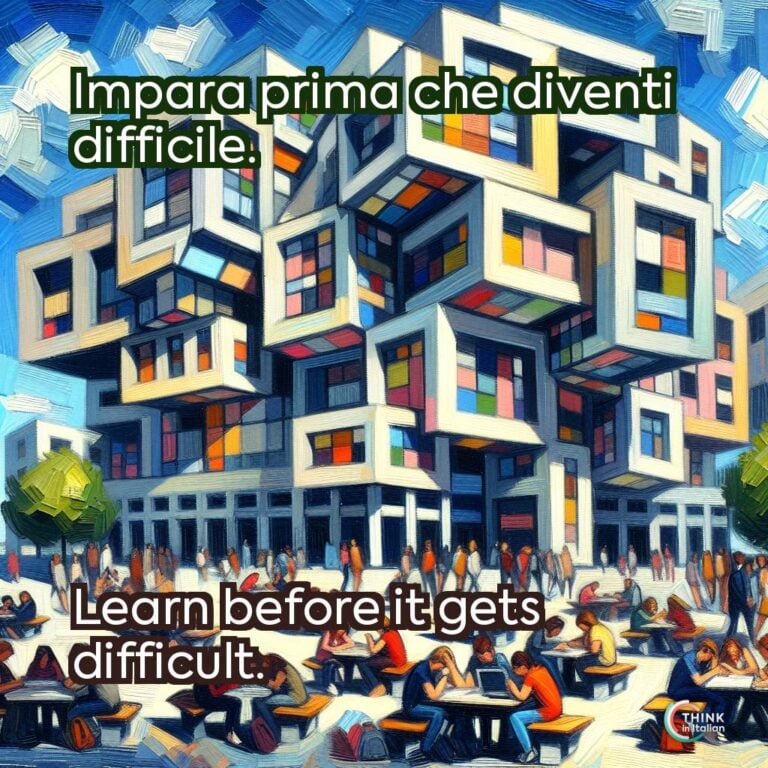
Impara prima che diventi difficile.
🔊
Chiudiamo le finestre prima che piova.
Learn on the go
Install the FREE Think In Italian app for faster loading, offline mode, and quick access anytime.
No registration needed. Works on all devices. Ready in 1 click and 3 seconds.

Audio lesson with 30 sentences to listen and repeat

Italian grammar video lesson

Main Article

“Prima” in Italian

In Italian, the word prima has multiple meanings and uses, which can be quite contextual. It generally translates to “before” “first“, or “earlier” and has two main grammatical applications:

  1. As an adjective: It can also be used as a feminine singular adjective meaning “first”, for instance, La prima volta (The first time).
  2. As an adverb: When used as an adverb, it typically means “before” or “earlier”, as in Vieni prima di cena (Come before dinner). In this case, it can be followed either by “di” or “che” depending on what type of sentence it is introducing. For example:

Torna a casa prima che faccia buio.

Come home before it gets dark.

Prima che vs Prima di

Both prima di and prima che can both be translated as “before” in English. However, in Italian they are used in different contexts. The main difference is thatprima di takes the infinitive, while prima che takes the subjunctive.

Prima di + infinitive

Mettiti la giacca prima di uscire.

Put your jacket on before going out.

Voglio mangiare prima di andare al cinema.

I want to eat before going to the cinema.

Prima che + subjunctive

Prima che tu esca ti devo dire una cosa.

Before you go out, I need to tell you something.

Mangiamo prima che finisca tutto.

Let’s eat before everything finishes.

How to use “Prima che” + Subjunctive?

Prima che is a temporal conjunction which indicates anteriority. As all conjunctions, it is used to combine two sentences: in this case, the action or occurrence described in one sentence happens before the action or occurrence described in the other.

The temporal conjunction prima che is always followed by the subjunctive mood, whether in the present or imperfect tense. Have a look at the examples below.

Present

Spero di arrivare prima che inizi a piovere.

I hope to arrive before it starts raining.

Cuciniamo prima che arrivino i miei, no?

Let’s cook before my parents arrive, shall we?

Imperfect

Ci sarebbe piaciuto arrivare prima che uscissi.

We would have liked to get here before you left.

Sandra voleva partire prima che iniziasse l’estate.

Sandra wanted to leave before the summer started.

Other Conjunctions + Subjunctive

Prima che is not the only Italian conjunction that requires congiuntivo.

Here are some other common ones with corresponding examples:

Non fidarti del suo parere, a meno che non sia un medico.

Do not trust his opinion unless he is a doctor.

  • Sebbene (although)

Sebbene avesse più di cinquant’anni, vinse la gara.

Although she was over 50, she won the competition.

  • Nel caso (che) (In case)

Nel caso (in cui) tu non abbia voglia di cucinare, ho preparato una zuppa.

In case you don’t feel like cooking, I prepared a soup.

Did you Know it… Before I Told you?

Lo sapevi, prima che te lo dicessi?

As you might have understood, mastering the phrase “prima che” is essential to communicate complex temporal relationships, conditions, and sequences that are crucial in everyday conversations and storytelling in Italian.

For people aiming at learning Italian, grasping such elements is not only beneficial for fluency but also for engaging deeply with Italian culture.

So, whether you’re planning your next trip to Italy, preparing for an Italian exam, or simply expanding your linguistic skills, pay close attention to these conjunctions and their correct grammatical contexts.

Remember, every step in learning brings you closer to mastering the art of Italian communication—prima che te ne accorga (before you know it)!

Key Terms and Concepts

Prima che

A temporal conjunction used to indicate an action happening before another. It always requires the subjunctive mood, outlining conditions or sequences.

Subjunctive Mood

A verb form used to express doubt, uncertainty, or hypothetical situations. In Italian, it follows certain conjunctions like prima che.

Prima di

A conjunction used with the infinitive form of a verb to indicate an action that occurs before another. It differs from prima che.

Congiuntivo

The Italian subjunctive mood used to express wishes, doubts, or hypothetical situations. It is often triggered by specific conjunctions like prima che.

Temporal Conjunctions

Words or phrases that connect clauses to establish a time relationship between them. In Italian, prima che is one such conjunction.

Adjective Usage of Prima

When used as an adjective, prima means 'first,' as in La prima volta, meaning 'the first time.'

Adverb Usage of Prima

As an adverb, it translates to 'before' or 'earlier,' used in contexts like Vieni prima di cena (Come before dinner).

Test your knowledge in 10 quick questions

Words

primabefore
subordinaresubordinate
congiunzioneconjunction
anterioritàanteriority
verboverb
congiuntivosubjunctive
infinitoinfinitive
presentepresent
imperfettoimperfect
moodmodo

Phrases

prima dibefore (infinitive)
congiunzione temporaletemporal conjunction
anterioritàanteriority
moodumore
congiuntivosubjunctive
a meno cheunless
sebbenealthough
nel casoin case
piacereto like
uscireto go out

Sentences

Aspetta qui prima che io torni.

Wait here before I return.

Chiama tua madre prima che sia troppo tardi.

Call your mother before it's too late.

Dobbiamo finire il progetto prima che il capo arrivi.

We need to finish the project before the boss arrives.

Studia bene prima che venga l'esame.

Study well before the exam comes.

Voglio parlarti prima che tu vada via.

I want to talk to you before you leave.

Match the Phrases

Memory game

Flip the cards to find matching pairs!

Crossword

Across
Down
Answers

FAQs

How do you use "prima" in Italian?

The Italian word "prima" translates to before in English. It can be used in conjunction with either the preposition "che" or any form of the preposition "di" (e.g. del, dello, della, dei, degli, delle).

Does "prima che" take subjunctive?

It is important to note that the temporal conjunction "prima che" is always accompanied by the subjunctive mood in any tense, be it present, future, or past. The subjunctive mood is used to express actions that may or may not happen, such as wishes, hopes, demands, or doubt.

think in italian reddit

The comments section has moved to the Think In Italian Reddit community. Join today!

Italian word of the day
d’oliva
È finito l’olio d’oliva. Dovremo comprarne ancora.
We ran out of olive oil. We’ll have to buy some more.

What's new

stefano lodola italian teacher (1)
30 Free Courses to Get You Started ($40 Value)
italian audio lesson preview
italian audio reading preview
italian ai tutor preview
"I've tried other apps like Babbel and Memrise. None made me fluent or made me feel like I was making much meaningful progress in learning a language."
testimonial 2
Ecem Topcu
Aug 7, 2025