
The Present Subjunctive – Regular Verbs: Italian Grammar Lesson

An interactive lesson guiding you from key takeaways to expert insights. Comes with Q&A, useful vocabulary, interactive audio, quizzes and games.

Maria preferisce che tu studi di più.
Published Jan 8, 2021
Updated May 14, 2025
Reviewed by
Italian language tutor, course author. MEng, MBA. Member of the International Association of Hyperpolyglots (HYPIA). After learning 12 languages, I can tell you that we all master languages by listening and mimicking. I couldn’t find an app to recommend to my students, so I made my own one. With my method, you’ll be speaking Italian from Lesson 1.
Written by
No data was found

Key Takeaways

  • The present subjunctive in Italian, or congiuntivo, is used to express doubt, desire, necessity, and possibility.
  • Regular verbs follow specific endings: for -are, use parli; for -ere, use creda; for -ire, use senta.
  • The subjunctive is always found in dependent clauses, often introduced by conjunctions like che or se.
  • Common introductory verbs for the subjunctive include pensare (to think), sperare (to hope), and credere (to believe).
  • Practice using the present subjunctive to enhance your ability to express uncertainty and emotions in Italian conversations.

Stefano's Insights

Play to see captions...
Ah, il congiuntivo! Il terrore di molti studenti di italiano. Ma non temete, amici miei! Il congiuntivo presente è qui per aiutarci a esprimere dubbi, desideri e necessità. È come un supereroe grammaticale, sempre presente nelle frasi subordinate, introdotto da 'che' o 'se'. Ricordate: il congiuntivo è il migliore amico del formalismo, come il mio vecchio professore che non lasciava mai passare un errore senza un sorriso ironico. Ecco un trucco: per 'io', 'tu', e 'lui/lei', l'ending è lo stesso. E se vi sentite persi, pensate a quanto sarebbe noiosa la vita senza un po' di incertezza linguistica!
Ah, the subjunctive! The terror of many Italian learners. But fear not, my friends! The present subjunctive is here to help us express doubts, desires, and necessities. It's like a grammatical superhero, always found in dependent clauses, introduced by 'che' or 'se'. Remember: the subjunctive is the best friend of formality, like my old professor who never let a mistake pass without an ironic smile. Here's a trick: for 'io', 'tu', and 'lui/lei', the ending is the same. And if you feel lost, think about how boring life would be without a bit of linguistic uncertainty!

Quick facts

What distinguishes the subjunctive mood in Italian?

The subjunctive mood expresses hopes, desires, doubts, and possibilities, unlike the indicative mood which states facts.

Why is the subjunctive preceded by "che"?

"Che" links the main clause to the subjunctive, signaling a shift from facts to subjective states like hopes or fears.

How does the subjunctive influence verb endings?

For the subjunctive, regular verbs take specific endings, often adding an "i" for differentiation from the indicative.

Why might the subjunctive seem familiar in some cases?

For first-person plural (noi), the subjunctive and indicative forms are identical, minimizing confusion in usage.

How is the subjunctive used in expressing fear?

It conveys fear by showing uncertainty or doubt, e.g., "Ho paura che mia sorella perda il lavoro" (I'm scared my sister might lose her job).

What role does the subjunctive play in expressing hope or preference?

It emphasizes personal desires or hopes, as in "Anna non vuole che i nonni partano" (Anna doesn't want her grandparents to leave).

How does the subjunctive affect perception of someone's statement?

It questions the seriousness or credibility, e.g., "Mi sembra che lei non parli sul serio" (I think she's not talking seriously).

Why is the subjunctive essential in conditional clauses?

It sets conditions or prerequisites, often introduced by phrases like "purché" (provided that) or "prima che" (before).

What common phrases typically require the subjunctive?

Phrases like "Penso che" (I think that) and "Spero che" (I hope that) usually precede the subjunctive, indicating uncertainty or wish.

How do negative statements influence the use of the subjunctive?

Negative forms of common phrases also use the subjunctive, maintaining the mood's role in expressing doubt or negation.

Audio images

🔊
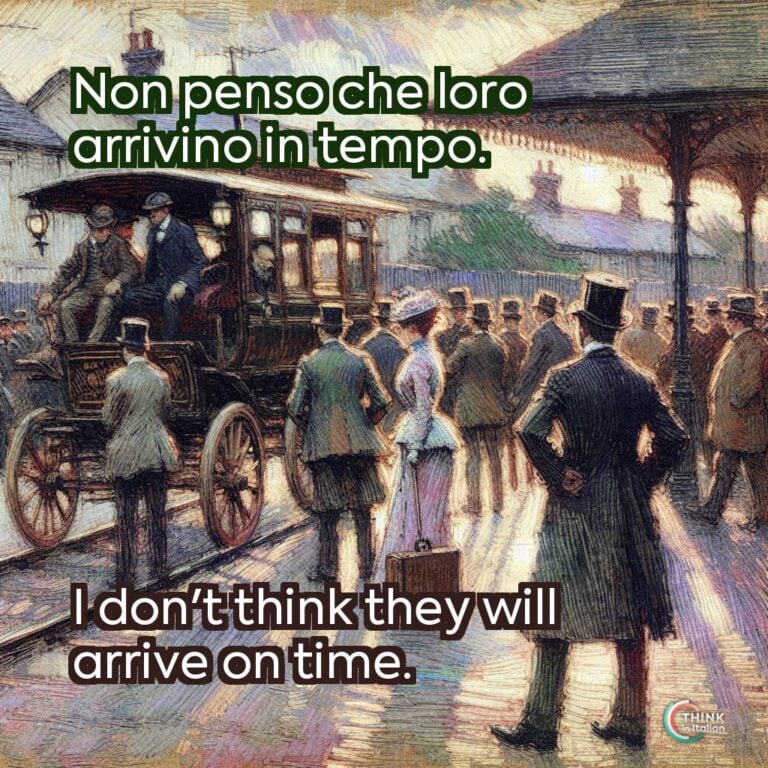
Non penso che loro arrivino in tempo.
🔊
Maria preferisce che tu studi di più.
Learn on the go
Install the FREE Think In Italian app for faster loading, offline mode, and quick access anytime.
No registration needed. Works on all devices. Ready in 1 click and 3 seconds.

Audio lesson with 30 sentences to listen and repeat

Italian grammar video lesson

Main Article

The Subjunctive Mood in Italian

The subjunctive mood in Italian, known as congiuntivo, is commonly used in dependent clauses that are introduced by certain conjunctions and expressions, specifically to express:

  • a doubt
  • a desire
  • a necessity
  • a possibility

It has four tenses: present, past, imperfect, and past perfect. Here, I will focus on the regular present subjunctive only.

There are articles dedicated to the irregular present subjunctive, past subjunctive, imperfect subjunctive, and past perfect subjunctive too, so go check them out!

Be careful with the use of the Italian subjunctive: learn the difference between congiuntivo presente and imperfetto!

Regular Present Subjunctive in Italian

Conjugation

As with all verb conjugations, in order to form the present subjunctive in Italian, you have to drop the ending of the infinitive (-are, –ere, –ire) and add those of the corresponding tense.

In the case of the Italian present subjunctive, the endings vary for each of the three verb conjugations:

  • -are as in parlare (to talk)
Io parli I talk
Tu parli You talk
Lui/lei parli He/she talks
Noi parliamo We talk
Voi parliate You talk
Loro parlino They talk
  • -ere as in credere (to think)
Io creda I think
Tu creda You think
Lui/lei creda He/she thinks
Noi crediamo We think
Voi crediate You think
Loro credano They think
  • -ire as in sentire (to feel)
Io senta I feel
Tu senta You feel
Lui/lei senta He/she feels
Noi sentiamo We feel
Voi sentiate You feel
Loro sentano They feel

You probably noticed the following patterns:

In case you did not notice, the present of the subjunctive mood is the same as the formal imperative!

Let me now give you some examples:

Non credo che Marco veda bene.

I don’t think Marco can see well.

Anna non vuole che i nonni partano.

Anna doesn’t want her grandparents to leave.

Spero veramente che vi sentiate meglio.

I really hope you feel better.

When to use Congiuntivo Presente

As you might know already, unlike other verb tenses, the Italian congiuntivo is always found in dependent clauses, which means it can never stand alone and always depends on the main clause it depends on.

This is the reason why it’s usually preceded by the conjunction che or se.

In Italian, we use the congiuntivo presente in the following cases:

  • To express doubt, uncertainty, or possibility:

Credo che lui abbia ragione.

I think that he is right.

Ho paura che mia sorella perda il lavoro.

I’m scared my sister might lose her job.

  • To express desire or hope:

Spero che tu stia bene.

I hope that you are well.

  • To express necessity or obligation:

È necessario che lei venga subito.

It is necessary that she comes immediately.

Introductory Phrases

Each tense of the congiuntivo mood is introduced by specific introductory verbs or phrases in a specific verb tense.

In the case of congiuntivo presente, these verbs are conjugated in the presente indicativo. This is because we use this verb tense when we are speaking in the present about present actions.

Here are some of the possible introductory verbs you can find and use. Of course, there are many more, as long as they vehiculate doubts, uncertainty, etc…

  • Pensare (to think)
  • Credere (to believe)
  • Sperare (to hope)
  • Essere possibile che (to be possible that)
  • Sembrare che (to seems that/like)
  • A meno che non (unless)
  • Affinché (so that)
  • Prima che (before)
  • Purché (provided that)

Here are some more examples:

Lei vuole venire a meno che tu non voglia vederla.

She wants to come unless you don’t want to see her.

Compra il biglietto prima che io cambi idea.

Buy the ticket before I change my mind.

Va bene purché tu dica la verità.

It’s fine, provided that you tell the truth.

Ready to Talk About Possibilities

Credo che tu possa imparare l’Italiano velocemente! (I think you can learn Italian fast!)

If you keep studying, I am sure you can! You are a step further in your Italian learning journey: I have just embarked the world of uncertainty. You can now express your desires, necessities, and doubts.

So, practice the use of this verb tense and unlock new topics and conversations!

Key Terms and Concepts

Congiuntivo

The Italian subjunctive mood, or congiuntivo, is used to express doubt, desire, necessity, or possibility in dependent clauses.

Regular Present Congiuntivo

The regular present subjunctive is formed by altering the infinitive endings (-are, -ere, -ire) and introduces uncertainty or potential actions.

Che and Se

In the Italian subjunctive, the conjunctions che and se often introduce dependent clauses, indicating conditions or uncertainties.

Introductory Verbs for Congiuntivo

Verbs in the indicative present tense introduce the present subjunctive, conveying doubt or desire, such as pensare (to think) and sperare (to hope).

Elementary Patterns in Subjunctive

In congiuntivo presente, endings for io, tu, and lui/lei are identical; noi aligns with present indicative.

Use Cases for Congiuntivo Presente

It expresses doubt, uncertainty, possibility, desire, hope, necessity, or obligation, always within dependent clauses.

Test your knowledge in 10 quick questions

Words

congiuntivosubjunctive
dubbiodoubt
desideriodesire
necessitànecessity
possibilitàpossibility
clausolaclause
chethat
seif
pensareto think
credereto believe

Phrases

congiuntivosubjunctive
dubbiodoubt
desideriodesire
necessitànecessity
possibilitàpossibility
chethat
seif
pensareto think
credereto believe
sperareto hope

Sentences

Spero che tu abbia un buon giorno.

I hope that you have a good day.

È importante che lui studi per l'esame.

It's important that he studies for the exam.

Penso che loro siano già arrivati.

I think that they have already arrived.

Credo che Maria parli troppo velocemente.

I believe that Maria speaks too quickly.

Desidero che tu venga alla festa.

I wish that you come to the party.

Match the Phrases

Memory game

Flip the cards to find matching pairs!

Crossword

Across
Down
Answers

FAQs

What does subjunctive in Italian mean?

The Italian language makes use of the subjunctive verb form in various contexts to express a range of emotions and attitudes. This grammatical structure is frequently employed to convey desires, hopes, and aspirations, as well as to express uncertainty or doubt. In addition, the subjunctive is utilized in Italian to express thoughts and beliefs, such as opinions or judgments about a particular subject or situation.

How do you form the present subjunctive in Italian?

If you want to create the present tense of the subjunctive in Italian, you need to maintain the root of the verb in the present indicative form. For instance, if we consider the roots of verbs like "parlare," "vedere," and "partire," the roots would be "parl-," "ved-," and "part-," respectively. After that, you should add the appropriate endings to complete the formation.

think in italian reddit

The comments section has moved to the Think In Italian Reddit community. Join today!

Italian word of the day
d’oliva
È finito l’olio d’oliva. Dovremo comprarne ancora.
We ran out of olive oil. We’ll have to buy some more.

What's new

stefano lodola italian teacher (1)
30 Free Courses to Get You Started ($40 Value)
italian audio lesson preview
italian audio reading preview
italian ai tutor preview
"I've tried other apps like Babbel and Memrise. None made me fluent or made me feel like I was making much meaningful progress in learning a language."
testimonial 2
Ecem Topcu
Aug 7, 2025