
The Subjunctive Mood in Italian
The subjunctive mood in Italian, known as congiuntivo, is commonly used in dependent clauses that are introduced by certain conjunctions and expressions, specifically to express:
- a doubt
- a desire
- a necessity
- a possibility
It has four tenses: present, past, imperfect, and past perfect. Here, I will focus on the regular present subjunctive only.
There are articles dedicated to the irregular present subjunctive, past subjunctive, imperfect subjunctive, and past perfect subjunctive too, so go check them out!
Be careful with the use of the Italian subjunctive: learn the difference between congiuntivo presente and imperfetto!
Regular Present Subjunctive in Italian
Conjugation
As with all verb conjugations, in order to form the present subjunctive in Italian, you have to drop the ending of the infinitive (-are, –ere, –ire) and add those of the corresponding tense.
In the case of the Italian present subjunctive, the endings vary for each of the three verb conjugations:
- -are as in parlare (to talk)
| Io parli | I talk |
| Tu parli | You talk |
| Lui/lei parli | He/she talks |
| Noi parliamo | We talk |
| Voi parliate | You talk |
| Loro parlino | They talk |
- -ere as in credere (to think)
| Io creda | I think |
| Tu creda | You think |
| Lui/lei creda | He/she thinks |
| Noi crediamo | We think |
| Voi crediate | You think |
| Loro credano | They think |
- -ire as in sentire (to feel)
| Io senta | I feel |
| Tu senta | You feel |
| Lui/lei senta | He/she feels |
| Noi sentiamo | We feel |
| Voi sentiate | You feel |
| Loro sentano | They feel |
You probably noticed the following patterns:
- for io, tu and lui/lei the ending is the same.
- for noi the subjunctive is exactly like the present of the indicative
In case you did not notice, the present of the subjunctive mood is the same as the formal imperative!
Let me now give you some examples:
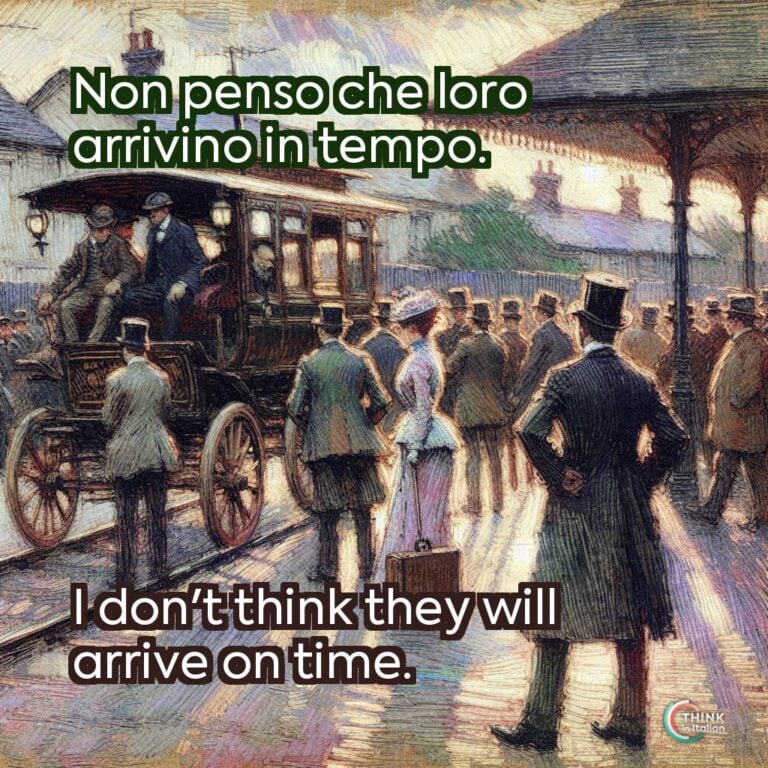
Non credo che Marco veda bene.
I don’t think Marco can see well.
Anna non vuole che i nonni partano.
Anna doesn’t want her grandparents to leave.
Spero veramente che vi sentiate meglio.
I really hope you feel better.
When to use Congiuntivo Presente
As you might know already, unlike other verb tenses, the Italian congiuntivo is always found in dependent clauses, which means it can never stand alone and always depends on the main clause it depends on.
This is the reason why it’s usually preceded by the conjunction che or se.
In Italian, we use the congiuntivo presente in the following cases:
- To express doubt, uncertainty, or possibility:
Credo che lui abbia ragione.
I think that he is right.
Ho paura che mia sorella perda il lavoro.
I’m scared my sister might lose her job.
- To express desire or hope:
Spero che tu stia bene.
I hope that you are well.
- To express necessity or obligation:
È necessario che lei venga subito.
It is necessary that she comes immediately.
Introductory Phrases
Each tense of the congiuntivo mood is introduced by specific introductory verbs or phrases in a specific verb tense.
In the case of congiuntivo presente, these verbs are conjugated in the presente indicativo. This is because we use this verb tense when we are speaking in the present about present actions.
Here are some of the possible introductory verbs you can find and use. Of course, there are many more, as long as they vehiculate doubts, uncertainty, etc…
- Pensare (to think)
- Credere (to believe)
- Sperare (to hope)
- Essere possibile che (to be possible that)
- Sembrare che (to seems that/like)
- A meno che non (unless)
- Affinché (so that)
- Prima che (before)
- Purché (provided that)
Here are some more examples:
Lei vuole venire a meno che tu non voglia vederla.
She wants to come unless you don’t want to see her.
Compra il biglietto prima che io cambi idea.
Buy the ticket before I change my mind.
Va bene purché tu dica la verità.
It’s fine, provided that you tell the truth.
Ready to Talk About Possibilities
Credo che tu possa imparare l’Italiano velocemente! (I think you can learn Italian fast!)
If you keep studying, I am sure you can! You are a step further in your Italian learning journey: I have just embarked the world of uncertainty. You can now express your desires, necessities, and doubts.
So, practice the use of this verb tense and unlock new topics and conversations!