What is the Italian infinitive?
To understand what an infinitive is, you need to know what a verb is.
A verb is a word that refers to an action. Examples are eating, reading, and playing.
The infinitive is the base form of a verb.
In Italian there are three types:
- -are verbs, like cucinare (to cook), cantare (to sing), andare (to go).
- -ere verbs, like bere (to drink), cadere (to fall), rimanere (to stay).
- -ire verbs, like dormire (to sleep), venire (to come), morire (to die).
There are two types of infinitives in Italian: the present infinitive and the past infinitive.
In today’s post, we’re going to focus on the Italian past infinitive.
How to form the Italian past infinitive?
Here are some examples of the past infinitive:
- Avere mangiato (to have eaten)
- Avere cucinato (to have cooked)
- Avere parlato (to have talked)
- Avere dormito (to have slept)
- Essere andato (to have gone)
- Essere venuta (to have come)
- Essere caduti (to have fallen)
- Essere scese (to have gone down)
You probably guessed we use either avere or essere in the infinitive, followed by the past participle.
By the way, we often drop the final -e of avere and essere. For example, we could say aver mangiato and esser venuta.
The Italian past infinitive: essere or avere?
We use avere with most Italian verbs.
We use essere with the following verbs:
- Verbs of movement (i.e.: andare – to go; venire – to come)
- Reflexive verbs (i.e.: svegliarsi – to wake up; lavarsi – to wash oneself)
- Verbs that indicate the state of something or someone (i.e.: essere – to be; stare – to be or feel).
When we use the past infinitive with the verb essere, the past participle agrees in number and gender with the noun it refers to, like in the example below:
Dopo essere tornati a casa, hanno deciso di rimanerci.
After having returned home, they decided to stay.
As you can we said tornati and not tornato or tornate, since we’re referring to more than one man.
How to form the past participles?
In case you don’t know or don’t remember, the past participles of regular verbs are conjugated as follows:
- Verbs ending in -are take -ato (i.e.: mangiare–> mangiato, ballare–> ballato)
- Verbs ending in -ere take -uto (i.e.: cadere–>caduto, avere–> avuto)
- Verbs ending in -ire take -ito (i.e.: capire–>capito, dormire–> dormito)
There are some irregular past participles:
- Essere (to be): stato
- Fare (to do): fatto
- Dire (to say): detto
- Chiedere (to ask): chiesto
- Leggere (to read): letto
- Mettere (to put): messo
- Vedere (to see): visto
- Vivere (to live): vissuto
When to use the Italian past infinitive?
We use the Italian past infinitive to refer to an action that happened before the one in the main sentence.
So, if the action expressed by the infinitive occurred before the main verb, we use the past infinitive.
Have a look at the examples below:
Teresa dice di aver visto Maria.
Teresa says to have seen Maria. (Teresa says she saw Maria.)
Marta crede di aver capito tutto.
Marta thinks to have understood everything. (Marta thinks she understood everything.)
Avere parlato con lei mi ha aiutata.
Having talked to her helped me.
As you can see, there are two actions in each sentence. And there’s a chronological order which is given by verb tenses.
How to use dopo and prima di + past infinitive?
We usually use the Italian past infinitive with the following time words:
- dopo: after
- prima di: before
Here’re some examples:
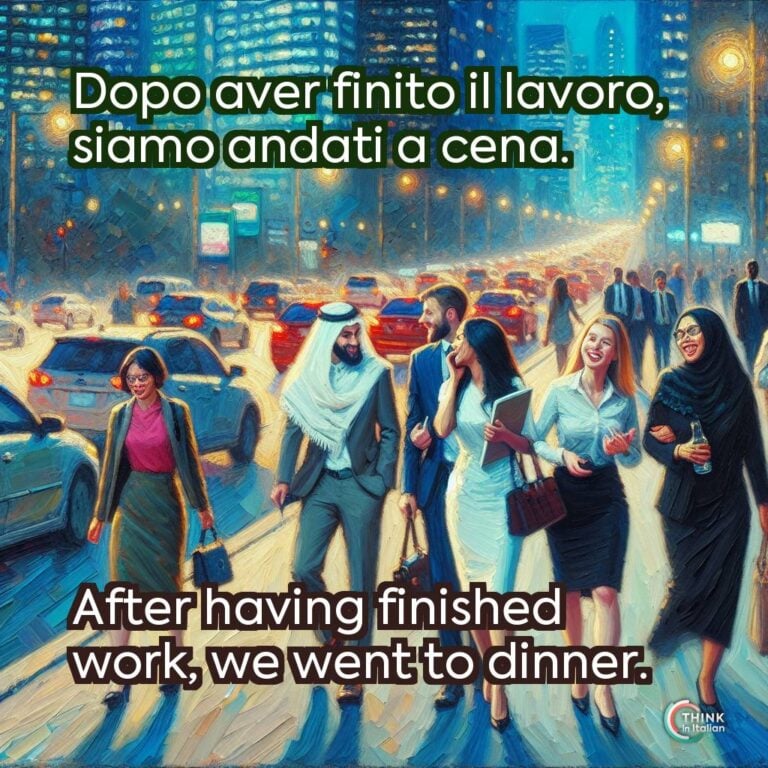
Dopo aver visto la casa, ho deciso di comprarla.
After having seen the house, I decided to buy it.
Dopo aver visitato il museo, ho capito tante cose sulla storia.
After having visited the museum, I understood many things about history.
Prima di essere andato a fare la spesa, ho fatto le pulizie.
Before going to do the grocery, I did the cleaning.
Prima di avere visto quel film, pensavo fosse interessante.
Before seeing that movie, I thought it was interesting.