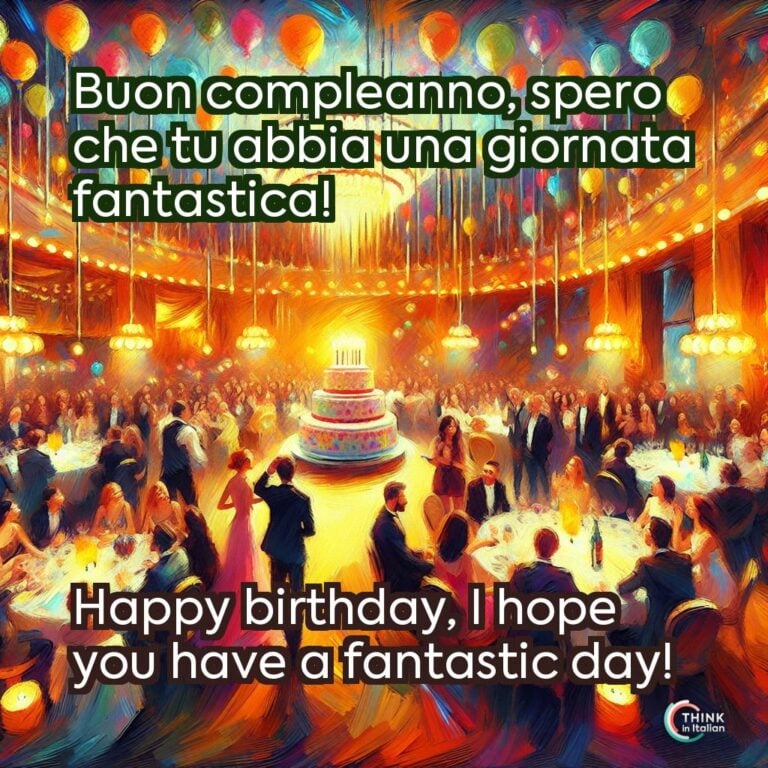

Happy birthday in Italian is buon compleanno. Italians say tanti auguri (many wishes) just as often, and you use the same words for a woman and for a man.
How to say happy birthday in Italian
There are a few ways you can say happy birthday in Italian, and today you’re going to learn some of them.
The most common phrases are buon compleanno, auguri and tanti auguri.
You can also wish someone a happy birthday by saying cento di questi giorni which literally means “one hundred of these days“.
You could also say felice compleanno, which means “happy birthday” in Italian. Felice literally means “happy.” However, this term is no longer widely used.
Below you will find ten ways to say it, how to wish happy birthday to a woman, to a man or to someone you address formally, how to reply, the song with lyrics, and a few Italian birthday customs.
10 ways to say happy birthday in Italian
| Italian | Meaning | When to use it |
|---|---|---|
| Buon compleanno! | Happy birthday! | the standard wish, works everywhere |
| Tanti auguri! | Many wishes! | very common when you speak, with friends and family |
| Auguri! | Best wishes! | short and informal |
| Auguroni! | Big wishes! | very informal and enthusiastic, with friends |
| Tanti auguri di buon compleanno! | Many wishes for a happy birthday! | cards and messages |
| Cento di questi giorni! | A hundred of these days! | traditional, it means “may you have many more birthdays” |
| Felice compleanno! | Happy birthday! (literally “happy birthday”) | correct but less common, more written than spoken |
| Ti auguro un buon compleanno. | I wish you a happy birthday. | full sentence, informal (tu) |
| Le auguro un buon compleanno. | I wish you a happy birthday. | full sentence, formal (Lei) |
| Tanti auguri in ritardo! | Happy belated birthday! | when you are a few days late |
How to pronounce buon compleanno and tanti auguri
- Buon compleanno: “bwon kom-pleh-AHN-no”. Buon is a single syllable, the stress falls on -an-, and the double n is held a little longer.
- Tanti auguri: “TAHN-tee ow-GOO-ree”. The au sounds like “ow” in “cow” and the stress falls on -gu-.
Buon compleanno
Buon compleanno is the most common way to say “happy birthday” in Italian.
It literally means “good birthday“, so it’s basically used like “happy birthday” in English. This makes it easy to remember.
Buon compleanno
Happy birthday
Auguri
Auguri is another common way of wishing someone a happy birthday.
It doesn’t literally mean “happy birthday”. Instead, it’s a more general way of wishing someone happiness.
You could also say tanti auguri which is a bit more emphatic.
What do auguri and tanti auguri mean in Italian?
Tanti auguri literally means “many wishes“. It is the phrase Italians reach for first when someone has a birthday, and it is often said in place of buon compleanno or together with it.
Auguri is the plural of augurio which means “wish“. So, it could be translated as “best wishes”.
Auguri is a little more versatile than buon compleanno and is often used on other special occasions.
You can say auguri to wish someone a Merry Christmas, Happy New Year, Happy Mother’s Day, and even a Happy Easter, as you can see below. For other occasions, see my lesson on how to say congratulations in Italian. Said on its own and in a different tone, auguri! can also mean “good luck!”, sometimes with a hint of irony when someone is about to face something difficult.
Tanti auguri di buon compleanno!
Many wishes for your birthday!
Auguri!
Best wishes!
Tanti auguri!
Many wishes!
Tanti cari auguri!
Many dear wishes!
Tanti auguri di buon Natale!
Merry Christmas!
Tanti auguri di buon anno nuovo!
Happy New Year!
Tanti auguri per la festa della mamma!
Happy Mother’s Day!
Tanti auguri di buona Pasqua!
Happy Easter!
As you can see, you can just say (tanti) auguri followed by the word di and the name of the event/holiday.
You can also say auguri or tanti auguri to wish someone the best when they’re starting a new job, when they are going to have a baby, or for their anniversary.
Happy birthday in Italian to a woman, to a man or to someone formal
Italian does not change buon compleanno or tanti auguri for gender, so you say exactly the same words to a woman and to a man. What changes is what you add after them, such as an affectionate word, which agrees with the person:
Buon compleanno, Giulia!
Happy birthday, Giulia!
Tanti auguri, caro Marco!
Happy birthday, dear Marco!
Tanti auguri, cara Giulia!
Happy birthday, dear Giulia!
Auguri, amico mio!
Happy birthday, my friend! (to a man)
Auguri, amica mia!
Happy birthday, my friend! (to a woman)
Buon compleanno, mamma!
Happy birthday, Mum!
Buon compleanno, papà!
Happy birthday, Dad!
With someone you address as Lei, such as a teacher, a client or an older neighbor, buon compleanno and tanti auguri are still fine. In a full sentence, use the formal Le instead of ti (see the lesson on how to use the formal Lei):
Ti auguro un buon compleanno.
I wish you a happy birthday. (informal)
Le auguro un buon compleanno.
I wish you a happy birthday. (formal)
Tanti auguri, signora Rossi!
Happy birthday, Mrs. Rossi!
When to say buon compleanno?
Note that wishing a happy birthday to a friend one or few days in advance is considered rude by Italians.
There is no actual reason for this.
It is simply considered something that brings bad luck, so be sure to know the exact date of your Italian friends’ birthdays!
On the other hand, if you’re a little late, you can try to fix it by saying:
Tanti auguri in ritardo!
Happy belated birthday!
How to reply to birthday wishes in Italian
When someone wishes you a happy birthday, the simplest reply is to say thank you:
Grazie!
Thank you!
Grazie mille!
Thanks a lot!
Grazie, sei gentile!
Thanks, that is kind of you! (informal)
Grazie, è molto gentile!
Thanks, that is very kind of you! (formal)
Grazie per gli auguri!
Thanks for the wishes!
Grazie a tutti per gli auguri!
Thanks everyone for the wishes!
Grazie di essere venuti!
Thank you for coming!
In the last example, venuti is plural because you are speaking to a group. To one man you say venuto, and to one woman venuta.
How to sing the happy birthday song in Italian
Singing happy birthday in Italian is done by using the tanti auguri phrase, and it simply goes like this:
These are the lyrics of the happy birthday song in Italian:
“Tanti auguri a te,
Tanti auguri a te,
Tanti auguri a (the name of the person)
Tanti auguri a te!”
The tune is the same as the English “Happy Birthday to You”. In English, the words are: “Many wishes to you, many wishes to you, many wishes to (the name of the person), many wishes to you!”
How to ask somebody about their age in Italian
It’s always good to know how old the festeggiato/festeggiata (birthday boy or girl) is.
You can ask them the following question:
Quanti anni compi?
How old are you today?
If you want to ask someone how old they are when it’s not their birthday, you should ask this question instead, as it doesn’t refer to a specific day:
Quanti anni hai?
How old are you?
You can also ask in which year they were born:
A: Di che anno sei?
B: Sono del settantadue
A: In which year were you born?
B: I was born in 1972.
If you know the numbers in Italian, it’ll be easier for you to have this kind of conversation with someone.
Italians often joke about the fact that asking someone’s age is impolite, especially to women who may be hesitant to reveal this information.
When approaching ladies, particularly mature women, it is preferable to ask about their birth date rather than their birth year.
If someone doesn’t want to tell you their age, they can just say the day they were born instead of the year:
Quando è il tuo compleanno?
Il 24 Marzo.
When is your birthday?
It’s on March 24.
Just so you know, we put the day first, and then the month.
If you ask someone you don’t know very well how old they are, and think they don’t look that age, you can say so in a polite way, like in the dialogue below:
A: Quanti anni ha?
B: Ho 45 anni.
A: Complimenti, non li dimostra!
OR
A: Complimenti, li porta bene!
A: How old are you? (formal)
B: I’m 45 years old.
A: Congratulations, you don’t look it! (Literally: you don’t show them!)
OR
A: Congratulations, you look pretty good! (Literally: you carry them well!)
Questions and answers about birthdays in Italian
Of course, when talking about a birthday in Italian, there are a few more things you need to know.
You might want to ask your friend what they want to do for their birthday:
A: Cosa vuoi fare per il tuo compleanno?
B: Non lo so, forse una festa a casa.
A: What do you want to do for your birthday?
B: I don’t know, maybe a house party.
If you want to ask your friend whose birthday is coming up soon what present they would like to receive, you can ask the following questions:
Che regalo vuoi?
What present do you want?
Cosa vuoi per il tuo compleanno?
What do you want for your birthday?
Italian birthday vocabulary
| Italian | English |
|---|---|
| il compleanno | birthday |
| la festa di compleanno | birthday party |
| la torta di compleanno | birthday cake |
| la candelina (plural le candeline) | birthday candle |
| spegnere le candeline | to blow out the candles (literally “to put out”) |
| il regalo | present |
| il biglietto di auguri | greeting card |
| il palloncino | balloon |
| l’invitato / l’invitata | guest (man / woman) |
| il festeggiato / la festeggiata | the birthday boy / the birthday girl |
| il brindisi | toast |
| la data di nascita | date of birth |
| compiere gli anni | to have a birthday, to turn a year older |
To say how old you are turning, use compiere with the age:
Domani compio trent’anni.
Tomorrow I turn thirty.
Ieri ho compiuto quarant’anni.
Yesterday I turned forty.
Tanti auguri per i tuoi diciotto anni!
Happy 18th birthday!
Birthday traditions
Italians like to celebrate their birthdays like people from other cultures: with a birthday cake, a birthday party or special meal, candles, and they usually receive gifts.
However, unlike in other cultures, when Italians celebrate their own birthdays, they invite friends and family out and pay the dinner, or drinks, for everyone.
Birthday cake and wishes
The birthday boy or girl is also expected to either buy or bake the cake.
While the “festeggiato” is blowing out the candles on his/her birthday cake, it is common practice to sing the Italian version of Happy Birthday.
As in many other nations, he or she needs to blow the candles and make birthday wishes.

It is believed that you cannot tell your wish to anyone, or it won’t come true!
Presents
Another typical Italian tradition is to open all the presents in front of everyone at the party.
You may want to buy something not too personal so that your friend won’t be ashamed to show it in public.
It is also common to accompany your gift and wishes with a birthday card, where you need to write down a few words to the birthday boy or girl.
Birthday messages in Italian for a card or a text
If you want to write more than a single phrase, here are some messages you can copy and adapt:
Buon compleanno! Ti auguro un anno pieno di gioia.
Happy birthday! I wish you a year full of joy.
Tanti auguri di buon compleanno! Che tu possa realizzare tutti i tuoi sogni.
Many happy birthday wishes! May you make all your dreams come true.
Auguri di cuore!
Heartfelt wishes!
Buon compleanno, amore mio! Grazie di esserci.
Happy birthday, my love! Thank you for being here.
Buon compleanno da tutti noi!
Happy birthday from all of us!
Le porgo i miei migliori auguri di buon compleanno.
I extend my best wishes for your birthday. (formal)
For family and close friends, you can add ti voglio bene (“I love you”, in the affectionate sense), as in Buon compleanno, mamma! Ti voglio bene. I explain when to use it in my guide to ti voglio bene.
Happy birthday cards in Italian
Are you looking for a “happy birthday” card in Italian for your loved ones?
For a customized buon compleanno card in Italian, there’s a website to send virtual cards by email or by sharing them on social media.
It’s 100% Italian.
Here’s how to send a card:
- Click on a card
- Choose how to send it
- Add a note
- Type your name and email address
- Type the recipient’s email address
- Select the date to schedule the delivery of your card
Useful Italian expressions
Here’s a list of other important Italian expressions you need to know:
By the way, if you’re looking for the perfect gift for Italian learners, we recommend reading our post about it.
You and your Italian friends will have a blast!