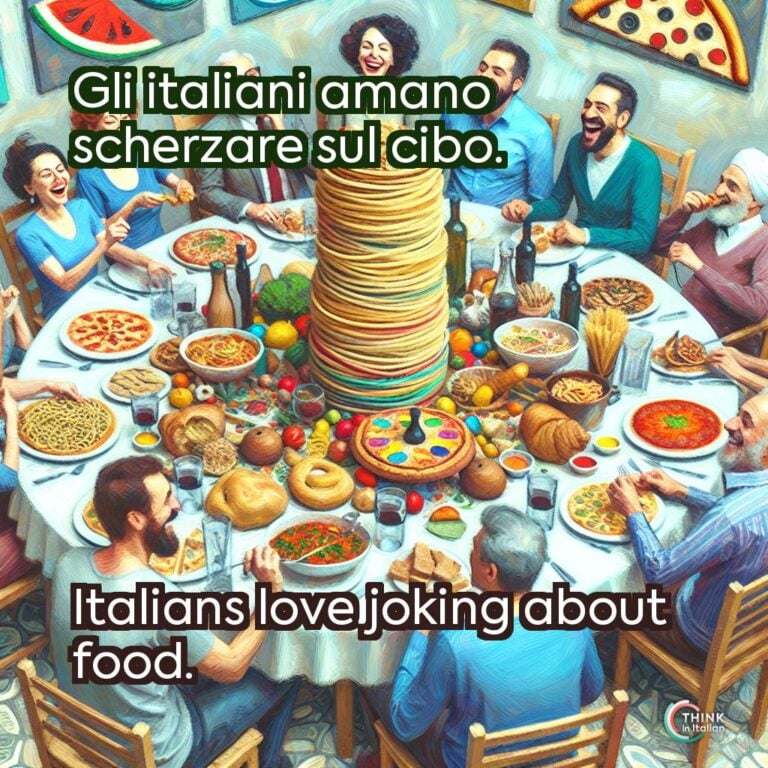
Below you’ll find 15 Italian jokes with English translations, from beginner puns to advanced wordplay, plus four riddles. “Joke” in Italian is barzelletta (a funny story), battuta (a witty remark) or scherzo (a prank), and every joke comes with a note on the wordplay that makes it work.
Introduction to Italian Jokes
Italians’ Sense of Humor
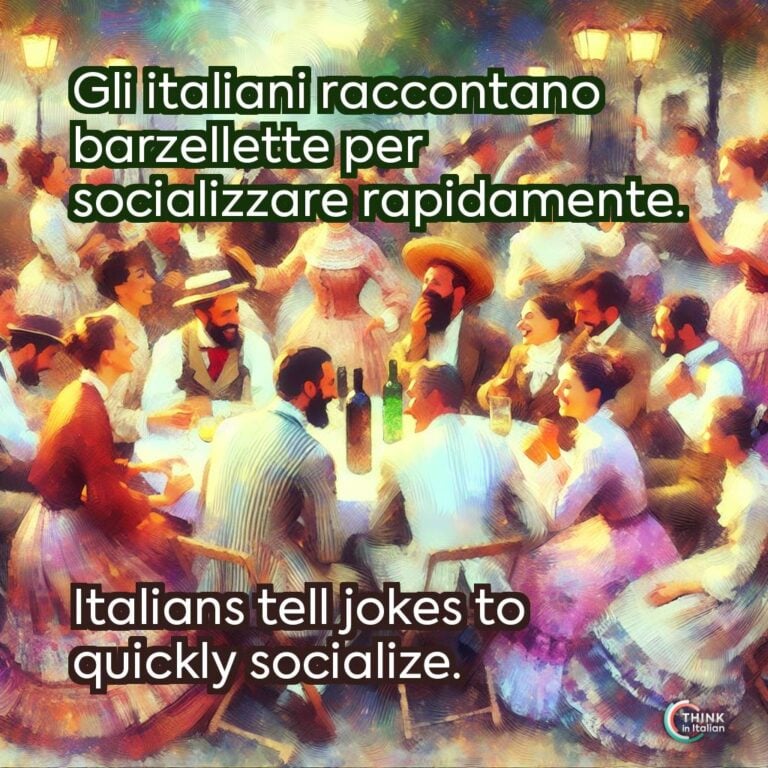
Italians have a rich tradition of storytelling, and jokes are an important part of that tradition. They use humor to express themselves, get through challenging circumstances, and form relationships with others.
Humor is also used to make social commentary and critique authority. Italians value comedy and frequently use it as a means of social interaction.
Italian jokes are known for their clever wordplay, puns, and cultural references. The jokes can vary from brief one-liners to lengthy tales – barzellette – with surprising turns.
As a language enthusiast, I have always enjoyed learning about the culture and traditions of other countries, because they reflect language and are reflected in language.
For me, one of the most interesting aspects of Italian culture is Italians’ sense of humor, because it is both witty and charming, as well as deep and clever sometimes.
Common Italian Joke Structures and Themes
Italian jokes can be organized in a variety of ways, although some typical formats include puns, wordplay, colloquial idioms, and cultural references.
Topics also vary a lot: food, school, family, politics, religion, and sex are some of the most frequent. Jokes that make fun of Italians themselves, and the regional stereotypes that go with them, have their own page: jokes about Italians.
The Importance of Learning Italian Jokes
Learning Italian jokes can be a fun and effective way to improve your language skills. Jokes are a great way to practice your vocabulary, grammar, and pronunciation. Also, they can help you learn new idiomatic expressions and cultural references.
Moreover, jokes can be a great icebreaker when you are trying to make new friends or practice your conversation skills. On the one hand, this will help you feel more comfortable when speaking Italian, while on the other hand, it will allow you to expand your network.
In fact, the best way to find a new Italian friend is to share a laugh with them. Trust me, make fun of an Italian person – respecting their boundaries and without being offensive – and you’ll have a new friend.
How to Say “Joke” in Italian
Italian has three common words for the English “joke”, and they are not interchangeable:
- Scherzo
- Battuta
- Barzelletta
Scherzo can be translated as “prank” or “trick”. It is a practical joke that you perform on others.
Sofia mi ha fatto uno scherzo: mi ha nascosto il telefono.
Sofia played a joke on me: she hid my phone.
Battuta is an oral joke, to make fun of someone or something. It is a witty remark and can easily be translated as “joke”.
Ma dai, era solo una battuta!
Come on, it was only a joke!
Barzelletta is a funny story. It is longer than a simple battuta because it leverages the storytelling itself to make listeners laugh.
Ora vi racconto una barzelletta.
Now I’ll tell you a joke (a funny story).
Despite the various alternatives, the verb “to joke” is only scherzare.
Stai scherzando?
Are you joking?
There are also several verbal combinations linked to these words. The most common one is the verb “fare“, as in fare uno scherzo and fare una battuta. The word barzelletta, instead, is usually linked to the verb raccontare (to tell), because it is, indeed, storytelling.
You will also hear two more names for types of jokes. A freddura is a short pun that earns a groan more than a laugh (the “Lampa Dario” joke below is one). A colmo is a riddle-joke that starts with Qual è il colmo per un…? (“What is the ultimate irony for a…?”) and ends with a paradox.
On this page I focus on barzellette and battute, and I added a few indovinelli (riddles) at the end.
Italian Jokes Translated into English
Beginner Level
-Chi è l’elettricista italiano piu famoso?
-Lampa Dario!
-Who is the most famous Italian electrician?
-Lampa Dario!
This is an easy word pun: “Dario” is a typical Italian name, and “Lampa” might easily be a surname since we’re asking the name of the most famous Italian electrician.

However, lampadario all together means “chandelier”, which is linked to the profession of the electrician himself.
-Perché il libro di matematica era triste?
-Perché era pieno di problemi!
-Why was the math book sad?
-It had many problems!
The joke hinges on the double meaning of problemi, which can mean both “problems” (math problems) and “troubles” in a more general sense. This requires a bit of understanding of dual meanings in Italian, which is already doable for beginners.
Ci sono una mela e un’arancia che giocano a carte.
La mela dice all’arancia: “Forza, pesca!”
An apple and an orange are playing cards.
The apple says to the orange: “Come on, draw a card!”
The word pesca has two meanings. It is the fruit (a peach), and it is also the command “draw a card” from the verb pescare (literally “to fish”). So the apple gives an order and calls the orange a peach at the same time.
Intermediate Level
-Perché il panettiere non ha problemi?
-Perché li-evita!
-Why does the baker have no problems?
-Because he avoids them!
The irony of this joke is in the double meaning of the answer: when writing it separately li evita means “(he) avoids them”, where “li” is a direct pronoun referring to i problemi (the problems).
When writing it all together, lievita means “it leavens”, namely the property of increasing in volume due to the effect of yeast fermentation.
-Com’è possibile che due sassi siano uguali?
-Sassommigliano!
-How is it possible that two rocks are the same?
-They look alike!
The irony lies in the answer, that is, “s’assomigliano” (they look alike) which, with the elision of the vowel “i”, becomes “sassomigliano”, practically creating the word “sasso” (stone). When you hear this joke, we immediately notice the similarity between words.
Advanced Level
-Dottore, ha qualcosa contro la tosse?
-No, no, tossisca pure!
-Doctor, do you have anything against the cough?
-No, no, cough!
Also in this case, the irony lies in the double meaning of the question: the first meaning is the logical translation of the patient asking if the doctor has any medicine to cure the cough.
However, when the doctor answers, the joke reveals a second interpretation: the expressions contro (against) might be interpreted as having anything against the cough, that is, whether it bothers him that the patient coughs.
Linguistically, the doctor responds with a formal imperative with “pure“, that can be translated as “no no, just cough!“, or rather: “it doesn’t bother me if you cough, you can cough peacefully!”
Effrazione allo spaccio di saponette, gli inquirenti se ne lavano le mani
Break-in at the soap shop, the investigators wash their hands of it.
This joke is a treasure trove of grammatical references: prepositions, phrasal verbs, and quite complex vocabulary.
“Lavarsene le mani” is a prepositional verb – phrasal verb – that has a very similar translation in English. However, its Italian structure is pretty difficult. It is a reflexive verb, as noticeable by the reflexive pronoun “si”, but it also makes use of an untranslatable pronoun “ne”.
In the joke, the wordplay lies in using the expression lavarsene le mani both in its literal sense (washing hands with soap, which ties back to the soap shop) and its idiomatic sense (to ignore responsibility).
Short Italian Jokes
A barzelletta is usually quite long. If you want to tell one and get a laugh, people have to follow you for a while, and that can be hard when you are still learning Italian.
This is why I collected some short Italian jokes with English translations that you can practice in your conversations. For even shorter ones, have a look at my best Italian one-liners.
Due amici s’incontrano:
“Lo sai? Ho appena bruciato 2.500 calorie.”
“Davvero? E come hai fatto?”
“Ho dimenticato la torta nel forno…”
Two friends meet:
“Guess what! I just burned 2,500 calories.”
“Really? And how did you do that?”
“I forgot the cake in the oven…”
The wordplay is on bruciare (to burn): you burn calories by exercising, but you also burn a cake by forgetting it in the oven.
Un ragazzo chiede al suo papà:
“Papà, dimmi, sei capace di scrivere il tuo nome ad occhi chiusi?”
“Penso di sì, perché?”
“Ottimo, devo farti firmare la pagella.”
A boy asks his dad:
“Dad, tell me, are you able to write your name with your eyes closed?”
“I think so, why?”
“Great, I need you to sign the report card.”
The pagella is the school report card, which a parent has to sign. With his eyes closed, the dad won’t see the bad grades.
“Dottore, dottore! Ho solo 59 secondi di vita, mi aiuti!”
“Certo! Un minuto e sono da lei!”
“Doctor, doctor! I only have 59 seconds to live, help me!”
“Sure, just give me one minute!”
The doctor’s un minuto is longer than the 59 seconds the patient has left. Note also the polite da lei (with you, formal), which a doctor would use with a patient.
Una bambina torna a casa dopo il suo primo giorno di scuola.
La madre le chiede: “Che cosa hai imparato oggi?”
La bambina risponde: “Non abbastanza, vogliono che torni anche domani.”
A little girl goes home after her first day of school.
Her mother asks her: “What did you learn today?”
The girl replies: “Not enough, they want me to go back tomorrow too.”
The girl has decided that school goes on tomorrow because she hasn’t learned enough today. There is also a small grammar point: after volere che (to want someone to do something) Italian uses the subjunctive, here torni. You can review it in the present subjunctive lesson.
Funny Italian Jokes: Pierino and Everyday Humor

Most long-standing Italian jokes play with the language or with a cultural reference. Learning what they mean will help you improve your understanding of Italians in general, as well as the Italian culture.
Se io mi metto la camicia di lino, che camicia si mette Lino?
If I put on a linen shirt, which shirt does Lino wear? (In Italian, lino means both linen and the name Lino.)
Many jokes involve Pierino, the Italian equivalent of Little Johnny. Just like in English, Pierino is a small boy who asks questions and makes statements that can sound embarrassing.
Pierino dice alla maestra:
“Signora maestra, sa dirmi quale animale mangia con la coda?”.
“Pierino, non dire stupidaggini, nessun animale mangia con la coda!”.
“Tutti mangiano con la coda… ne conosce forse qualcuno che se la toglie prima di mangiare?”.
Pierino says to the teacher:
“Teacher, can you tell me which animal eats with its tail?”.
“Pierino, don’t talk nonsense, no animal eats with its tail!”.
“Every animal eats with their tail… do you know an animal that takes its tail off before eating?”.
The teacher hears “eats using its tail”, while Pierino only means “eats while having a tail”. The preposition con makes both readings possible.
La maestra interroga Pierino:
“Pierino, dimmi due pronomi!”.
“Chi? Io?”.
“Bravissimo Pierino! Ora sentiamo un altro”.
The teacher quizzes Pierino:
“Pierino, tell me two pronouns!”.
“Who? Me?”.
“Well done, Pierino! Now let’s hear someone else”.
Pierino’s questions, chi and io, are two pronouns, so he gives the right answer without meaning to. If you want to review them, see my lesson on Italian personal pronouns.
Jokes are part of our daily conversations. We like teasing our friends, and we usually do not get offended if someone plays a prank on us.
– Vuoi una mano?
– No, grazie. Ne ho due.
– Do you need a hand? (Do you need help?)
– No, thanks. I have two (hands).
Vuoi una mano? is an offer of help, but the answer takes it literally. The pronoun “ne” in Ne ho due stands for mani (hands).
Looking for jokes that make fun of Italians? Read my page on jokes about Italians.
Italian Riddles (Indovinelli)
Another type of joke I love is riddles. The Italian word is indovinello, from the verb indovinare (to guess). Riddles play around language and words, and they are more interactive than standard jokes. Whenever I have to use my brain, I am engaged!
Va su e giù ma non si muove.
La scala.
It goes up and down but it doesn’t move.
The ladder.
Ha molti denti, ma non può masticare.
Il pettine.
It has many teeth, but cannot chew.
The comb.
Può riempire una stanza, ma non occupa spazio.
La luce.
It can fill a room, but it doesn’t take up space.
The light.
Più si cresce e più si accorcia.
La vita.
The more it grows, the shorter it gets.
Life.
Read more Italian riddles.
Useful Phrases for Telling and Reacting to Jokes
If you want to use jokes in real conversations, these phrases will get you started:
Ti racconto una barzelletta.
I’ll tell you a joke.
Conosci quella del panettiere?
Do you know the one about the baker?
Non ho capito la battuta.
I didn’t get the joke.
Questa è bella!
That’s a good one!
Ho riso a crepapelle.
I laughed my head off.
Non fa ridere.
It’s not funny.
Scherzavo!
Just kidding!
Three words are worth knowing when you explain a joke: il gioco di parole (the pun, the wordplay), il doppio senso (the double meaning) and la battuta finale (the punchline).
Learn the Italian Language Through Jokes
It is now clear that exploring Italian jokes offers a delightful window into the Italian language and culture. Not only do these jokes provide you with entertainment, but they also enhance your Italian language skills.
In fact they can introduce you to idiomatic expressions, puns, and an overall understanding of Italian grammar. Whether you’re a beginner or an advanced learner, the humor found in Italian jokes can make your learning journey more enjoyable and engaging.
Also, jokes usually carry cultural references that reflect the unique charm of Italy. So, while laughing and learning, you’re also immersing yourself in the vibrant spirit of Italy.
So start honing your Italian puns and get ready to belly laugh!