How to use “mi sa che”: Italian Grammar Lesson

An interactive lesson guiding you from key takeaways to expert insights. Comes with Q&A, useful vocabulary, interactive audio, quizzes and games.

Mi sa che l'incontro è cancellato.
Published Aug 6, 2021
Updated Sep 7, 2025
Written by
Italian language tutor, course author. MEng, MBA. Member of the International Association of Hyperpolyglots (HYPIA). After learning 12 languages, I can tell you that we all master languages by listening and mimicking. I couldn’t find an app to recommend to my students, so I made my own one. With my method, you’ll be speaking Italian from Lesson 1.
Reviewed by
A linguist specializing in psycholinguistics and Italian language education. I hold a Research Master’s in Linguistics and teach Italian, passionately connecting research with practical teaching.

Key Takeaways

  • Mi sa che expresses a personal impression or feeling, similar to "I have a feeling that" in English.
  • It uses the indicative mood and can be conjugated in various tenses depending on the context.
  • To respond to yes or no questions, use mi sa di sì for "I think so" and mi sa di no for "I don't think so."
  • The expression is only used in the first person singular with the indirect pronoun mi.
  • It is synonymous with mi sembra che and penso che, indicating a perceived reality.

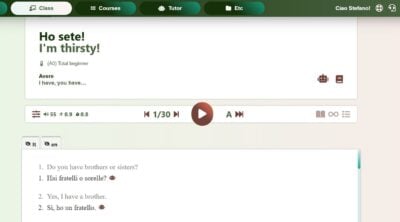
Audio images

🔊
Mi sa che l'incontro è cancellato.
🔊
Mi sa che domani piove.
🔊
Mi sa che farà freddo domani.

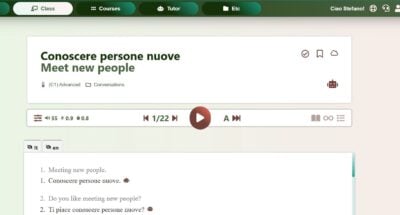
Audio lesson with 30 sentences to listen and repeat

Italian grammar video lesson

Main Article

“Mi sa che” in Italian

Meaning

Mi sa che is a colloquial expression that is used in Italian to indicate the impression, suspicion, or feeling about something. It is often used in informal contexts to express an opinion or intuition.

It doesn’t have exact equivalents in other languages, in fact, there is no literal translation for this construction. However, it is similar to saying “I have a feeling that” or “it seems to me that” in English.

It is only used in the first person singular, with the indirect pronoun mi (for “I”). Have a look at these examples:

Mi sa che non sono venuti.

I think they did not come.

Mi sa che vuole invitarvi a cena.

I have the feeling that she wants to invite you over for dinner.

Construction

In this expression, the verb sa is the third person singular conjugation of the verb sapere (to know). In fact, the subject of the sentence is what you have the feeling or suspicion about, while the indirect pronoun states the person that experiences that feeling.

In this sense, the construction is the same as that of the verbs servirepiacere, sembrare, or mancare. Therefore, it could literally be translated as “something feels somehow to me”, where “something” is the subject of the sentence and “to me” is the indirect pronoun.

Let me break down the structure so that you can understand better:

Mi sa che il ristorante è chiuso.

To me it feels that the restaurant is closed.

In other words, mi sa che is a synonym of mi sembra che (it seems to me that), penso che (I think that), or credo che (I believe that).

Verb Tense

As you might have seen already, we use the indicative mood with this expression. The tense depends on when the event occurred, therefore you can use the present, past, future etc…

However, if you are familiar with the subjunctive mood you might wonder: since it is a personal opinion, why don’t we use the subjunctive mood?

Well, let me explain you why: mi sa che is used to express a personal impression, belief, or sensation. Although it is an opinion, the speaker considers it relatively certain or factual. It works just like secondo me (according to me).

In other words, by using mi sa che we are indicating that the statement is based on a perception or feeling, but it is considered a probable reality.

In contrast, if you were to express something with more uncertainty or subjectivity, you would use the subjunctive mood. For example:

Non sono sicuro che lui sia a casa.

I am not sure that he is at home.

How to use “mi sa di sì” and “mi sa di no”

There are two similar constructions that are used to answer a yes or no question. In this case, instead of che, we use the preposition di right before or no. This is how it results like:

  • Mi sa di sì (I think so)
  • Mi sa di no (I don’t think so)

Have a look at the example:

A: Venite stasera?
B: Mi sa di no.

A: Are you coming tonight?
B: I don’t think so.

A: Ha passato l’esame?
B: Mi sa di sì.

A: Did she pass the exam?
B: I think so.

Key Terms and Concepts

Words

impressioneimpression
sospettosuspicion
sensazionefeeling
pronomepronoun
sapereto know
indicativoindicative mood
certocertain
fattofactual
domandaquestion
pensareto think

Phrases

impressioneimpression
sospettosuspicion
sensazionefeeling
sapereto know
mi sa cheI have a feeling that
pronome indirettoindirect pronoun
umore indicativoindicative mood
certocertain
affermativofactual
mi sa di sìI think so

Sentences

Mi sa che oggi pioverà.

I have a feeling that it will rain today.

Mi sa che abbiamo dimenticato le chiavi a casa.

I have a feeling that we left the keys at home.

Mi sa che lui non verrà alla festa stasera.

I have a feeling that he won't come to the party tonight.

Mi sa che questo film sarà interessante.

I have a feeling that this movie will be interesting.

Mi sa di sì, possiamo andare al parco.

I think so, we can go to the park.

FAQs

What is the meaning of "mi sa che"?

We are literally saying “it tastes or smells to me like…”. We use it to say something along the lines of I have the feeling or impression that.

What is the other constuction with "mi sa di"?

We can also use a similar construction to answer a yes or no question. In this case, instead of che, we use di right before sì or no: Mi sa di sì (I think so) and mi sa di no (I don’t think so).

think in italian reddit

The comments section has moved to the Think In Italian Reddit community. Join today!

Italian word of the day
diverse
Al mercato si trovano cose diverse a seconda della stagione.
At the market, you will find different things depending on the season.

What's new

Social signup
"I've tried other apps like Babbel and Memrise. None made me fluent or made me feel like I was making much meaningful progress in learning a language."
testimonial 2
Ecem Topcu
Aug 7, 2025
Social login (faster)