How to use “Mancare”: Italian Grammar Lesson

An interactive lesson guiding you from key takeaways to expert insights. Comes with Q&A, useful vocabulary, interactive audio, quizzes and games.

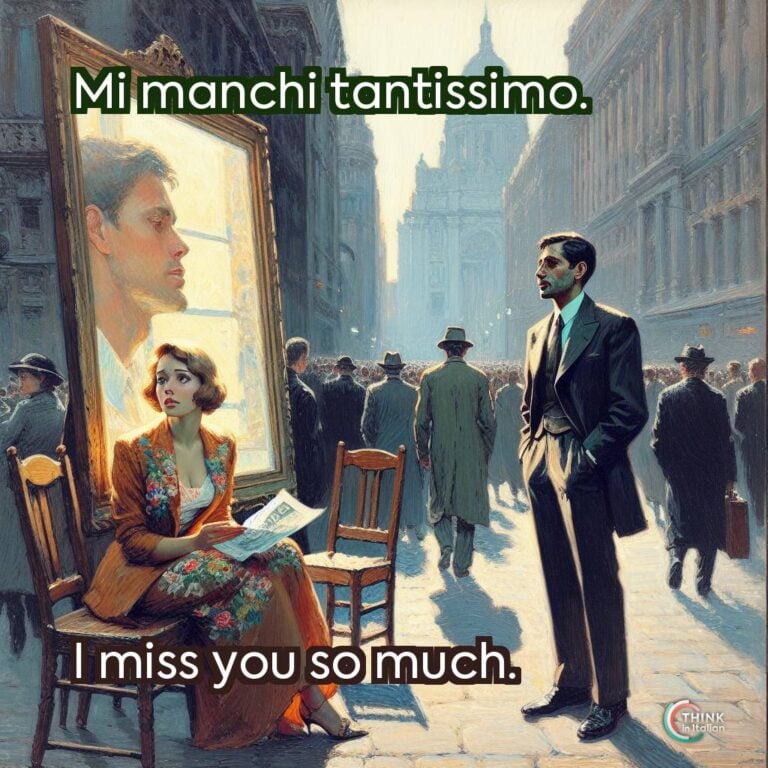
Mi manchi tantissimo.
Published Apr 20, 2021
Updated Jun 15, 2025
Written by
Italian language tutor, course author. MEng, MBA. Member of the International Association of Hyperpolyglots (HYPIA). After learning 12 languages, I can tell you that we all master languages by listening and mimicking. I couldn’t find an app to recommend to my students, so I made my own one. With my method, you’ll be speaking Italian from Lesson 1.
Reviewed by
No data was found

Key Takeaways

  • Mancare means “to miss” in Italian, expressing absence or nostalgia for people or items.
  • The verb is a regular first-conjugation verb, making its conjugation straightforward and similar to other verbs like parlare and mangiare.
  • As an intransitive verb, mancare often requires an indirect object pronoun to indicate who is missing something.
  • Use mancare to indicate missing items, such as “Manca un bottone” (A button is missing).
  • The verb can also express missing time or distance, as in “Mancano venti chilometri” (Twenty kilometers to go).
  • Italians often emphasize feelings of missing someone with words like tanto (a lot) or troppo (too much).

Stefano's Insights

Play to see captions...
Ah, il verbo 'mancare' in italiano, un piccolo enigma per chi impara la lingua! È come quando cerchi le chiavi e scopri che sono sempre state nella tua tasca. 'Mancare' significa 'to miss', ma la sua struttura è più complicata di un puzzle. È un verbo intransitivo, quindi attenzione agli oggetti indiretti! Mi ricordo quando ho cercato di spiegare a un amico americano che 'mi manchi' non significa che io manco a me stesso... un momento esilarante! Ma una volta capito, 'mancare' diventa un verbo versatile, perfetto per esprimere assenze emotive, fisiche o quantitative. E, ovviamente, noi italiani non possiamo resistere a dire 'mi manchi tantissimo'!
Ah, the verb 'mancare' in Italian, a little enigma for language learners! It's like looking for your keys only to find them in your pocket all along. 'Mancare' means 'to miss', but its structure is trickier than a puzzle. It's an intransitive verb, so watch out for those indirect objects! I remember trying to explain to an American friend that 'mi manchi' doesn't mean I miss myself... quite a hilarious moment! But once understood, 'mancare' becomes a versatile verb, perfect for expressing emotional, physical, or quantitative absences. And, of course, we Italians can't resist saying 'mi manchi tantissimo'!

Quick facts

How does the verb "mancare" in Italian differ syntactically from "to miss" in English?

Unlike English, "mancare" structures the missed entity as the subject and the person missing as the indirect object, requiring an indirect pronoun or preposition "a."

What is the literal translation of "Tu mi manchi"?

The literal translation is "You are missed by me," which means "I miss you."

Why are Italian personal pronouns often omitted in sentences like "Mi manchi"?

Italian personal pronouns are not mandatory because verb conjugations already indicate the subject, making "Mi manchi" sufficient to mean "I miss you."

How do you say "We miss our friends" using "mancare"?

"Ci mancano i nostri amici," where "ci" is the indirect object pronoun for "us" and "i nostri amici" is the subject.

How do you express missing an item from somewhere in Italian?

Use "mancare" as in "Manca un bottone dalla camicia," meaning "A button is missing from the shirt."

Can "mancare" be used for estimating remaining time or distance?

Yes, "Mancano venti chilometri" means "Twenty kilometers to go," and "Quanto manca?" asks "How much longer?"

What does "Mi mancano venti pagine" mean in the context of reading?

"I'm missing twenty pages," indicating the speaker hasn't read twenty pages yet.

How is "mancare" used to indicate the absence of a person?

"Ci siamo quasi tutti. Manca solo Filippo" means "We're almost all here. Only Filippo is missing."

What are common emphatic words used with "mancare"?

Italians often use "tanto," "tantissimo," and "troppo" to emphasize missing someone a lot, so much, or too much.

How does the verb "mancare" cover different types of absence?

"Mancare" can express emotional absence, physical absence, and quantitative deficiencies, showing its versatility in Italian.

Audio images

🔊
Mi manchi tantissimo, amore mio.
🔊
Mi manchi tantissimo.
🔊
Mi manchi tantissimo.
Learn on the go
Install the FREE Think In Italian app for faster loading, offline mode, and quick access anytime.
No registration needed. Works on all devices. Ready in 1 click and 3 seconds.

Audio lesson with 30 sentences to listen and repeat

Italian grammar video lesson

Main Article

“Mancare” in Italian

Meaning

Mancare is translated in English as “to miss”. In both languages, it is used to express the lack of something – in the sense of the absence of one ore more items or people – or the lack of someone – in the sense of nostalgia of one or more people.

However, their structure is quite different. Let’s have a look at some examples:

Tu mi manchi.

I miss you.

Ci mancano i nostri amici.

We miss our friends.

Conjugation

Mancare is an regular first-conjugation verb. This means that its conjugation is pretty simple, and is similar to that of other first-conjugation verbs like parlare (to speak), cantare (to sing), or mangiare (to eat).

Let me show you its present tense conjugation:

  • Io manco (I’m missed)
  • Tu manchi (You’re missed)
  • Lui/lei manca (He/She’s missed)
  • Noi manchiamo (We’re missed)
  • Voi mancate (You’re missed)
  • Loro mancano (They’re missed)

Since it follows a regular pattern, I am confident you’ll find it easy to conjugate its other verb tenses as well. Give it a try, and let me know how it went!

The only tricky thing you have to keep in mind when conjugating it is that it is an intransitive verb. This means that it might require an indirect object in order for its meaning to be fulfilled.

Let me remind you what Italian indirect objects look like:

  • mi: (to) me
  • ti: (to) you
  • gli/le(to) him/ her
  • ci: (to) us
  • vi: (to) you
  • gli: (to) them

Of course, the subject of the sentence is the item, person, object that seems somehow to someone. In this sense, its conjugation is very similar to that of servirepiacere and sembrare.

Ci mancano le giornate al mare da bambini.

We miss beach days as children.

Stasera mi mancava Elisa.

Tonight I missed Elisa.

It is important that you remember that you remember the placement of Italian pronouns!

As you can see, in Italian the subject of the sentence is the item, person, object that is missed by someone, and the person experiencing the feeling of missing is expressed by the indirect pronoun.

Of course, if you want to specify that a person misses something, you do not need an indirect object pronoun, but you can use the name of that person. In this case, the indirect object is introduced by the preposition a🔊.

For example:

A Martina mancano i suoi geitori.

Martina misses her parents.

A Enrico e Riccardo manca il mare.

Enrico and Riccardo miss the sea.

How Do I Use “Mancare”?

Basic Expression

You can use the verb “mancare” with the basic meaning of missing someone.

Mi mancano i miei amici.

My friends are missed by me. = I miss my friends.

Ti manca l’Italia?

Do you miss Italy?

In the last sentence, ti manca uses the indirect object pronoun ti (to you) and l’Italia is the subject, indicating what is being missed.

Absence of an Item

You can also use the verb mancare to indicate that something is missing from somewhere.

Manca un bottone dalla camicia.

A button is missing from the shirt.

Here, manca refers directly to the button being absent, with un bottone as the subject.

Missing Pieces or Parts in Context

-Hai finito il puzzle?
Manca un pezzo.

-Did you finish the puzzle?
-A piece is missing.

Manca un pezzo states the piece as the subject that is missing. As you can see, here there is no need for an indirect pronoun because you are just stating that something is missing, in general.

-Hai letto il libro?
bMi mancano venti pagine.

-Did you read the book?
-I’m missing twenty pages.

Mi mancano refers to the pages (plural) that are absent or yet to be read, and using mi indicates that the speaker is the one experiencing the absence.

Estimating Time or Distance

Just like you can be missing an item, you can be missing amounts, namely time or distance that are remaining.

Quanto manca?

How much longer?

Tra mezz’ora arriviamo.

We’ll be there in half an hour.

Mancano venti chilometri.

Twenty kilometers to go.

These examples use mancare to estimate time or distance remaining. The verb adapts to plural forms when referring to multiple units (like kilometers).

Absence in Various Contexts

Manca la corrente!

The power is out!

Ci siamo quasi tutti. Manca solo Filippo.

We’re almost all here. Only Filippo is missing.

In these sentences, manca denotes the absence of electricity and a person, respectively, showing the flexibility of mancare in indicating what is lacking.

Did You Miss Anything?

Now that you understood the difference between English and Italian, it’ll be easier to understand the use of this versatile verb in Italian. In fact, the verb “mancare” in Italian can cover emotional absence, physical absence, and quantitative deficiencies.

Also know that, since Italians are known for being passionate, we like to emphasize, so you might find the following words right after the verb mancare:

  • tanto (a lot)
  • tantissimo (so much)
  • troppo (too much)

When we miss someone, we miss them a lot!

Key Terms and Concepts

Verb Mancare

A versatile Italian verb meaning 'to miss.' It expresses emotional absence, physical absence, or quantitative deficiencies, often requiring an indirect object pronoun.

Indirect Object Pronouns

Pronouns like mi, ti, gli, and ci, representing to whom or for whom the action is done in a sentence.

First-Conjugation Verbs

Regular Italian verbs that follow the -are conjugation pattern in present tense, e.g., parlare (to speak), cantare (to sing).

Intransitive Verbs

Verbs that do not require a direct object. The action does not directly affect an object, like mancare.

Subject in Mancare Sentences

The entity that is missed, such as a person or object, instead of the person feeling the absence.

Placement of Italian Pronouns

Correctly positioning pronouns in sentences, especially with verbs like mancare, where they precede the conjugated verb.

Test your knowledge in 10 quick questions

Words

assenzaabsence
conjugazioneconjugation
soggettosubject
pronomepronoun
oggettoobject
sentimentofeeling
verboverb
tempotime
distanzadistance
pezzopiece

Phrases

mancareto miss
mi manchiI miss you
mancais missing
mito me
tito you
glito him
tantoso much
tantissimovery much
troppotoo much
mancanzaabsence

Sentences

Mi manchi tanto.

I miss you so much.

A Marco manca un'ora per finire il lavoro.

Marco has an hour to finish the work.

Gli mancano le chiavi della macchina.

He is missing the car keys.

Ci mancano solo due chilometri per arrivare a destinazione.

We are only two kilometers away from reaching our destination.

Alla festa mancavano molte persone.

Many people were missing at the party.

Match the Phrases

Memory game

Flip the cards to find matching pairs!

Crossword

Across
Down
Answers

FAQs

What is the verb to miss someone in Italian?

Learning the phrase "mi manchi" in Italian is highly recommended as it means I miss you. This expression is unique as it uses the verb "mancare" which is not commonly used in other conjugations or tenses.

What is "mi manchi molto"?

The phrase "mi manchi molto" in Italian translates to I miss you so much in English.

think in italian reddit

The comments section has moved to the Think In Italian Reddit community. Join today!

Italian word of the day
testo
In che lingua tradurranno il testo?
What language are they translating the text to?

What's new

stefano lodola italian teacher (1)
30 Free Courses to Get You Started ($40 Value)
italian audio lesson preview
italian audio reading preview
italian ai tutor preview
"I've tried other apps like Babbel and Memrise. None made me fluent or made me feel like I was making much meaningful progress in learning a language."
testimonial 2
Ecem Topcu
Aug 7, 2025