
How to use “Sembrare”: Italian Grammar Lesson

An interactive lesson guiding you from key takeaways to expert insights. Comes with Q&A, useful vocabulary, interactive audio, quizzes and games.

Stanno tutti bene, mi sembra.
Published Apr 16, 2021
Updated Jun 11, 2025
Written by
Italian language tutor, course author. MEng, MBA. Member of the International Association of Hyperpolyglots (HYPIA). After learning 12 languages, I can tell you that we all master languages by listening and mimicking. I couldn’t find an app to recommend to my students, so I made my own one. With my method, you’ll be speaking Italian from Lesson 1.
Reviewed by
No data was found

Key Takeaways

  • Sembrare means "to seem" and is often followed by an adjective to express opinions.
  • Sembrare is a regular first-conjugation verb, making its conjugation straightforward and similar to other verbs like parlare.
  • When using sembrare, remember it is an intransitive verb that may require an indirect object for clarity.
  • To specify who seems something, you can use an indirect object pronoun or a name with the preposition a.
  • Examples illustrate how to use sembrare in different contexts, enhancing understanding of its application.

Stefano's Insights

Play to see captions...
Ah, "sembrare"! Un verbo che ci permette di esprimere le nostre percezioni, come quando dico che il mio caffè del mattino sembra sempre più necessario. È un verbo regolare della prima coniugazione, quindi facile da padroneggiare, simile a "parlare" o "mangiare". Ma attenzione: è intransitivo e a volte richiede un complemento indiretto, come "mi sembra". Ricorda, il posizionamento dei pronomi è cruciale! E se vuoi specificare a chi qualcosa sembra in un certo modo, usa "a" prima del nome. Ah, quanto mi piace quando le cose sembrano più semplici di quanto siano!
Ah, "sembrare"! A verb that lets us express our perceptions, like when I say my morning coffee always seems more necessary. It's a regular first conjugation verb, so easy to master, similar to "parlare" or "mangiare". But watch out: it's intransitive and sometimes requires an indirect object, like "mi sembra". Remember, pronoun placement is crucial! And if you want to specify to whom something seems a certain way, use "a" before the name. Ah, how I love when things seem simpler than they are!

Quick facts

What does "sembrare" mean in Italian?

"Sembrare" means "to seem" or "to appear," used to express personal opinions about someone or something.

How is "sembrare" typically used in sentences?

It is often followed by adjectives like "carino" (nice) or "stanco" (tired) to describe someone's appearance or state.

Can you give an example of "sembrare" in use?

Sure, "Sembri stanca. Stai bene?" translates to "You seem tired. Are you ok?"

How do you conjugate "sembrare" in the present tense?

The verb "sembrare" is conjugated as: io sembro, tu sembri, lui/lei sembra, noi sembriamo, voi sembrate, loro sembrano.

What makes "sembrare" a regular verb?

It follows the regular conjugation pattern of -are verbs, like "parlare" and "cucinare," making it straightforward to learn.

How do indirect object pronouns modify "sembrare"?

Indirect object pronouns like "mi" (to me) specify the perspective, as in "Lei mi sembra tanto carina" (She seems very nice to me).

What's an example of using "mi sembra" in a sentence?

"Lei mi sembra tanto carina" translates to "She seems very nice to me," adding a personal touch.

How does one express collective opinion with "sembrare"?

Use the plural form, as in "Ci sembra inutile parlare con il professore" (It seems useless to us to talk to the teacher).

Can "sembrare" reflect past impressions?

Yes, for example, "Tua mamma sembrava arrabbiata" means "Your mum seemed angry," indicating a past state.

How can "sembrare" convey surprise?

Use it with expressions of emotion, like "Sembri sorpreso. Non lo sapevi?" (You seem surprised. Did you not know?).

Audio images

🔊
Il cibo sembra delizioso.
🔊
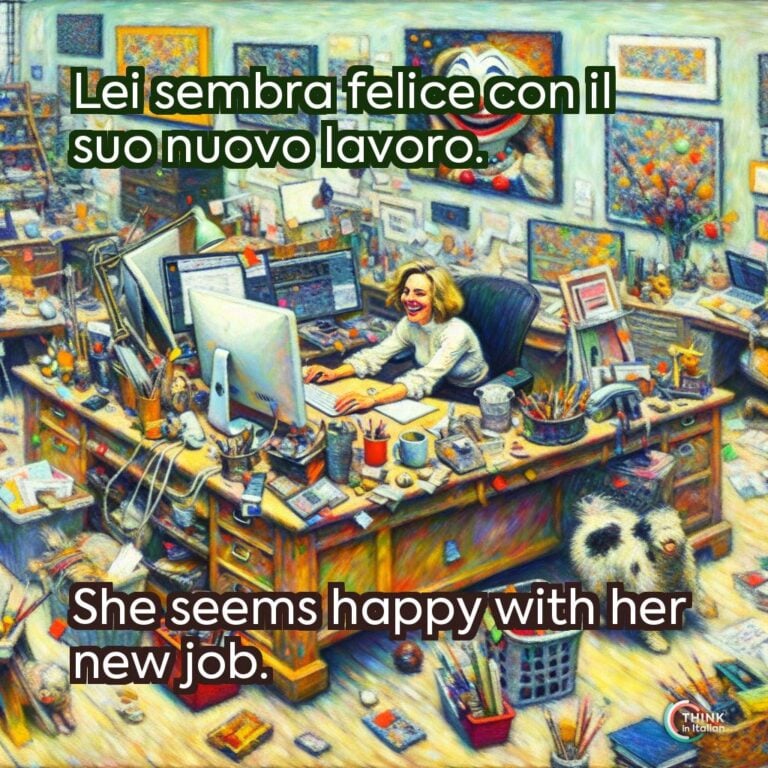
Lei sembra felice con il suo nuovo lavoro.
🔊
Stanno tutti bene, mi sembra.
Learn on the go
Install the FREE Think In Italian app for faster loading, offline mode, and quick access anytime.
No registration needed. Works on all devices. Ready in 1 click and 3 seconds.

Audio lesson with 30 sentences to listen and repeat

Italian grammar video lesson

Main Article

“Sembrare” in Italian

Meaning

Sembrare is translated in English as “to seem”. In both languages, it is usually followed by an adjective to give a personal opinion about something or someone.

Let’s have a look at some examples:

Sembri stanca. Stai bene?

You seem tired. Are you ok?

Loro sembrano simpatici.

They seem nice.

Tua mamma sembrava arrabbiata.

Your mum seemed angry.

Conjugation

Sembrare is a regular first-conjugation verb. This means that its conjugation is pretty simple, and is similar to that of other first-conjugation verbs like parlare (to speak), cantare (to sing), or mangiare (to eat).

Let me show you its present tense conjugation:

  • Io sembro (I seem)
  • Tusembri (You seem)
  • Lui/lei sembra (He/She seems)
  • Noi sembriamo (We seem)
  • Voi sembrate (You seem)
  • Lorosembrano (They seem)

Since it follows a regular pattern, I am confident you’ll find it easy to conjugate its other verb tenses as well. Give it a try, and let me know how it went!

The only tricky thing you have to keep in mind when conjugating is that it is an intransitive verb. This means that it might require an indirect object in order for its meaning to be fulfilled.

Let me remind you what Italian indirect objects look like:

  • mi: (to) me
  • ti: (to) you
  • gli/le: (to) him/ her
  • ci: (to) us
  • vi: (to) you
  • gli: (to) them

Of course, the subject of the sentence is the item, person, object that seems somehow to someone. In this sense, its conjugation is very similar to that of piacere, servire, and mancare.

Ci sembra inutile parlare con il professore.

It seems useless for us to talk to the teacher.

Stasera mi sembravate arrabbiate.

You looked angry tonight.

It is important that you remember that you remember the placement of Italian pronouns!

Let me show you two very similar sentences, but with a slight difference:

Lei sembra tanto carina.

She seems very nice.

Lei mi sembratanto carina.

She seems very nice to me.

Of course, if you want to specify that a person seems somehow, you do not need an indirect object pronoun, but you can use the name of that person. In this case, the indirect object is introduced by the preposition a.

For example:

A Marco e Loredana questa borsa sembra rotta.

This bag seems broken to Marco and Loredana.

A Luca questi dolci sembrano buoni.

To Luca, these sweets seem good.

Key Terms and Concepts

Sembrare

A regular first-conjugation Italian verb meaning 'to seem.' It often follows a regular conjugation pattern and is used with adjectives to express opinions.

First-conjugation verbs

Italian verbs ending in -are, following a regular conjugation pattern, including verbs like parlare (to speak) and mangiare (to eat).

Intransitive verb

A verb that does not take a direct object. In Italian, it may require an indirect object to complete its meaning.

Indirect object pronouns

Italian pronouns that replace the indirect object in a sentence, like mi, ti, gli, le, ci, vi, gli.

Pronoun placement in Italian

The positioning of pronouns in relation to verbs, crucial for understanding sentence structure. Pronouns often come before conjugated verbs.

Test your knowledge in 10 quick questions

Words

sembrareto seem
opinioneopinion
aggettivoadjective
congiugazioneconjugation
intransitivointransitive
pronomipronouns
strutturastructure
preposizionepreposition
oggettoobject
personaperson

Phrases

SembrareTo seem
Mi sembraIt seems to me
Ti sembraIt seems to you
Gli sembraIt seems to him
Le sembraIt seems to her
Ci sembraIt seems to us
Vi sembraIt seems to you (plural)
A loro sembraIt seems to them
AggettivoAdjective
ConiugazioneConjugation

Sentences

Mi sembra che oggi farà bel tempo.

It seems to me that the weather will be nice today.

Ti sembrano stanchi dopo il lungo viaggio.

They seem tired to you after the long journey.

Gli sembra un'ottima idea partecipare al concorso.

It seems like a great idea to him to participate in the contest.

Ci sembra che il film sia troppo lungo.

It seems to us that the movie is too long.

Vi sembra che il ristorante sia chiuso oggi?

Does it seem to you that the restaurant is closed today?

Match the Phrases

Memory game

Flip the cards to find matching pairs!

Crossword

Across
Down
Answers

FAQs

What does "sembrare" mean in Italian?

The word "sembrare" is an Italian verb that is commonly used in the third person to convey the meaning of to seem.

How to use "mi sembra"?

For specifying who something seems nice too, an indirect object pronoun is needed.

think in italian reddit

The comments section has moved to the Think In Italian Reddit community. Join today!

Italian word of the day
testo
In che lingua tradurranno il testo?
What language are they translating the text to?

What's new

stefano lodola italian teacher (1)
30 Free Courses to Get You Started ($40 Value)
italian audio lesson preview
italian audio reading preview
italian ai tutor preview
"I've tried other apps like Babbel and Memrise. None made me fluent or made me feel like I was making much meaningful progress in learning a language."
testimonial 2
Ecem Topcu
Aug 7, 2025