How to use “ormai”: Italian grammar lesson

An interactive lesson guiding you from key takeaways to expert insights. Comes with Q&A, useful vocabulary, interactive audio, quizzes and games.

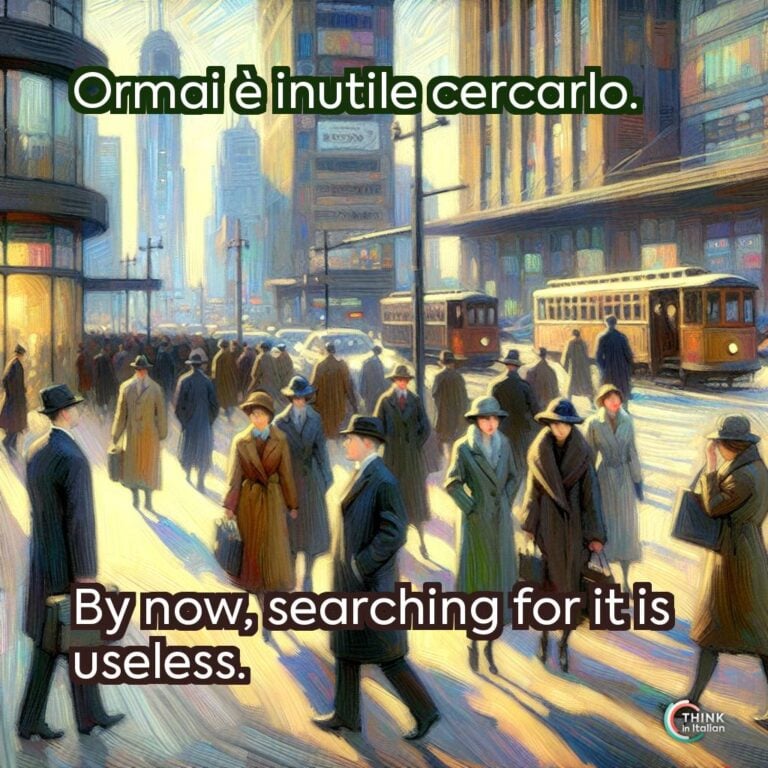
Ormai è inutile cercarlo.
Published Aug 7, 2021
Updated Sep 8, 2025
Written by
Italian language tutor, course author. MEng, MBA. Member of the International Association of Hyperpolyglots (HYPIA). After learning 12 languages, I can tell you that we all master languages by listening and mimicking. I couldn’t find an app to recommend to my students, so I made my own one. With my method, you’ll be speaking Italian from Lesson 1.
Reviewed by
A linguist specializing in psycholinguistics and Italian language education. I hold a Research Master’s in Linguistics and teach Italian, passionately connecting research with practical teaching.

Key Takeaways

  • Ormai translates to by now and can indicate a sense of time passed or current relevance.
  • Use ormai to mean at this point or currently, highlighting a shift from past to present.
  • It emphasizes the passing of time, often translated as already, to indicate how long something has been the case.
  • When expressing that it is too late, ormai carries a negative connotation compared to già.
  • In contexts where time is crucial, ormai suggests that actions may no longer be possible or relevant.

Audio images

🔊
Ormai è inutile cercarlo.
🔊
Ormai ha deciso di cambiare lavoro.
🔊
Ormai ho finito tutti i compiti.

Audio lesson with 30 sentences to listen and repeat

Italian grammar video lesson

Main Article

What is ormai in Italian?

Ormai is an adverb of time, and it can generally be translated into English by now. However, it can take on different shades of meaning depending on the context.

Let’s see how!

Sono sicura che ormai è andato via, gli parlerò domani.

I am sure he’s gone by now; I will talk to him tomorrow.

How to use ormai as at this point?

Ormai can be used with the meaning of at this point or currently as opposed to a past time. This is a very similar meaning to now.

Have a look at the examples below:

Ormai questo programma non lo guarda più nessuno.

Currently, no one watches this show anymore.

Ormai dovresti sapere cosa fare.

You should know what to do at this point (by now).

How to use ormai to emphasize the passing of time?

Sometimes, we use ormai to emphasize the passing of time. In this case, we could translate it as already.

Sono ormai due settimane che non ci vediamo.

It’s been already two weeks since we last met.

Ormai sono due anni che mi sono trasferita.

It’s been already two years since I moved.

Ormai can be translated as already in other contexts, too. Have a look at the following examples:

Ormai è grande, non trattarlo come un  bambino.

He’s already a grown-up, does not treat him like a child.

Lo sapevo che si sarebbe arrabbiato, ormai lo conosco.

I knew he would get angry; I already knew him. (I know him by now).

How to use ormai to say it is too late?

Even if it can be translated in many different ways, one of the main functions of ormai is to state that it is too late for something.

Using ormai rather than già (already) or a questo punto (at this point) often adds a negative connotation of being too late.

Read these examples and find the difference:

Sono già le dieci, arriveremo in ritardo.

It’s already 10 o’clock, we’ll be late.

Ormai sono le dieci, è troppo tardi.

It’s already ten o’clock; it’s too late.

In the first example, già implies that it is getting late, but we’re still in time, while in the other sentence, ormai implies that it is actually too late to do what we had to do.

Key Terms and Concepts

Words

ormaiby now
giàalready
adessonow
tempotime
cambiamentochange
finalitàfinality
tardilate
situazionesituation
negativonegative
puntopoint

Phrases

ormaiby now/already
giàalready
a questo puntoat this point
finalitàfinality
cambiamentochange
passatopast
negativonegative
connotazioneconnotation
troppo tarditoo late
situazionesituation

Sentences

Ormai è troppo tardi per iscriversi al corso.

By now, it's too late to enroll in the course.

Ho cercato di convincerlo, ma ormai ha già deciso.

I tried to convince him, but he's already decided.

Ormai siamo arrivati, non ha senso tornare indietro adesso.

We're already here, there's no point in turning back now.

Ormai non ci importa più del risultato, ci siamo divertiti comunque.

By now, we no longer care about the result, we had fun anyway.

Ormai è diventato un esperto nel suo lavoro.

By now, he has become an expert in his job.

FAQs

What is "ormai" in Italian?

Is an adverb of time that can be translated in English as by now.

Are other translations possible?

Yes! "Ormai" can also mean at this point and currently and as a already to emphasize the passing of time.

Does "ormai" have a main function?

Yes! "Ormai" states that it is too late for something and adds a negative connotation for being too late.

think in italian reddit

The comments section has moved to the Think In Italian Reddit community. Join today!

Italian word of the day
diverse
Al mercato si trovano cose diverse a seconda della stagione.
At the market, you will find different things depending on the season.

What's new

Social signup
"I've tried other apps like Babbel and Memrise. None made me fluent or made me feel like I was making much meaningful progress in learning a language."
testimonial 2
Ecem Topcu
Aug 7, 2025
Social login (faster)