Why Old Italian Songs Are Great for Learning
Not only is learning Italian through music an enjoyable experience, but it is also a powerful tool for language acquisition.
Classic Italian songs provide a perfect combination of rich vocabulary, cultural insight, and pronunciation practice all at once.
While pop songs use fast-beat rhythm or slang, classic songs make use of simple yet poetic language. This is really important for beginners, who can focus on pronunciation and vocabulary without getting overwhelmed with complicated phrases or idiomatic expressions.
Whether you are a beginner or advanced, immersing yourself into the melodies and lyrics of these timeless pieces can make your learning journey feel like a serenade.
Let me share with you some of my favorites Italian songs for beginners and advanced and how to make practical use of them.
Top old Italian Songs to Start With
“Nel Blu Dipinto di Blu” (Domenico Modugno)
Known globally as “Volare“, this song became a symbol of Italian culture worldwide. The song’s poetic imagery makes it an excellent resource for expanding your vocabulary and understanding Italian sentence structure.
The song introduces verbs like volare (to fly) and phrases such as nel blu dipinto di blu (in the blue, painted blue). These poetic expressions showcase the flexibility of Italian and how abstract ideas are beautifully conveyed in the language.
This song also captures the dreamy, imaginative aspect of Italian culture, making it not only a language lesson but also an introduction to Italy’s artistic soul.
“O Sole Mio” (Eduardo di Capua)
This Neapolitan classic is a love letter to sunny days, embodying the warmth and passion of southern Italy. Besides its universal appeal, the song is full of descriptive vocabulary and emotional expressions.
Italian adjectives like bella (beautiful) are essential in describing a person in Italian. The song also uses regional expressions, giving learners a taste of Italy’s rich linguistic diversity.
If you sing along, you will also improve your pronunciation skills. The emotive depth of the words mirrors the Italian approach to life, valuing the beauty and the natural world, a perspective which can enrich the cultural connection while learning.
“Funiculì, Funiculà” (Luigi Denza)
This catchy song was written in 1880 to advertise a new cable car in Naples, but it soon turned out to be an international symbol of Italian joie de vivre.
The cheerful melody and repetitive structure make it perfect for the practice of Italian verbs and imperatives, key elements of conversational Italian.
Its upbeat tempo also encourages learners to improve their pronunciation and fluency in a fun and engaging way. Moreover, it is full of regional flair, which is one way to learn about Italian dialects.
How to use Lyrics to Learn Italian
Break Down the Song
The best way to learn from a song is to take it line by line. For instance, take “Volare“:
Penso che un sogno così non ritorni mai più.
I think a dream like this will never come again.
- Penso: first-person singular, present tense of the verb pensare (to think).
- Che: relative pronoun, introduces a subordinate clause (that).
- Un: indefinite article, masculine singular (a).
- Sogno: masculine singular noun (dream).
- Così: adverb (like this, so, in this way).
- Non: negation adverb (not).
- Ritorni: third-person singular, present subjunctive of the verb ritornare (to return).
- Mai: adverb (ever, never in a negative context).
- Più: adverb (more, no more in a negative context).

Breaking down the lyrics allows you to focus on specific grammar points and understand how words come together in context.
Sing Along
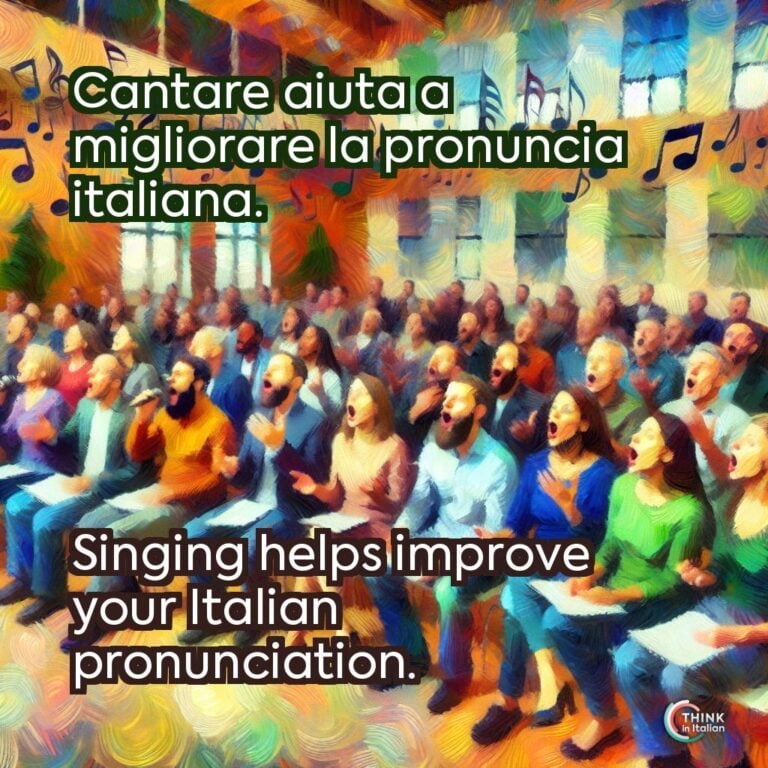
Singing isn’t just fun, it’s a powerful tool for improving your pronunciation and intonation. Italian vowels are consistent, making it easier to mimic the sounds accurately.
By repeating the lyrics, you’ll gain a natural feel for how words flow in Italian. This approach also boosts your confidence in speaking and helps you internalize vocabulary without rote memorization.
Look Up Cultural Context

Every song has a story. For example “Nel Blu Dipinto di Blu“ reflects post-war Italy’s desire for optimism and imagination, while “O Sole Mio“ captures the essence of southern Italy’s sunny landscapes and romantic outlook.
Understanding the cultural and historical context of these songs not only enhances your appreciation but also makes the language more relatable and memorable.
Start Singing now
Learning Italian doesn’t have to feel like a chore. Classic Italian songs combine language practice with cultural immersion, making them an enjoyable and effective tool for learners of all levels.
Music is an excellent tool for learning a language because it combines repetition and melody, making vocabulary and phrases easier to remember.
By singing along to these timeless melodies, you’ll improve your vocabulary, grammar, and pronunciation while connecting with Italy’s rich musical heritage.