
Ci Vuole: Italian Grammar Lesson

An interactive lesson guiding you from key takeaways to expert insights. Comes with Q&A, useful vocabulary, interactive audio, quizzes and games.

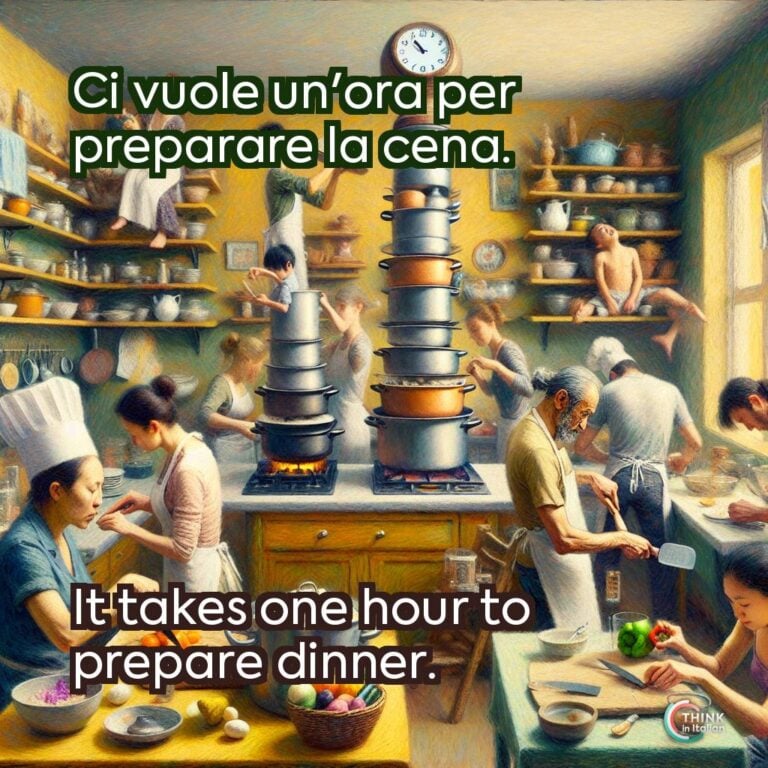
Ci vuole un'ora per preparare la cena.
Published Apr 30, 2020
Updated Mar 22, 2026
Written by
Italian language tutor, course author. MEng, MBA. Member of the International Association of Hyperpolyglots (HYPIA). After learning 12 languages, I can tell you that we all master languages by listening and mimicking. I couldn’t find an app to recommend to my students, so I made my own one. With my method, you’ll be speaking Italian from Lesson 1.
Reviewed by
No data was found

Key Takeaways

  • The verb volerci indicates the amount of time required to complete an action, using ci as a locative pronoun.
  • Conjugation of volerci is limited to third person singular and plural: ci vuole and ci vogliono.
  • When expressing time, use the preposition per followed by a verb in infinitive tense to introduce the action.
  • Unlike volerci, metterci emphasizes how long it takes a specific person to complete an action.
  • Both verbs require the pronoun ci, which remains unchanged, but they serve different grammatical purposes in sentences.

Stefano's Insights

Play to see captions...
Ah, il verbo "volerci"! Non è solo un semplice "volere" con un ci, ma una vera e propria magia temporale. Quando parliamo di quanto tempo serve per fare qualcosa, "volerci" è il nostro asso nella manica. Ricordo quando insegnavo a un gruppo di studenti, e uno di loro mi chiese quanto ci volesse per imparare l'italiano. Ho risposto con un sorriso: "Ci vogliono anni di pratica, ma ci mettiamo il cuore!". E poi c'è "metterci", per quando vogliamo essere un po' più personali, come dire "ci metto una vita a capire la grammatica italiana!". Quindi, se vuoi sembrare un vero italiano, non dimenticare di usare "volerci" e "metterci" con saggezza. E ricordati, il "ci" non cambia mai, proprio come il mio amore per la pasta!
Ah, the verb "volerci"! It's not just a simple "volere" with a ci, but a true temporal magic. When we talk about how much time is needed to do something, "volerci" is our ace up the sleeve. I remember teaching a group of students, and one asked me how long it takes to learn Italian. I replied with a smile: "It takes years of practice, but we put our hearts into it!". And then there's "metterci", for when we want to be a bit more personal, like saying "it takes me a lifetime to understand Italian grammar!". So, if you want to sound like a true Italian, don't forget to use "volerci" and "metterci" wisely. And remember, the "ci" never changes, just like my love for pasta!

Quick facts

What does "ci vuole" literally mean in English?

"Ci vuole" translates to "it takes," not "to want," focusing on the time needed for an action.

When do you use "ci vogliono" instead of "ci vuole"?

Use "ci vogliono" for plural time periods like minutes, hours, or days.

How does "ci vuole" relate to travel time?

"Ci vuole" is used to describe the time needed to reach a destination, like "It takes 3 hours by train."

Can "ci vuole" refer to non-specific instances?

Yes, "ci vuole" generally describes typical time durations, not specific instances.

What is the infinitive form of "ci vuole" and "ci vogliono"?

The infinitive form is "volerci," used for discussing the time required for actions or travel.

What are some examples of singular time periods that use "ci vuole"?

Singular time periods include "un minuto" (one minute), "un’ora" (one hour), and "un giorno" (one day).

What is a real-world example of "ci vogliono" in a sentence?

"Per andare in centro in autobus ci vogliono 20 minuti," meaning it usually takes 20 minutes by bus.

Why might students find "ci vuole" and "ci vogliono" confusing?

Students often get confused because "volere" typically means "to want," but here it pertains to the time needed.

How do you ask about the time needed for an action in Italian?

You ask, "Quanto tempo ci vuole per [action]?" meaning "How long does it take to [action]?"

What are some plural time periods examples for "ci vogliono"?

Plural time periods include "20 minuti" (20 minutes), "tre ore" (three hours), and "cinque giorni" (five days).

Audio images

🔊
Ci vogliono due giorni per leggere il libro.
🔊
Il film dura due ore.
🔊
Ci vuole un'ora per preparare la cena.
Learn on the go
Install the FREE Think In Italian app for faster loading, offline mode, and quick access anytime.
No registration needed. Works on all devices. Ready in 1 click and 3 seconds.

Audio lesson with 30 sentences to listen and repeat

Italian grammar video lesson

Main Article

The Italian Verb “Volerci”

Meaning

The Italian verb volere literally means “to want”, but when used in combination with the locative pronoun ci, it takes on the meaning of taking a certain amount of time to do something. In fact, volerci is used to express how long it takes to complete an action, for example:
Ci vogliono due ore per arrivare. It takes two hours to get there. Quanto ci vuole per fare una torta? How long does it take to bake a cake?
As you can see, the verb can be either singular or plural, as it depends on the amount of time it is required to perform a certain action.

Conjugation

As with all pronominal verbs – those verbs that require a pronoun to be properly conjugated – the verb volerci must be divided: the pronoun on the one hand, and the standard conjugation of the verb volere on the other. However, as I mentioned before, there are only two forms you will need: third person singular and third person plural: Let me show you the present tense:
  • ci vuole
  • ci vogliono
Of course, make sure you know the rules of pronouns placement with verbs in Italian! Unlike reflexive verbs, where the reflexive pronoun changes depending on the subject, the pronoun ci never changes when used in this structure. The pronoun ci has several different meanings, but it is typically used as a locative pronoun, meaning it substitutes for nouns referring to places. To make the use of this structure easier, I always tell my students they should interpret it in the same way here as well. So, try to perceive it as standing for “in it”, “there”, resulting in a translation like:
Ci vuole un’ora per finire il lavoro. In this situation it takes one hour to finish the work.
Ci vogliono almeno 2 giorni per la spedizione. In this situation it takes at least 2 days for the shipping.
When using volerci to indicate the time it takes to perform an action, we generally use preposition per to introduce the action, and it is always followed by a verb in infinitive tense. Let me show you some more examples:
Quanto ci vuole per arrivare in ufficio? How long does it take to get to the office? Ci vogliono 30 minuti per preparare la cena. It takes 30 minutes to make dinner. Ci vuole un minuto a fare un acquisto online. It takes one minute to buy online.

“Volerci” vs “Metterci”

Metterci is another pronominal verb, also used to indicate how long it takes to complete an action. Both volerci and metterci and share the ci structure, meaning they necessarily require the pronoun ci to be conjugated and this pronoun never changes. However, there is an important difference between these two verbs. Here, I will explain this difference how I explain it to my students:
  • volerci is objective: it is used to emphasize the amount of time that is needed to complete an action. This is why it can be conjugated either in the third person singular or plural only.
  • metterci is subjective: it is used to emphasize how long it takes a specific person to complete an action. This is why it is conjugated according to the subject of the sentence, taking on a subjective meaning.
In this sense, we might say that metterci sounds more personal than volerci.
Ci vuole un’ora ad arrivare in centro. It takes one hour to get to the city center (to anyone, to people in general).
Ci metto un’ora ad arrivare in centro. It takes me one hour to get to the office (to me specifically).
I hope that these grammar notes help cure your Needfluenza!

Key Terms and Concepts

Volerci

A pronominal verb used to express the time required to complete an action. It emphasizes the amount of time objectively needed for anyone.

Metterci

Another pronominal verb indicating how long it takes a specific person to complete an action, thus emphasizing a subjective perspective.

Ci Pronoun

A locative pronoun used in pronominal verbs like volerci and metterci, referring to places or situations.

Third Person Singular and Plural Conjugations

Volerci is only conjugated in third person singular ci vuole or plural ci vogliono depending on the time required.

Objective vs Subjective Time Expression

Volerci is used for general time needed, while metterci specifies the time for a particular individual.

Usage of Per

The preposition per introduces the action following volerci, generally followed by verbs in the infinitive tense.

Test your knowledge in 10 quick questions

Words

tempotime
azioneaction
cithere/in it
volercito take (time)
mettercito take (time) - subjective
infinitivoinfinitive
preposizionepreposition
singolaresingular
pluraleplural
congiugareto conjugate

Phrases

ci vuoleit takes (singular)
ci voglionoit takes (plural)
volercito take (time)
mettercito take (time) - subjective
locativolocative
pronomepronoun
infinitivoinfinitive
preposizionepreposition
tempotime
azioneaction

Sentences

Ci vuole un'ora per preparare la cena.

It takes an hour to prepare dinner.

Ci vogliono due settimane per imparare questa canzone.

It takes two weeks to learn this song.

Ci vuole un minuto per rispondere alla tua domanda.

It takes a minute to answer your question.

Ci vogliono tre giorni per completare il progetto.

It takes three days to complete the project.

Ci vuole molto tempo per diventare esperti in italiano.

It takes a long time to become proficient in Italian.

Match the Phrases

Memory game

Flip the cards to find matching pairs!

Crossword

Across
Down
Answers

FAQs

How do you use ci vuole in Italian?

The present tense (ci vuole and ci vogliono) is used to describe how long it usually takes to get somewhere. This has a broad meaning and does not refer to any particular instance.

How do you use Volerci in Italian?

Volerci can be translated as "to be required," "to be needed," or "to be necessary." In English, we frequently use "it takes" or "you need" to express this idea in casual conversation.

think in italian reddit

The comments section has moved to the Think In Italian Reddit community. Join today!

Italian word of the day
consegnare
Non potremo consegnare in tempo.
We will not be able to deliver it in time.

What's new

stefano lodola italian teacher (1)
30 Free Courses to Get You Started ($40 Value)
italian audio lesson preview
italian audio reading preview
italian ai tutor preview
"I've tried other apps like Babbel and Memrise. None made me fluent or made me feel like I was making much meaningful progress in learning a language."
testimonial 2
Ecem Topcu
Aug 7, 2025