
How to use “Come se”: Italian Grammar Lesson

An interactive lesson guiding you from key takeaways to expert insights. Comes with Q&A, useful vocabulary, interactive audio, quizzes and games.

Parla come se fosse un esperto.
Published Jul 1, 2021
Updated Aug 7, 2025
Written by
Italian language tutor, course author. MEng, MBA. Member of the International Association of Hyperpolyglots (HYPIA). After learning 12 languages, I can tell you that we all master languages by listening and mimicking. I couldn’t find an app to recommend to my students, so I made my own one. With my method, you’ll be speaking Italian from Lesson 1.
Reviewed by
No data was found

Key Takeaways

  • Come se translates to "as if" and is used to describe imaginary or hypothetical situations.
  • It triggers the Italian subjunctive, specifically congiuntivo imperfetto for present hypotheticals and congiuntivo trapassato for past hypotheticals.
  • Use congiuntivo imperfetto to express ongoing situations, where the main and dependent clauses happen simultaneously.
  • Employ congiuntivo trapassato for unreal past situations, where the dependent clause occurs before the main clause.
  • Examples illustrate the structure: "Mi guarda come se sapesse..." shows present hypotheticals, while "Si comportava come se non ci fossimo mai visti..." indicates past hypotheticals.

Stefano's Insights

Play to see captions...
Ah, 'come se'! Un'espressione affascinante e un po' drammatica, no? In italiano, la usiamo per dipingere scenari immaginari o ipotetici, e richiede il congiuntivo, che è il nostro modo di dire 'sto sognando, ma non troppo'. Puoi usarlo con il congiuntivo imperfetto per situazioni presenti non vere, tipo 'mi guarda come se sapesse cosa sto pensando' - oh, la paranoia! Oppure con il congiuntivo trapassato per quelle belle situazioni passate che non sono mai successe, tipo 'si comportava come se non ci fossimo mai visti'. Ricordo quando un amico mi guardava 'come se' avessi rubato il suo gelato... e non era vero, giuro! Un trucco? Pensate al congiuntivo come al vostro alleato per navigare il mare delle ipotesi italiane.
Ah, 'come se'! A fascinating and somewhat dramatic expression, right? In Italian, we use it to paint imaginary or hypothetical scenarios, and it requires the subjunctive—our way of saying 'I'm dreaming, but not too much'. You can use it with the imperfect subjunctive for present unreal situations, like 'he looks at me as if he knew what I'm thinking'—oh, the paranoia! Or with the past perfect subjunctive for those lovely past situations that never happened, like 'he behaved as if we had never seen each other'. I remember when a friend looked at me 'as if' I had stolen his ice cream... and it wasn't true, I swear! A tip? Think of the subjunctive as your ally for navigating the sea of Italian hypotheses.

Quick facts

What does "come se" mean in Italian?

"Come se" translates to "as if" in English, used to express hypothetical or imaginary situations.

Why does "come se" trigger the subjunctive mood?

"Come se" triggers the subjunctive because it deals with hypothetical or non-real scenarios, requiring a mood that expresses doubt, possibility, or uncertainty.

What are the two subjunctive forms used after "come se"?

The congiuntivo imperfetto (imperfect subjunctive) and congiuntivo trapassato (past perfect subjunctive) are used after "come se."

When is the congiuntivo imperfetto used after "come se"?

The congiuntivo imperfetto is used for present or past events that occur simultaneously with the main clause.

Can you provide an example of "come se" with congiuntivo imperfetto?

"Mi guarda come se fosse arrabbiato con me" means "He looks at me as if he were angry at me."

When do you use the congiuntivo trapassato after "come se"?

The congiuntivo trapassato is used when the hypothetical event happened before the event in the main clause.

What's an example of "come se" followed by congiuntivo trapassato?

"È felice come se niente fosse successo" translates to "She’s happy as if nothing had happened."

How do you express a feeling of being undervalued using "come se"?

"Mi fai sempre sentire come se non facessi mai nulla di buono" means "You always make me feel as if I never did anything good."

What does "Mi parlava come se io non capissi" mean?

It translates to "She spoke to me as if I didn’t understand," illustrating the use of congiuntivo imperfetto for simultaneous past events.

How would you describe someone packing for a long trip using "come se"?

"Sta facendo le valigie come se andasse via per un anno" means "He’s packing as if he left for a year."

Audio images

🔊
Parla come se fosse un esperto di cucina.
🔊
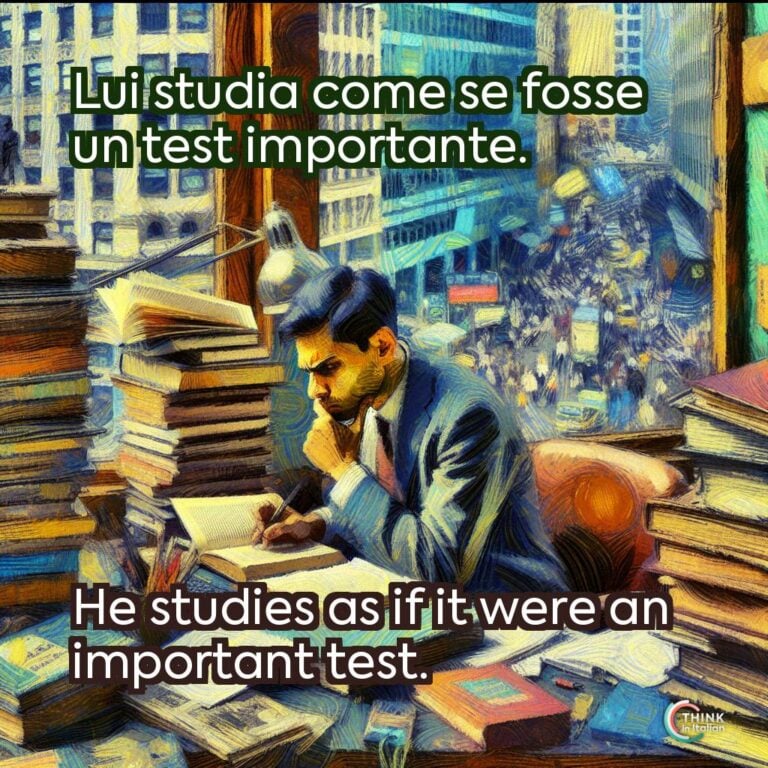
Lui studia come se fosse un test importante.
🔊
Parla come se fosse un esperto.

Audio lesson with 30 sentences to listen and repeat

Italian grammar video lesson

Main Article

“Come se” Mean in Italian

What Does “Come se” Mean in Italian?

As simple as it is, the Italian expression come se can be translated with “as if” in English. In both languages, we use this expression to talk about an imaginary situation or a situation that may not be true but that is likely or possible.

Mia nonna mi parla come se non mi conoscesse.

My grandmother talks to me as if she didn’t know me.

How to use “come se” in Italian?

The Italian come se is one of those expressions that trigger the Italian subjunctive because it expresses a hypothetical possibility.

Specifically, we can use either congiuntivo imperfetto (imperfect subjunctive) or congiuntivo trapassato(past perfect subjunctive). However, notice that the English counterpart is always the same.

Let me guide you through the use of this expression with these two verb tenses.

“Come se” With Subjunctive

“Come se” + Imperfect Subjunctive

We use the congiuntivo imperfetto to express a hypothetical situation in the present, to talk about an ongoing situation or a general state of being. It describes something that is not true but is imagined as if it were true.

Mi guarda come se sapesse cosa sto pensando.

He looks at me as if he knew what I am thinking.

Me l’ha ridato come se fosse mio.

He gave it back to me as if it were mine.

Mi parlava come se io non capissi.

She spoke to me as if I didn’t understand.

As you can see, the event in the main clause and the hypothetical event in the dependent clause happen simultaneously.

Have a look at the second sentence: the simultaneity refers to the fact that both the action of giving something back and the hypothetical condition of it being mine are occurring at the same time.

“Come se” + Past Perfect Subjunctive

We use the congiuntivo trapassato to express a hypothetical, unreal, or imagined situation in the past that did not happen.

Si comportava come se non ci fossimo mai visti.

He behaved as if we had never seen each other.

È felice come se niente fosse successo.

She’s happy as if nothing had happened.

Ci tratta come se noi avessimo rubato le sue cose.

He treats us as if we had stolen his things.

Here, the event of the dependent clause was supposed to be happening (or not happening, in this case) before the event in the main clause. Therefore, the events are ordered chronologically.

Have a look at the first sentence: the dependent clause non ci fossimo mai visti suggests a hypothetical scenario where you had never met the person. This event is imagined to have taken place before the behavior described in the main clause.

Key Terms and Concepts

Come se

An Italian expression equivalent to 'as if' in English, used to describe an imaginary or hypothetical situation.

Congiuntivo Imperfetto

A subjunctive tense used in Italian to express a hypothetical or imagined scenario in the present, often following come se.

Congiuntivo Trapassato

This past perfect subjunctive tense expresses a hypothetical or unreal situation in the past, typically involving events that did not actually occur.

Italian subjunctive mood

A verb mood used to express doubt, uncertainty, or hypothetical situations. It is often triggered by expressions like come se.

Simultaneity in subjunctive

Refers to the occurrence of the main and dependent clause events at the same time when using the congiuntivo imperfetto.

Test your knowledge in 10 quick questions

Words

ipoteticohypothetical
immaginarioimaginary
congiuntivosubjunctive
imperfettoimperfect
trapassatopluperfect
situazionesituation
clausolaclause
simultaneamentesimultaneously
cronologicochronological
eventoevent

Phrases

come seas if
congiuntivo imperfettoimperfect subjunctive
congiuntivo trapassatopluperfect subjunctive
ipoteticohypothetical
immaginarioimaginary
situazionesituation
presentepresent
passatopast
clausola principalemain clause
clausola dipendentedependent clause

Sentences

Parla come se fosse un esperto.

He speaks as if he were an expert.

Lei si comporta come se non mi conoscesse.

She behaves as if she doesn't know me.

Ha reagito come se avesse visto un fantasma.

He reacted as if he had seen a ghost.

Guarda la televisione come se non avesse niente di meglio da fare.

She watches TV as if she had nothing better to do.

Mi ha trattato come se fossi un bambino.

He treated me as if I were a child.

Match the Phrases

Memory game

Flip the cards to find matching pairs!

Crossword

Across
Down
Answers

FAQs

What does "come se" mean?

In English it can be translated as as if.

How to use "come se" in Italian?

For talking about an imaginary situation or a situation that may not be true but that is likely or possible. That is why it triggers the use of the subjunctive.

When to use "come se" + imperfect subjunctive?

When the event in the main clause and the hypothetical event in the other clause happen or happened around the same time.

When to use "come se" + past perfect subjunctive?

When a hypothetical event happened before the event in the main clause.

think in italian reddit

The comments section has moved to the Think In Italian Reddit community. Join today!

Italian word of the day
cancellato
Ho preso un appuntamento ma poi ho cancellato.
I made an appointment but then I cancelled.

What's new

stefano lodola italian teacher (1)
30 Free Courses to Get You Started ($40 Value)
italian audio lesson preview
italian audio reading preview
italian ai tutor preview
"I've tried other apps like Babbel and Memrise. None made me fluent or made me feel like I was making much meaningful progress in learning a language."
testimonial 2
Ecem Topcu
Aug 7, 2025