

Colloquial Italian
One of the most enjoyable aspects of traveling in Italy is picking up on the Italian slang. Each phrase offers a small window into the culture, humor, and unique quirks of Italian life.
The nice thing is that you don’t need to be fluent to use them. Just learning their contextual use will help you connect with locals and gain insights into Italian life.
You will soon notice that most of the expressions I chose and wrote here are those Italian words with no equivalent in English, which is the reason why you need to learn them in context.
Below, I will show you 18 Italian expressions together with practical tips on how to use them, to help you connect with locals and dive a little deeper into Italian culture.
I promise that knowing these few key expressions will open up entirely new experiences with the people you meet.
18 Italian Colloquial Words and Expressions
Aó / Oh
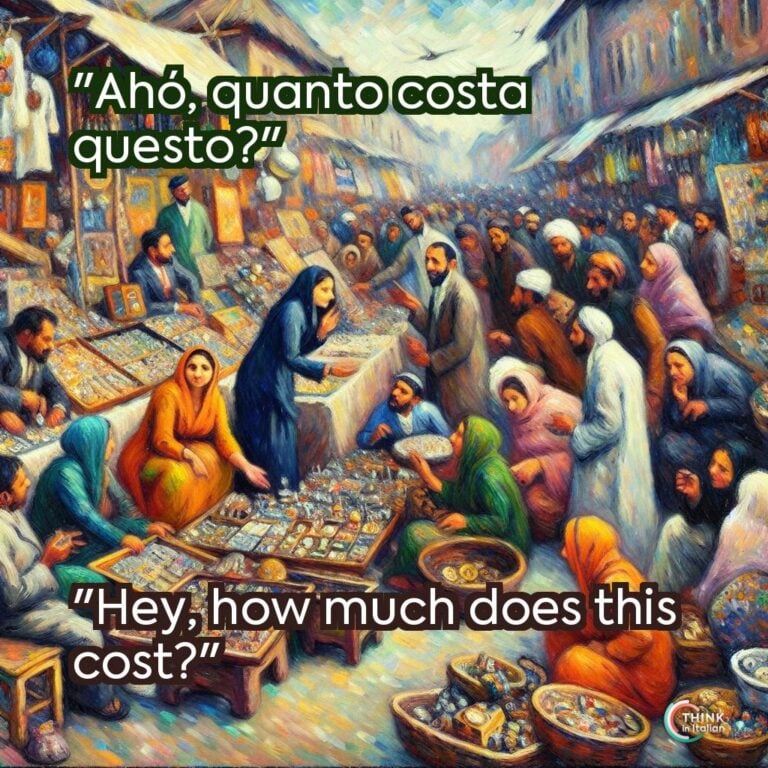
Aó – or oh depending on the region – is a popular, informal greeting in Italy, particularly in Rome. It’s used to get someone’s attention or as a casual “hey!” when seeing a friend.
Aó, Marco! Dove sei stato?
Hey, Marco! Where have you been?
- Do: use it with friends in informal, friendly settings or to show enthusiasm.
- Don’t: avoid it in professional contexts, as it’s a bit too casual.
Allora
Allora is a filler word, similar to “so” or “um”, often used to give the speaker a moment to think. It’s versatile and adds a natural Italian rhythm to conversations.
Allora, dove andiamo per cena?
So, where are we going for dinner?
- Do: use it to gather your thoughts or add flow to your sentences.
- Don’t: avoid overusing it, or it may come across as hesitancy.
Ammazza
Ammazza is a common exclamation, like saying “wow!” or “OMG!”. Italians use it to express amazement, surprise, or admiration, especially when they encounter something truly remarkable.
Ammazza che bella vista!
Wow, what a beautiful view!
- Do: use it to show surprise or admiration; it is great for impressive views or unexpected events.
- Don’t: avoid using it in serious conversations or you’ll end up sounding overly dramatic.
Avere il Ciclo
Avere il ciclo is a casual phrase used to say someone is on their period. It is a neutral way to touch the topic.
Non mi sento molto bene oggi, ho il ciclo.
I do not feel very well, I’m on my period.
- Do: use it in informal settings with close friends or family.
- Don’t: avoid using it in formal or professional conversations. Choose avere le mestruazioni, instead.
Avere un Chiodo Fisso in Testa
This phrase means “to have a nail fixed in one’s head” and refers to someone who is fixated on an idea or goal. It’s ideal for describing someone with intense focus or dedication.
Luca ha un chiodo fisso in testa: vuole diventare un artista famoso.
Luca has one thing on his mind: he wants to become a famous artist.
- Do: use it to describe someone passionate or dedicated.
- Don’t: avoid using it to be negative unless you’re joking, as it can imply stubbornness.
Bella
Bella literally means “beautiful“, but it is also commonly used as a greeting, especially among youths. It can be directed at both men and women and adds a warm, affectionate touch to any interaction.
Bella, come va?
Hey, how’s it going?
- Do: use it as a casual hello with friends or close acquaintances.
- Don’t: avoid using it with strangers or in formal situations.
Boh
Boh is a classic Italian word to express uncertainty or indifference, like saying “I don’t know”. It’s short, punchy, and useful in many situations.
Quando torni a casa?
When are you coming home?
Boh!
I don’t know!
- Do: use it to shrug off a question or to say you’re not sure.
- Don’t: avoid using it with serious questions, as it can sound dismissive.
Che Palle
Che palle literally translates to “what balls” but is used to express frustration, similar to saying “what a drag!” in English. It’s often used to show annoyance or impatience.
Che palle dover rifare tutto da capo!
What a drag to have to redo everything from scratch!
- Do: use it with friends to complain about something tedious or irritating.
- Don’t: avoid using it in professional settings; it can sound rude or unprofessional.
Culo e Camicia
Culo e camicia means “like butt and shirt”, and is an idiom for two people who are very close, like “two peas in a pod” in English. It’s a warm, affectionate way to describe close friendships.
Marco e Luca sono culo e camicia.
Marco and Luca are inseparable.
- Do: use it to describe people who are inseparable or share a strong bond.
- Don’t: avoid using it with people you’re not close with.
Dai
Dai is an Italian expression used to encourage someone, similar to saying “come on” in English. Italians use it for everything from motivating someone to hurrying them along.
Dai, vieni con noi!
Come on, join us!
- Do: use it to cheer someone on or express mild impatience.
- Don’t: avoid using it in formal context or overusing it, as it can sound bossy in excess.
Essere alla Frutta
Essere alla frutta literally means “to be at the fruit” and is used to say someone has reached their limit, as fruit is eaten at the end of the meal. It is common when someone is exhausted or out of ideas.
Dopo questa giornata, sono alla frutta.
After this day, I’m at my limit.
- Do: use it to express you’re at the end of your rope or mentally drained.
- Don’t: avoid using it too casually, as it implies you’ve truly hit your limit.
Essere tra le Nuvole
This phrase means “to be floating in the clouds” and describes someone who is daydreaming or distracted. It can be positive, implying creativity, or critical, implying they’re not paying attention.
Sei sempre tra le nuvole durante le lezioni.
You’re always daydreaming during class.
- Do: use it lightheartedly for someone who’s daydreaming or being imaginative.
- Don’t: use it harshly unless it’s a friendly joke as it can imply they’re inattentive.
Essere Fuori Come un Balcone
Essere fuori come un balcone translates to “to be out like a balcony” and describes someone who is “out of their mind” or acting wild. It’s a humorous way to refer to someone being eccentric or out of control.
Hai visto come si è comportato ieri? Fuori come un balcone!
Did you see how he acted yesterday? Out of his mind!
- Do: use it in friendly situations to joke about someone acting a bit crazy.
- Don’t: use it with strangers, as it might be taken as an insult.
Magari
Magari is a versatile Italian word that means “maybe”, “perhaps”, or “if only”, depending on the context. Italians use it to express a hope or a wish, and is a common word that captures both the uncertainty and the optimism of the Italian outlook on life.
Verrai in vacanza con noi quest’estate?
Will you come on vacation with us this summer?
Magari!
I wish!
- Do: use it to express hope or wishful thinking when you’re talking about something you’d like to happen but isn’t certain.
- Don’t: avoid using it to give a definite answer, as it implies possibility or hope, not certainty.
Meno Male
Meno male translates as “less bad” but is used to mean “thank goodness” or “luckily”. Italians use it to express relief or a sense that things could have gone worse.
Meno male che abbiamo trovato un parcheggio!
Thank goodness we found a parking spot!
- Do: use it when relieved by a positive outcome or small victory.
- Dont: avoid overusing it, as it’s best reserved for moments of true relief.
Pisolino
Pisolino is the Italian word for a nap, specifically an afternoon rest. In Italy, taking a short pisolino after a long lunch is a beloved tradition that embodies relaxation.
Dopo pranzo, mi faccio un pisolino.
After lunch, I’m going to take a nap.
- Do: embrace the pisolino as a way to recharge while in Italy.
- Don’t: do not confuse it with a long sleep. It is usually a short rest.
Una Cifra / Un Botto
Una cifra or un botto mean “a lot” or “a ton”. It is a very colloquial and informal way to describe something in large quantities or to say that something is expensive.
Questo telefono costa una cifra!
This phone costs a ton!
- Do: use it to describe something costly or in great quantity.
- Don’t: avoid using it in formal contexts.
A Fagiolo
A fagiolo literally means “up to the bean” and is used to indicate something that fits perfectly, like the English “on spot”. It’s often used when something is the ideal solution or match for a situation.
Questo lavoro è proprio a fagiolo per te.
This job is just right for you.
- Do: use it to express satisfaction with a solution or fit.
- Don’t: avoid using it as its literal meaning, as it has nothing to do with beans really.