


How to Respond to Invitations in Italian

An interactive lesson guiding you from key takeaways to expert insights. Comes with Q&A, useful vocabulary, interactive audio, quizzes and games.

Magari potessi venire alla festa.
Published Sep 12, 2024
Updated Sep 26, 2024
Reviewed by
Italian language tutor, course author. MEng, MBA. Member of the International Association of Hyperpolyglots (HYPIA). After learning 12 languages, I can tell you that we all master languages by listening and mimicking. I couldn’t find an app to recommend to my students, so I made my own one. With my method, you’ll be speaking Italian from Lesson 1.
Written by
No data was found

Key Takeaways

  • To confirm your attendance casually, use vengo for a straightforward response meaning "I'm coming".
  • For a more enthusiastic reply among friends, say ci sto, which translates to "I'm in".
  • For future events, use ci sarò to indicate your commitment, meaning "I will be there".
  • In formal situations, respond with accetto con piacere, meaning "I gladly accept", to express politeness.
  • For spontaneous invitations, perché no? ("why not?") conveys a playful and flexible attitude.
  • If you wish you could attend but can't, use magari, expressing desire with an implication of uncertainty.

Stefano's Insights

Play to see captions...
Rispondere a un invito in italiano non è solo dire "sì" o "no". Ci sono modi diversi che esprimono entusiasmo, formalità e impegno. "Vengo" è diretto e semplice, perfetto per confermare subito. "Ci sto" è più informale e coinvolgente, usato tra amici. Per eventi futuri o formali, "ci sarò" è l'ideale. "Accetto con piacere" è elegante e adatto alle occasioni ufficiali. "Perché no?" è spontaneo, mentre "magari" esprime desiderio con incertezza. Ricordo una volta in cui ho detto "magari" a un invito per un viaggio in Sicilia: un mix di voglia e impegni già presi! Esplorare queste espressioni arricchisce la tua capacità di comunicare in modo sfumato e autentico in italiano.
Responding to an invitation in Italian isn't just about saying "yes" or "no". There are different ways that express enthusiasm, formality, and commitment. "Vengo" is direct and simple, perfect for immediate confirmation. "Ci sto" is more informal and engaging, used among friends. For future or formal events, "ci sarò" is ideal. "Accetto con piacere" is elegant and suitable for official occasions. "Perché no?" is spontaneous, while "magari" expresses desire with uncertainty. I remember once saying "magari" to an invitation for a trip to Sicily: a mix of eagerness and prior commitments! Exploring these expressions enriches your ability to communicate in a nuanced and authentic way in Italian.

Quick facts

How can you directly confirm an invitation in Italian?

Use "vengo," meaning "I'm coming," for straightforward confirmation.

When might "ci sto" be an appropriate response?

"Ci sto," translating to "I'm in," suits casual, enthusiastic settings.

What's a formal way to confirm future attendance?

"Ci sarò," meaning "I will be there," is ideal for formal future commitments.

How do you politely accept a formal invitation?

"Accetto con piacere," or "I gladly accept," conveys politeness and gratitude.

What phrase conveys spontaneity in accepting an invitation?

"Perché no?" meaning "Why not?" matches spontaneous, casual invitations perfectly.

What phrase shows desire but uncertainty about attending?

"Magari," translating to "I wish," expresses enthusiasm with some uncertainty.

How does "ci sto" differ from "vengo" in tone?

"Ci sto" is more upbeat and shows involvement compared to the straightforward "vengo."

What should you avoid confusing with "ci sarò"?

Avoid confusing "ci sarò" with "ci starò"; the latter means "I will stay there."

How does "magari" function in conversational Italian?

"Magari" expresses strong desire with uncertainty, often used with the subjunctive mood.

In what context is "accetto con piacere" most appropriate?

"Accetto con piacere" is most appropriate for formal events like weddings or business dinners.

Audio images

🔊
Hai voglia di uscire stasera?
🔊
Accetto con piacere l'invito per la cena di lavoro.
🔊
Sei libero sabato? Possiamo fare un picnic.
🔊
Posso venire alla tua festa.
🔊
Andiamo a fare una passeggiata, vieni?
🔊
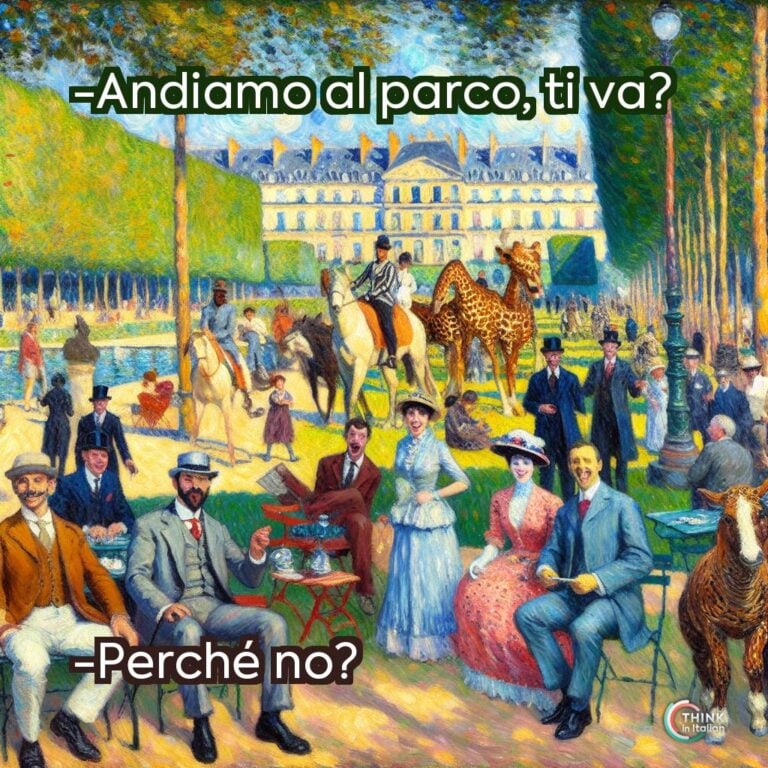
-Andiamo al parco, ti va?
🔊
-Vieni alla festa stasera?
🔊
-Vuoi venire al concerto con noi?
🔊
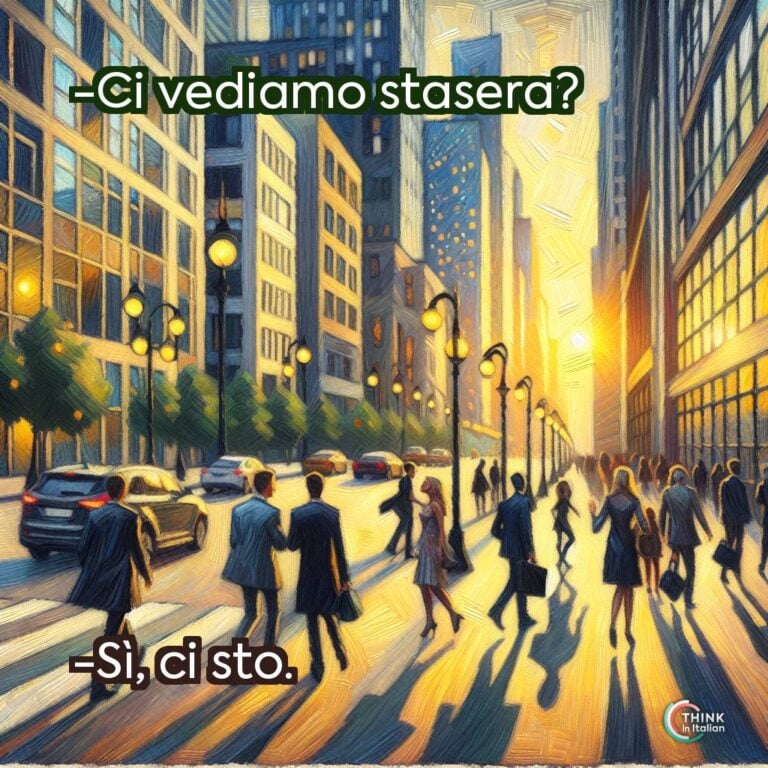
-Ci vediamo stasera?
🔊
Magari potessi venire alla festa.
Learn on the go
Install the FREE Think In Italian app for faster loading, offline mode, and quick access anytime.
No registration needed. Works on all devices. Ready in 1 click and 3 seconds.

Main Article

How to Respond to Invitations in Italian

Did you just move to Italy? Are you making new friends or perhaps you need advice on how to date someone in Italy? Mastering how to respond to invitations is part of the learning process.

If you already know how to say “yes” and how to say “no”, then it is time to discover more alternatives to convey different levels of enthusiasm, formality, and intent. Let me show you some common ways to accept an invitation in Italian, along with their contexts and alternatives.

Exploring Different Ways to Say “Yes”

“Vengo”: The Straightforward Confirmation

Vengo is the first person singular of the present tense of the verb venire (to come), therefore meaning “I’m coming”. I think it is the most direct way to respond to an invitation in Italian: a clear and simple declaration of your intent to present.

For instance, if someone invites you out and you want to confirm your presence without much embellishment, you can simply say okay, vengo.

-Domani io e i miei amici andiamo al cinema. Vieni?

-Tomorrow my friends and I are going to the cinema. Are you coming?

-Sì, vengo.

-Yes, I’m coming.

-Stiamo per andare via, tu che fai?

-We’re about to leave, what are you doing?

Vengo anche io.

I am coming, too.

“Ci Sto”: Casual and Upbeat

If you’re looking to add a bit more enthusiasm to your response, ci sto might be your best bet. It can literally be translated to “I’m in”, and it is the perfect phrase for informal settings to express both agreement and excitement.

I use ci sto quite frequently among friends when planning activities, because it gives me the feeling of expressing more than just agreeing: for me, it conveys a sense of involvement.

-Domani io e i miei amici andiamo a cena fuori. Vieni?

-Tomorrow my friends and I are going out for dinner. Are you coming?

-Sì, ci sto!

-Yes, I’m in!

Notice that, in this expression, the pronoun “ci” can be translated as “there”, meaning the place where you are going to be present. It usually refers to physical locations, but in this context, it conveys a more figurative sense of being present or involved in a situation.

Learn Italian on the go
Learn in the car with Think in Italian

When you say ci sto you are essentially saying, “I am there” not in a literal place, but “there” in terms of your willingness to participate.

“Ci Sarò”: A More Formal Future Commitment

While vengo and ci sto are perfect for immediate plans, there are times when you need to confirm your presence for a future event. This is where ci sarò comes into play.

Ci sarò is the future tense of the verb essere meaning “I will be there”. It is particularly useful for more formal events, like meetings, conferences, or official gatherings, where you need to confirm your future attendance.

It is important that you distinguish ci sarò from ci starò. The distinction between essere and stare is essential in Italian: ci starò means “I will stay there”, which isn’t the intended meaning when accepting an invitation.

“Accetto con Piacere”: The Polite Formal Response

For more formal invitations, such as a business dinner, a wedding, or any official event, you might opt for accetto con piacere, which translates to “I gladly accept”.

This is the most polite response you can choose, as it allows to also expresses gratitude while confirming your attendance.

“Perché No?”: A Spontaneous Yes

Sometimes, invitations are more spontaneous, and you want your response to match that vibe. In these cases, you could say perché no? which means “why not?”.

Free Guide
How to Learn Languages Fast

I use a lot this phrase, because it is playful, perfect for casual situations where the plan isn’t too serious. I feel like saying “yeah, let’s do it!”. It really underlines the flexibility of Italian people in informal contexts.

“Magari!”: When You Wish You Could

Magari is one of the hardest words to translate in English. It is one of those words that have no equivalent in English, which require you to just learn them in context.

Magari translates to “I wish!” or “if only!” and it expresses a strong desire to accept but also implies some uncertainty, implying you actually cannot accept the invitation or leaving room for future confirmation.

It’s a versatile expression that shows your enthusiasm but also your limitations. We often use magari + congiuntivo, to express possibility or uncertainty, similar to maybe or perhaps in English.

Key Terms and Concepts

Vengo

A straightforward way to confirm attendance, meaning 'I'm coming'. It's the first person singular present tense of venire (to come).

Ci Sto

An informal, enthusiastic way to accept an invitation, meaning 'I'm in'. It conveys a sense of involvement and readiness to participate.

Ci Sarò

A formal commitment to attend a future event, translating to 'I will be there'. Used for meetings, conferences, or official gatherings.

Accetto con Piacere

A polite and formal way to accept invitations, meaning 'I gladly accept'. Ideal for business dinners, weddings, or official events.

Perché No?

A spontaneous, playful acceptance of an invitation meaning 'why not?'. Used in casual situations to express willingness.

Magari

Expresses a strong desire to participate but also uncertainty, akin to 'I wish!' or 'if only!'. Often used with the subjunctive mood.

Test your knowledge in 10 quick questions

Words

invitoinvitation
accettareaccept
rifiutaredecline
partecipareparticipate
confermareconfirm
venirecome
presentepresent
entusiasmoenthusiasm
formaleformal
informaleinformal

Phrases

vengoI'm coming
ci stoI'm in
ci saròI will be there
accetto con piacereI gladly accept
perché no?why not?
magariI wish
accettareto accept
declinareto decline
invitoinvitation
partecipareto participate

Sentences

Vengo.

I'm coming.

Ci sto!

I'm in!

Ci sarò.

I will be there.

Accetto con piacere.

I gladly accept.

Perché no?

Why not?

Match the Phrases

Memory game

Flip the cards to find matching pairs!

Crossword

Across
Down
Answers
think in italian reddit

The comments section has moved to the Think In Italian Reddit community. Join today!

Italian word of the day
d’oliva
È finito l’olio d’oliva. Dovremo comprarne ancora.
We ran out of olive oil. We’ll have to buy some more.

What's new

stefano lodola italian teacher (1)
30 Free Courses to Get You Started ($40 Value)
italian audio lesson preview
italian audio reading preview
italian ai tutor preview
"I've tried other apps like Babbel and Memrise. None made me fluent or made me feel like I was making much meaningful progress in learning a language."
testimonial 2
Ecem Topcu
Aug 7, 2025