
“Compared to” in Italian: Grammar Lesson

An interactive lesson guiding you from key takeaways to expert insights. Comes with Q&A, useful vocabulary, interactive audio, quizzes and games.

In confronto a mia madre, mio padre guida più veloce.
Published Dec 25, 2020
Updated May 8, 2025
Written by
Italian language tutor, course author. MEng, MBA. Member of the International Association of Hyperpolyglots (HYPIA). After learning 12 languages, I can tell you that we all master languages by listening and mimicking. I couldn’t find an app to recommend to my students, so I made my own one. With my method, you’ll be speaking Italian from Lesson 1.
Reviewed by
No data was found

Key Takeaways

  • The comparative in Italian, or comparativo, is used to compare two entities based on a specific quality.
  • There are three types of comparatives: comparativo di maggioranza (majority), comparativo di minoranza (minority), and comparativo di uguaglianza (equality).
  • Use più/meno di for comparing different entities, and più/meno che for comparing qualities or actions of the same entity.
  • To say “compared to” in Italian, use the structure in confronto a followed by the items being compared.
  • When using in confronto a, ensure the preposition a agrees in gender and number with the noun it precedes.
  • For pronouns after in confronto a, use the extended forms of indirect object pronouns like a me or a te.

Stefano's Insights

Play to see captions...
Fare confronti in italiano è un'arte sottile e affascinante. Abbiamo il comparativo di maggioranza, minoranza e uguaglianza, ciascuno con il suo fascino. Usare "più/meno di" per confrontare entità diverse è come scegliere il vino giusto per una cena: fondamentale. "Più/meno che" invece è per confrontare qualità della stessa entità, come decidere se sei più bravo a cucinare o a mangiare (io sicuramente nel secondo!). E poi c'è "in confronto a", un'espressione che richiede attenzione con le preposizioni e i pronomi, un po' come fare la valigia perfetta per un viaggio. Ricorda, la precisione è la chiave per evitare malintesi, proprio come quando cerchi di spiegare a tua nonna perché il tuo nuovo taglio di capelli è alla moda.
Making comparisons in Italian is a subtle and fascinating art. We have the comparative of majority, minority, and equality, each with its charm. Using "più/meno di" to compare different entities is like choosing the right wine for a dinner: essential. "Più/meno che" is for comparing qualities of the same entity, like deciding if you're better at cooking or eating (I'm definitely better at the latter!). And then there's "in confronto a", an expression that requires attention with prepositions and pronouns, a bit like packing the perfect suitcase for a trip. Remember, precision is key to avoiding misunderstandings, just like when you try to explain to your grandma why your new haircut is trendy.

Quick facts

How do Italians express "to compare"?

Italians use "paragonare" or "confrontare" to mean "to compare," though "confrontare" is a false friend and doesn’t mean "to confront."

What phrase means "compared to" in Italian?

The phrase "in confronto a" is used to mean "compared to" in Italian, followed by the object of comparison.

Does "in confronto a" change based on gender and number?

Yes, "in confronto a" can change to "in confronto alle" or "in confronto agli" to match the gender and number of the noun.

Can "in confronto a" be used with indirect object pronouns?

Yes, "in confronto a" can be paired with pronouns like me, te, lui/lei, noi, voi, loro to compare people.

Does sentence order affect meaning when using "in confronto a"?

No, "in confronto a" can be placed at the beginning or end of a sentence without altering the meaning.

How is size comparison expressed using "in confronto a"?

To compare sizes, say "In confronto a [object], [subject] è più grande/piccolo," such as “In confronto all’Italia, la Germania è più grande.”

Can "in confronto a" be used for personal comparisons?

Yes, for instance, "In confronto a me, lei è più bassa" means "Compared to me, she's shorter."

How do you say "independent" in a comparative sentence in Italian?

Use "indipendente" as in "In confronto ad altri bambini, Luca è indipendente" meaning "Compared to other kids, Luca is independent."

How do Italians express a slight difference in strength by gender?

"I ragazzi sono leggermente più forti, in confronto alle ragazze" means "Boys are slightly stronger compared to girls."

What indicates significant change over time using "in confronto a"?

"Sei cambiata tantissimo, in confronto a prima" translates to "You've changed a lot compared to before," denoting noticeable change.

Audio images

🔊
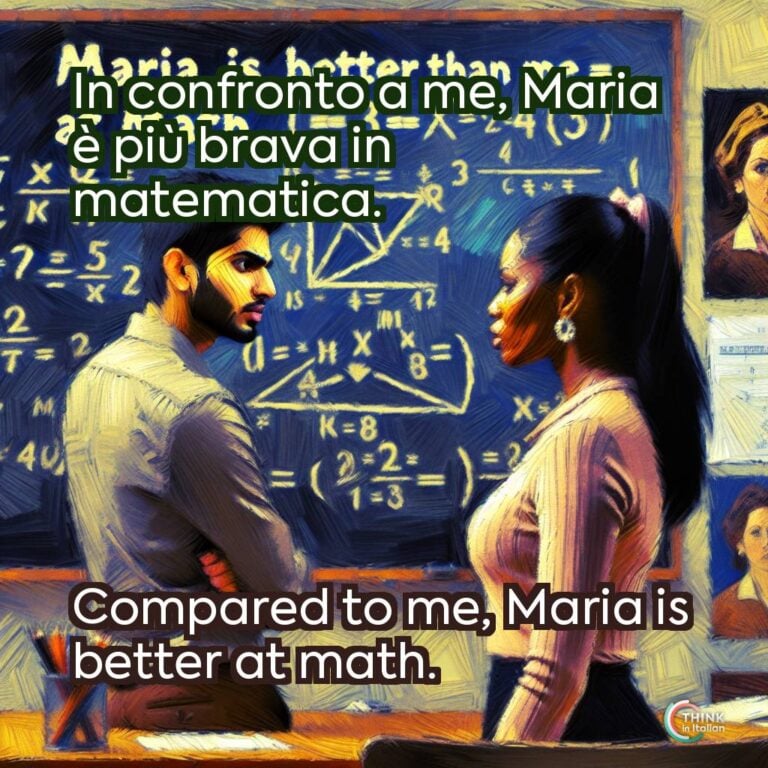
In confronto a me, Maria è più brava in matematica.
🔊
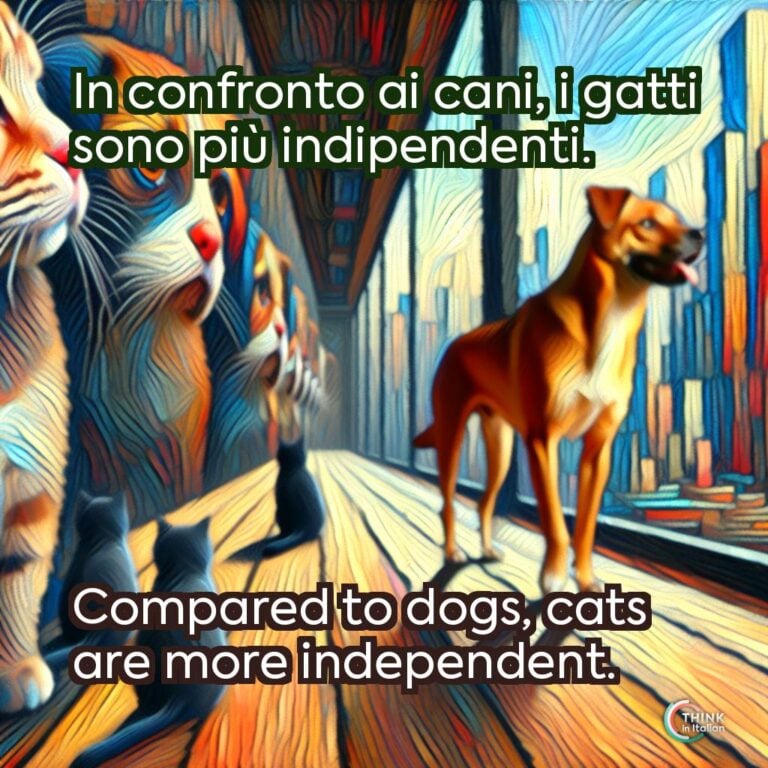
In confronto ai cani, i gatti sono più indipendenti.
🔊
In confronto a mia madre, mio padre guida più veloce.
Learn on the go
Install the FREE Think In Italian app for faster loading, offline mode, and quick access anytime.
No registration needed. Works on all devices. Ready in 1 click and 3 seconds.

Audio lesson with 30 sentences to listen and repeat

Italian grammar video lesson

Main Article

How to Make Comparisons in Italian

Comparisons in Italian

The comparative in Italian, called comparativo, is used to compare two things or people, indicating whether one has more, less, or the same degree of a certain quality as the other.

There are three main types of comparatives in Italian: comparativo di maggioranza (comparative of majority), comparativo di minoranza (comparative of minority), and comparativo di uguaglianza (comparative of equality).

Also, there are two different ways to create Italian comparatives:

  • The first way is using più/meno di: used to compare two different entities or make numerical comparisons, as in:

Marco è più alto di Paolo.

Marco is taller than Paolo.

  • The second way is using più/meno che: used to compare two qualities of the same entitytwo actions, or quantities related to the same entity, and it’s used before prepositions or infinitive verbs, as in:

Luca è più intelligente che bello.

Luca is more intelligent than handsome.

“To Compare” in Italian

The Italian translation of the English “to compare” is paragonare. We also have another verb, confrontare, but be careful because this is a false friend: it sounds like the English verb “to confront”, but its meaning is different.

Therefore, if you want to say “compared to”, you can use the structure in confronto a + the items/groups/people we are comparing something to.

Sei cambiata tantissimo, in confronto a prima.

You’ve changed a lot compared to before.

Let me explain it in more detail.

“In Confronto a”

There are two main things you must keep in mind when using the Italian expression in confronto a.

The first aspect is that the preposition a must be combined to the article it precedes, which, in turn, must agree in gender and number with the noun. So you can potentially see all the following combinations:

Preposition il lo la l’ i gli le
a al allo alla all’ ai agli alle

Here are some examples:

In confronto alla mia, cameria tua è enorme.

Compared tomine, your bedroom is huge.

I ragazzi sono in media più alti in confronto alle ragazze.

Boys are in average taller compared to girls.

The second important aspect is that, if you use a pronoun right after the preposition, that must be the extended form of the indirect object pronouns.

This means that you must use the following forms:

Subject Pronoun a + indirect object pronoun
io a me
tu a te
lui a lui
lei a lei
noi a noi
voi a voi
loro a loro

For example:

In confronto a me, lei è più bassa.

Compared to me, she’s shorter.

In confronto a te, lui non vale niente.

Compared to you, he’s not worth anything.

Key Terms and Concepts

Comparativo

The comparative form in Italian, used to compare two entities, indicating which has more, less, or the same degree of a quality.

Comparativo di maggioranza

This is the Italian comparative of majority, used to indicate that one entity possesses more of a quality than another.

Comparativo di minoranza

The Italian comparative of minority, used to show that one entity has less of a quality compared to another.

Comparativo di uguaglianza

The comparative of equality in Italian, used to indicate that two entities possess the same degree of a quality.

In confronto a

An expression used in Italian to mean "compared to," often combined with articles that agree in gender and number with the noun.

Paragonare and Confrontare

Italian verbs meaning "to compare." Confrontare is a false cognate, not meaning "to confront" as in English.

Italian Prepositions

In Italian, prepositions must agree in gender and number with the noun they precede. They can appear in forms like al, alla, etc.

Test your knowledge in 10 quick questions

Words

comparativocomparative
maggioranzamajority
minoranzaminority
uguaglianzaequality
piùmore
menoless
confrontocomparison
entitàentity
qualitàquality
quantitàquantity

Phrases

più dimore than
meno diless than
più chemore than (same entity)
meno cheless than (same entity)
in confronto acompared to
comparativo di maggioranzacomparative of majority
comparativo di minoranzacomparative of minority
comparativo di uguaglianzacomparative of equality
a meto me
a teto you

Sentences

Il libro è più interessante di quello che pensavo.

The book is more interesting than I thought.

Lei è meno stanca di ieri.

She is less tired than yesterday.

In confronto a lui, sono meno bravo nel giocare a calcio.

Compared to him, I am less skilled at playing soccer.

Questa città è più grande che bella.

This city is more large than beautiful.

In confronto a me, lui parla italiano molto meglio.

Compared to me, he speaks Italian much better.

Match the Phrases

Memory game

Flip the cards to find matching pairs!

Crossword

Across
Down
Answers

FAQs

What does "in confronto" a mean?

In Italian, the phrase “in confronto a” is used to express comparison between two or more items, people, or groups.

How to say "to compare" in Italian?

In Italian, the verbs "paragonare" and "confrontare" can be both used to express the concept of "comparing".

think in italian reddit

The comments section has moved to the Think In Italian Reddit community. Join today!

Italian word of the day
testo
In che lingua tradurranno il testo?
What language are they translating the text to?

What's new

stefano lodola italian teacher (1)
30 Free Courses to Get You Started ($40 Value)
italian audio lesson preview
italian audio reading preview
italian ai tutor preview
"I've tried other apps like Babbel and Memrise. None made me fluent or made me feel like I was making much meaningful progress in learning a language."
testimonial 2
Ecem Topcu
Aug 7, 2025