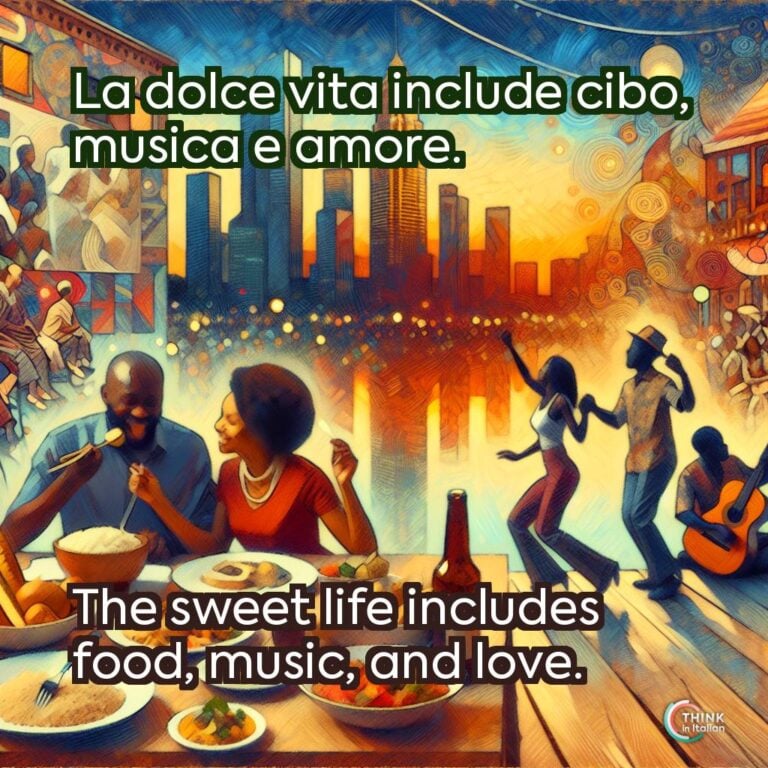
“La Dolce Vita”: Meaning
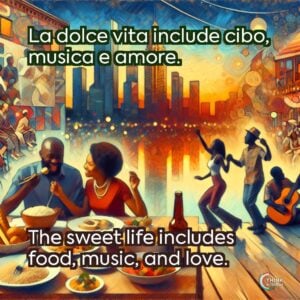
In Italian, la dolce vita literally means “the sweet life”, also commonly translated to “the good life”. This phrase captures Italy’s enduring philosophy of savoring beauty, pleasure, and the simple joys of life.
The Italian dolce vita reflects a unique Italian perspective: a life of balance, where both enjoyment and deeper meaning are pursued.
This expression is not only a musical combination of elegant Italian words: it has a deep cultural and historical meaning, and it shaped both how Italians live their life and how they are perceived from abroad.
Let me guide you through a detailed overview of this expression from different perspectives.
La dolce vita: translation and pronunciation
| Phrase | la dolce vita |
| Literal translation | “the sweet life” |
| Common English meaning | “the good life”: a life of pleasure, leisure and enjoyment |
| Word by word | la (the) + dolce (sweet) + vita (life) |
| Pronunciation | lah DOHL-cheh VEE-tah |
| Where it comes from | The title of Federico Fellini’s 1960 film |
The stress falls on the first syllable of dolce and on the first syllable of vita. In dolce, the c before e sounds like the “ch” in “chair”, so it is “DOHL-cheh”, not “DOHL-seh”. The final e is pronounced.
In Italian, dolce is an adjective and vita is a feminine noun, so the article is la. English speakers often drop it and say “dolce vita”, and English dictionaries list it that way, but in Italian you need the article: la dolce vita. For more on the adjective, see my guide to what dolce means in Italian.
La Dolce Vita
Origin
The term la dolce vita became a global phenomenon thanks to Federico Fellini‘s 1960 film, La Dolce Vita. This cinematic masterpiece captured the glamorous, indulgent, and often chaotic lives of socialites, journalists, and celebrities in Rome.
The film starred Marcello Mastroianni as Marcello Rubini and won the Palme d’Or at the 1960 Cannes Film Festival. Its scene with Anita Ekberg wading into the Trevi Fountain is one of the best-known images in cinema.
Through the lens of the film’s main character, the journalist Marcello Rubini, audiences around the world were introduced to the glitzy nightlife, romantic escapades, and existential musings of Rome’s elite.
I think this is one of the most beautiful and important films of the Italian cinematic panorama. It left an indelible mark on popular culture, and influenced fashion, art, and the way the world views Italian culture.
I find it very interesting because not only does it show a life of luxury and glamour, but it also explores the emptiness that can accompany a life of excess. This duality is what, for me, really adds depth to the concept, reminding us that la dolce vita is best enjoyed in balance.
Historical Context

In the late 1950s and early 1960s, Italy experienced an economic boom known as the miracolo economico (economic miracle), which lifted the country from the devastation due to the war to a new phase of prosperity.
During this period, Italy experienced a shift that drove it into a consumer-driven society and gave rise to huge social contrasts: wealth and optimism versus the scars of the war.
The release of Federico Fellini’s 1960 film captured these events, and explored both the glamour and the existential emptiness that arose from Italy’s rapid modernization.
The best social aspect of the film lies in the question of whether this “sweet life” was truly fulfilling or merely a glamorous facade. It served as a subtle critique of the rising consumerism in postwar Italy.
The character Paparazzo, a relentless photographer, symbolizes this intrusion of consumer culture into private life. His name gave rise to the term paparazzi, one of those Italian words used in English and many other languages.
Living “La Dolce Vita” Today
In modern Italy, la dolce vita is a lifestyle that continues to influence Italy’s daily life. Italians embrace it by finding joy in simple pleasures. For me, it really is about savoring the present and valuing quality over quantity.
Think of the café culture: Italians take pleasure in the ritual of coffee, sitting at cafés for extended periods, sipping espresso, and engaging in conversation.
But this Italian lifestyle is not limited to Italy: it has transcended Italy’s borders and became a phrase known worldwide to represent an enviable, fulfilling lifestyle.
For many, it’s a synonym of the dream of living in Italy, enjoying its landscapes, and adopting a slower, more enjoyable pace of life.
How to use “la dolce vita” in a sentence
In English, “la dolce vita” usually names a lifestyle. In Italian, you will more often hear it with the verb fare, as in fare la dolce vita (to live the sweet life). Depending on the tone, it can be admiring or slightly critical, because it suggests a life spent on pleasure rather than work.
Da quando è in pensione, fa la dolce vita.
Since he retired, he has been living the sweet life.
Quest’estate voglio fare la dolce vita in riva al lago.
This summer I want to live the sweet life by the lake.
In English, people use it more loosely: “They retired to the coast to live la dolce vita.”
Expressions close to “la dolce vita”
| Italian | Meaning |
| il dolce far niente | the sweetness of doing nothing: enjoying idle, relaxed time |
| la bella vita | the good life, often a comfortable life without worries |
| godersi la vita | to enjoy life |
| la vita è bella | life is beautiful (also the title of Roberto Benigni’s 1997 film) |

You can find more sayings about life in my list of Italian idioms.
La dolce vita: quick questions
What does “la dolce vita” mean in English?
It means “the sweet life” or “the good life”: a life of pleasure, beauty and ease.
Is “la dolce vita” only about luxury?
No. Fellini’s film shows a glamorous, excessive Rome, but today many Italians use the idea for small pleasures: a slow coffee, a long lunch, an evening walk. Both readings exist.
Is “dolce vita” without “la” correct?
It is common in English and in dictionaries, but in Italian the article is part of the phrase, so say la dolce vita.
Immerse Yourself in the Italian Dolce Vita
La dolce vita is more than a phrase, it’s a way of life that encourages you and us all to find beauty in the everyday, celebrate connections, and enjoy life’s pleasures.
Fellini’s film also serves as a reminder of the importance of balance: I know it might be tempting to seek a life filled with pleasure, but the pursuit of la dolce vita without depth can feel empty.
An exploration of La dolce vita in these deeper contexts highlights how Fellini’s film was a mirror of its time and a prophecy of ours. It is an invitation to redefine what a “sweet life” truly means.