
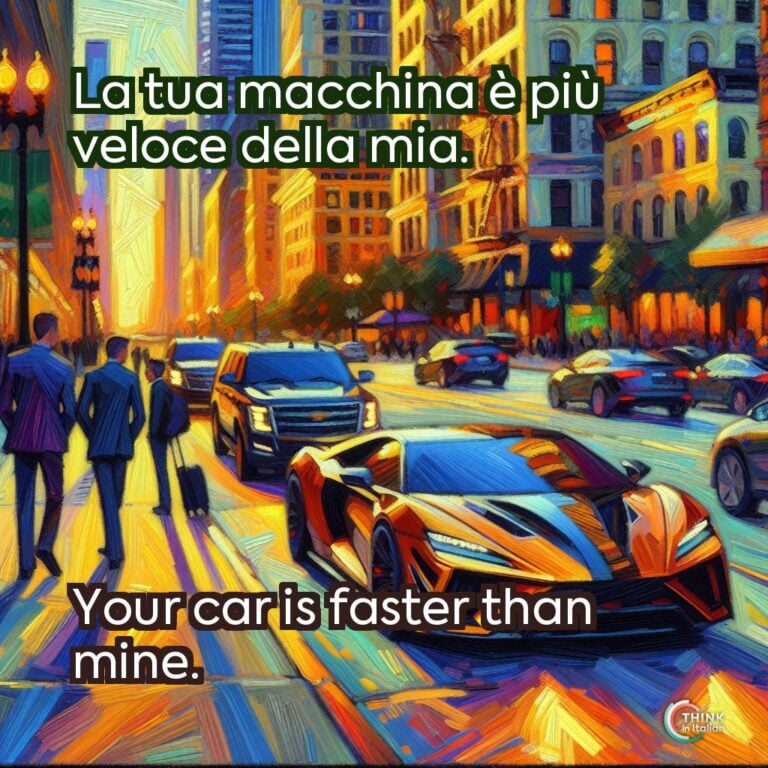
To make a comparison in Italian, use più (more) or meno (less) with an adjective, an adverb or a noun, and put di before the second item: Marco è più alto di Paolo (Marco is taller than Paolo). To say that two things are equal, use così… come or tanto… quanto: Marco è alto quanto Paolo (Marco is as tall as Paolo).
How to Make Comparisons in Italian
The comparative in Italian, called comparativo, is used to compare two things or people, indicating whether one has more, less, or the same degree of a certain quality as the other.
There are three main types of comparatives in Italian: comparativo di maggioranza (comparative of majority), comparativo di minoranza (comparative of minority), and comparativo di uguaglianza (comparative of equality).
Before we move into a detailed explanation, learn these words, as these are used to create Italian comparatives: più (more), meno (less), tanto quanto (as…as).
Now that you know them, let me give you a brief overview of two different ways to create Italian comparatives:
- The first way is using più/meno di: used to compare two different entities or make numerical comparisons, as in:
Marco è più alto di Paolo
Marco is taller than Paolo.
- The second way is using più/meno che: used to compare two qualities of the same entity, two actions, or quantities related to the same entity, and it’s used before prepositions or infinitive verbs, as in:
Luca è più intelligente che bello
Luca is more intelligent than handsome.
In this article, I will explain the first way of making comparisons.
Check the article about the second way to make comparisons in Italian!
Comparatives in Italian
When to use “più di” and “meno di”?
As mentioned before, we use più/meno di when we are comparing one characteristic of two different people, objects, or concepts. It can be used with adjectives, adverbs, and nouns, creating the following structure:
più/meno + adjective/adverb/noun + di + noun/pronoun
- Adjective
Giulio è meno ricco di te.
Giulio is less rich than you.
Adesso il tempo è più bello di prima.
Now the weather is better than before.
- Adverb
Marco corre più velocemente di Paolo.
Marco runs faster than Paolo.
- Noun
Ho più libri di Maria.
I have more books than Maria.
Be careful: when the second item of the comparison is preceded by a definite article, it joins the preposition di becoming preposizione articolata:
| il | lo | l’ | la | i | gli | le | |
|---|---|---|---|---|---|---|---|
| di | del | dello | dell’ | della | dei | degli | delle |
Mia madre è più giovane della signora Anna.
My mother is younger than Ms. Anna.
I miei occhiali sono più costosi dei tuoi.
My glasses are more expensive than yours.
Comparing With Pronouns and Numbers
After di, use the stressed pronouns me, te, lui, lei, noi, voi and loro. Do not use io or tu:
Sono più giovane di te.
I’m younger than you.
Lei è più brava di lui.
She is better at it than he is.
With numbers, “more than” and “less than” are also più di and meno di:
Ci sono più di cento persone.
There are more than a hundred people.
Ho meno di dieci euro.
I have less than ten euros.
Il film dura più di due ore.
The film lasts more than two hours.
How to use di “più” with Verbs?
When making comparisons involving a verb in Italian, and the term of comparison is not explicitly stated, di is added before più. This structure is commonly used to express “more” in relation to an action, and looks as follow:
Verb + di più
This construction is used to indicate that more of an action is desired, needed, or performed, without specifying what it is compared to.
Per saperne di più, clicca qui.
To learn more, click here.
Quel modello costa di più perché è nuovo.
That model costs more because it’s new.
Devi studiare di più per passare l’esame.
You need to study more to pass the exam.
Equality: “Così… Come” and “Tanto… Quanto”
To say that two things have the same degree of a quality, use così… come or tanto… quanto (the comparative of equality, comparativo di uguaglianza). The first word of each pair is often left out:
Marco è alto quanto Paolo.
Marco is as tall as Paolo.
Sara è simpatica come sua sorella.
Sara is as nice as her sister.
Oggi studio quanto te.
Today I study as much as you.
In negative sentences, both pairs work as well:
Non è così alto come Paolo.
He’s not as tall as Paolo.
For more on the many uses of tanto, see my lesson on the meaning of “tanto”.
Irregular Comparatives
Some adjectives and adverbs have their own comparative form:
| Basic word | Comparative |
| buono (good) | migliore (better), also più buono |
| cattivo (bad) | peggiore (worse), also più cattivo |
| grande (big) | maggiore (bigger, older), also più grande |
| piccolo (small) | minore (smaller, younger), also più piccolo |
| bene (well) | meglio (better) |
| male (badly) | peggio (worse) |
Questa pizza è migliore di quella di ieri.
This pizza is better than yesterday’s.
Parli italiano meglio di me.
You speak Italian better than me.
Mia sorella è minore di me.
My sister is younger than me.
Use the adjectives (migliore, peggiore) with nouns and after the verb essere, and the adverbs (meglio, peggio) with verbs.
“Di” or “Che”? A Quick Guide
| Use | When you compare | Example |
| di | two different people or things, or a number | Giulio è meno ricco di te. |
| che | two qualities, two verbs or two nouns of the same subject | È più facile parlare che scrivere. (It’s easier to speak than to write.) |
The second case has its own lesson, how to make comparisons II. If you want to say “compared to”, read my lesson on “compared to” in Italian. To say “the tallest” or “the least expensive”, continue with “the most” and “the least”.