
How to use Italian Modal Verbs

An interactive lesson guiding you from key takeaways to expert insights. Comes with Q&A, useful vocabulary, interactive audio, quizzes and games.

Posso venire alla tua festa domani.
Published Aug 26, 2024
Updated Nov 21, 2025
Reviewed by
Italian language tutor, course author. MEng, MBA. Member of the International Association of Hyperpolyglots (HYPIA). After learning 12 languages, I can tell you that we all master languages by listening and mimicking. I couldn’t find an app to recommend to my students, so I made my own one. With my method, you’ll be speaking Italian from Lesson 1.
Written by
No data was found

Key Takeaways

  • Modal verbs in Italian include potere (can), volere (want), dovere (must), and sapere (know how to).
  • These verbs must be followed by an infinitive verb, indicating the action being performed, such as posso cucinare (I can cook).
  • Conjugation varies across tenses, with distinct forms in presente, imperfetto, and passato prossimo, essential for accurate communication.
  • Combining modal verbs is possible, allowing for complex expressions, like devo saper sciare (I must know how to ski).
  • Understanding the nuances of each modal verb helps convey ability, desire, obligation, and knowledge effectively in conversation.

Stefano's Insights

Play to see captions...
Ah, i verbi modali italiani: potere, volere, dovere e sapere. Sono come i supereroi della grammatica, sempre pronti a salvare le nostre frasi. Questi verbi non possono mai stare da soli, devono sempre accompagnarsi a un altro verbo. Ricordo quando cercavo di spiegare a un mio studente americano che "posso" non significa che puoi fare qualsiasi cosa, ma solo che potresti, se il contesto lo permette. E poi c'è "sapere", che non è solo sapere qualcosa, ma anche saper fare qualcosa. Insomma, i verbi modali sono un po' come un buon caffè espresso: essenziali per iniziare bene la giornata linguistica, ma meglio se li conosci bene!
Ah, Italian modal verbs: potere, volere, dovere, and sapere. They're like the superheroes of grammar, always ready to save our sentences. These verbs can never stand alone; they must always accompany another verb. I remember trying to explain to an American student that "posso" doesn't mean you can do anything, but only that you could, if the context allows. And then there's "sapere," which isn't just knowing something but also knowing how to do something. In short, modal verbs are like a good espresso: essential to start your linguistic day right, but better if you know them well!

Quick facts

What are modal verbs in linguistics?

Modal verbs are auxiliary verbs that express abilities, possibilities, permissions, and obligations.

Can modal verbs stand alone in a sentence?

No, modal verbs must be linked to a main verb that conveys the action.

What is the Italian modal verb for expressing possibility?

The Italian verb "potere" translates to "can" or "to be allowed to."

How do you express desires using Italian modal verbs?

Use "volere," which means "to want," to express desires, like "Vorrei una pizza margherita" (I would like a pizza margherita).

Which Italian modal verb indicates obligation?

"Dovere" means "to have to" or "must," indicating necessity or obligation.

How is the verb "sapere" uniquely used among Italian modal verbs?

"Sapere" is used to express knowing how to do something, like a skill or ability.

Can Italian modal verbs be combined?

Yes, modal verbs can be combined, with one acting as an auxiliary verb and the other as the main verb.

How do you conjugate "potere" in the present tense?

"Potere" is conjugated as posso, puoi, può, possiamo, potete, possono in the present tense.

What is the past participle of "volere"?

The past participle of "volere" is "voluto," essential for forming compound tenses like passato prossimo.

How is the future tense of "sapere" conjugated?

In the future tense, "sapere" is conjugated as saprò, saprai, saprà, sapremo, saprete, sapranno.

Audio images

🔊
<em>Puoi venire a casa mia domani?</em>
🔊
Deve lavorare più duramente per ottenere buoni risultati.
🔊
Posso aiutarti con i compiti.
🔊
Dovrò finire il lavoro entro domani.
🔊
Andranno al concerto domani sera.
🔊
Devo finire i compiti prima di cena.
🔊
Comprerò i biglietti domani.
🔊
Possono venire alla festa stasera?
🔊
Devo andare a casa presto.
🔊
Devo lavorare fino a tardi stasera.
🔊
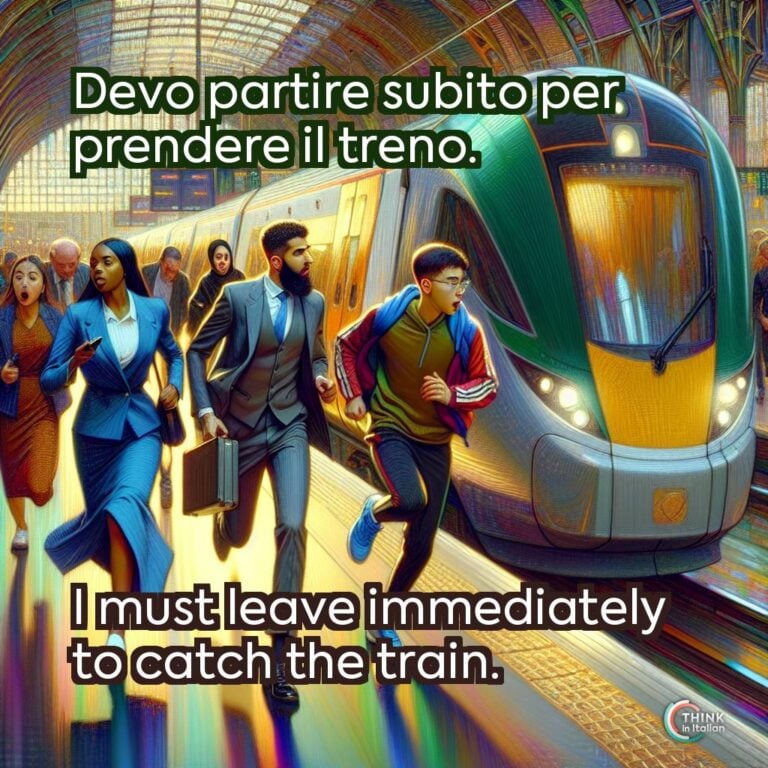
Devo partire subito per prendere il treno.
🔊
Vorrei leggere un buon libro questa sera.
🔊
<em>Possono venire alla festa domani?</em>
🔊
Posso venire alla tua festa domani.
Learn on the go
Install the FREE Think In Italian app for faster loading, offline mode, and quick access anytime.
No registration needed. Works on all devices. Ready in 1 click and 3 seconds.

Italian grammar video lesson

Main Article

What are Modal Verbs?

In linguistics, modal verbs are a special category of auxiliary verbs that are used to specify the way an action is performed. They express abilities, possibilities, permissions, obligations, and knowledge.

Unlike other verbs, modals cannot stand alone, but they must be linked to another verb – the main verb – that expresses the meaning of the action itself. In Italian, the main verb is always conjugated in the present infinitive.

Italian modal verbs are potere (can), volere (want), dovere (must), and sapere (know how to, be able to). Being able to use them and conjugating them in different tenses is essential for fluent communication.

There are multiple articles on this topic, because Italian modal verbs are irregular, therefore it is important that you properly learn how to conjugate them.

Italian Modal Verbs

“Potere” – the Verb of Possibility

Potere can be translated in English as “to can” or “to be allowed to”, depending on the context. For example, if you want to ask someone if you can borrow their book, you can say:

Posso prendere in prestito il tuo libro?

Can I borrow your book?

When discussing your capabilities or possibility, you might say:

Posso cucinare io se non ti va.

I can cook if you do not want to.

As you can see, potere is always followed by an infinitive verb.

“Volere” – Expressing What you Want

When it comes to expressing desires, you can use volere, meaning “to want”. If you’re in a restaurant and want to order pizza, you can say:

Vorrei una pizza margherita.

I would like a pizza margherita.

If you’re telling a friend about your weekend plans, you might say:

Volevo visitare il museo, ma era chiuso.

I wanted to visit the museum, but it was closed.

As you can see, I conjugated the verb in other tenses, to show you that modal verbs can be used with different purposes.

“Dovere” – the Verb of Obligation

Dovere means “to have to” or “to must”, and is therefore used to express necessity or obligation. If you have to study for an exam, you can say:

Devo studiare per l’esame.

I must study for the exam.

Or if you want to give advice or make recommendations, you can say:

Dovresti riposare.

You should rest.

“Sapere” – Knowing how to do Something

Sapere has a unique use and translation among Italian modal verbs because it’s about knowing how to do something, not just knowing facts. It’s used when you want to express that you have the knowledge or skill to do something.

For example, if you’re talking about a skill like playing the piano, you can say:

So suonare il pianoforte.

I know how to play the piano.

Or if you’re discussing whether someone knows how to cook a particular dish, you might say:

Sai cucinare la carbonara?

Do you know how to cook carbonara?

Combining Modal Verbs

Although modal verbs are auxiliary verbs, they can be combined. This results in both behaving as auxiliary verbs and another verb behaving as the main verb, as in the following examples:

Devo saper sciare bene per andare in vacanza.

I must know how to ski properly to go on holiday.

Voglio potere parlare bene l’italiano.

I want to be able to speak Italian well.

As you can see, there must be an infinitive verb after the modal verb, be it alone or combined.

Conjugating Modal Verbs

Presente

Potere Volere Dovere Sapere
Io posso voglio devo so
Tu puoi vuoi devi sai
Lui/Lei può vuole deve sa
Noi possiamo vogliamo dobbiamo sappiamo
Voi potete volete dovete sapete
Loro possono vogliono devono sanno

Let me give you some examples:

Posso ripetere se non hai capito.

I can repeat if you did not understand.

Voglio bere un caffè.

I want to drink a coffee.

Devi studiare per l’esame.

You must study for the exam.

Sanno cucinare molto bene.

They can cook very well.

Participio Passato

As you know, the past participle is essential to form compound verbs, like passato prossimo or futuro anteriore. Here, you can study the conjugation of the past participle of Italian modal verbs:

Potere Volere Dovere Sapere
(no subject) potuto voluto dovuto saputo

Imperfetto

Here, you can study the conjugation of the imperfect of Italian modal verbs:

Pronoun Potere Volere Dovere Sapere
Io potevo volevo dovevo sapevo
Tu potevi volevi dovevi sapevi
Lui/Lei poteva voleva doveva sapeva
Noi potevamo volevamo dovevamo sapevamo
Voi potevate volevate dovevate sapevate
Loro potevano volevano dovevano sapevano

For example:

Da bambino potevo mangiare senza ingrassare.

When I was a child I could eat without gaining weight.

Mio cugino voleva diventare un medico.

My cousin wanted to become a doctor.

Nel fine settimana dovevamo svegliarci presto ogni giorno.

In the weekend we had to wake up early every day.

Loro sapevano leggere già da piccoli.

They knew how to read already as children.

Passato Prossimo

Here, you can study the conjugation of the present perfect of Italian modal verbs:

Potere Volere Dovere Sapere
Io ho potuto ho voluto ho dovuto ho saputo
Tu hai potuto hai voluto hai dovuto hai saputo
Lui/Lei ha potuto ha voluto ha dovuto ha saputo
Noi abbiamo potuto abbiamo voluto abbiamo dovuto abbiamo saputo
Voi avete potuto avete voluto avete dovuto avete saputo
Loro hanno potuto hanno voluto hanno dovuto hanno saputo
See the example:

Non ho potuto richiamarti.

I was not able to call you back.

Hai voluto fare il dolce? Ora finiscilo!

Did you want to bake the cake? Now finish it!

Siamo dovuti partire presto stamattina.

We had to leave early this morning.

Lui ha saputo rispondere alle domande.

He could answer the questions.

Futuro Semplice

Potere Volere Dovere Sapere
Io potrò vorrò dovrò saprò
Tu potrai vorrai dovrai saprai
Lui/Lei potrà vorrà dovrà saprà
Noi potremo vorremo dovremo sapremo
Voi potrete vorrete dovrete saprete
Loro potranno vorranno dovranno sapranno
For instance:

Potrò visitare la Spagna l’anno prossimo.

I will be able to visit Spain next year.

Vorranno vivere in campagna un giorno.

They will want to live in the countryside someday.

Dovrai fare attenzione durante la presentazione.

You will have to pay attention during the presentation.

Sapremo riconoscere l’anello falso.

We will be able to spot the fake ring.

Key Terms and Concepts

Modal Verbs

Special auxiliary verbs used to express abilities, possibilities, permissions, obligations, and knowledge. In Italian, they include potere, volere, dovere, and sapere.

Potere

An Italian modal verb meaning 'can' or 'to be allowed to,' it conveys capability or possibility. It is used with the present infinitive.

Volere

This modal verb means 'to want' in Italian and is used to express desires or intentions, often used in various tenses.

Dovere

Meaning 'to have to' or 'must,' this verb expresses necessity or obligation. It can be used to give advice or make recommendations.

Sapere

A unique modal verb in Italian used to indicate knowing how to do something, reflecting knowledge or skill.

Present Infinitive

The base form of a verb used with Italian modal verbs to express the meaning of the action, for example, posso cucinare.

Combining Modal Verbs

In Italian, modal verbs can be combined to express complex actions, with both acting as auxiliaries and requiring an infinitive, e.g., devo saper sciare.

Test your knowledge in 10 quick questions

Words

poterecan
volerewant
doveremust
sapereknow how to
conjugareto conjugate
infinitoinfinitive
abilitàabilities
possibilitàpossibilities
permessipermissions
obblighiobligations

Phrases

poterecan
volerewant
doveremust
sapereknow how to
infinitivoinfinitive
abilitàabilities
possibilitàpossibilities
permessopermission
obbligoobligation
irregolareirregular

Sentences

Può venire alla festa domani?

Can he come to the party tomorrow?

Voglio imparare a suonare la chitarra.

I want to learn to play the guitar.

Dobbiamo partire presto per evitare il traffico.

We must leave early to avoid the traffic.

Sai nuotare bene?

Do you know how to swim well?

Non posso andare al cinema oggi perché devo lavorare.

I can't go to the cinema today because I have to work.

Match the Phrases

Memory game

Flip the cards to find matching pairs!

Crossword

Across
Down
Answers
think in italian reddit

The comments section has moved to the Think In Italian Reddit community. Join today!

Italian word of the day
consegnare
Non potremo consegnare in tempo.
We will not be able to deliver it in time.

What's new

stefano lodola italian teacher (1)
30 Free Courses to Get You Started ($40 Value)
italian audio lesson preview
italian audio reading preview
italian ai tutor preview
"I've tried other apps like Babbel and Memrise. None made me fluent or made me feel like I was making much meaningful progress in learning a language."
testimonial 2
Ecem Topcu
Aug 7, 2025