
How to use “Insomma”: Italian Grammar Lesson

An interactive lesson guiding you from key takeaways to expert insights. Comes with Q&A, useful vocabulary, interactive audio, quizzes and games.

Insomma, devi studiare più seriamente.
Published Jan 3, 2021
Updated May 12, 2025
Written by
Italian language tutor, course author. MEng, MBA. Member of the International Association of Hyperpolyglots (HYPIA). After learning 12 languages, I can tell you that we all master languages by listening and mimicking. I couldn’t find an app to recommend to my students, so I made my own one. With my method, you’ll be speaking Italian from Lesson 1.
Reviewed by
No data was found

Key Takeaways

  • Insomma is an Italian adverb used to summarize or conclude conversations, translating to "in short" or "all in all."
  • It can express impatience or urgency when asking questions, similar to "well" or "so."
  • When used as a response, insomma conveys a sense of being "not too bad" or "so-so."
  • In expressions of frustration, it means "for goodness' sake!" or "that's enough!" often used with ma (but).
  • Understanding the context of insomma enhances your conversational fluency in Italian.

Audio images

🔊
Insomma, devi studiare più seriamente.
🔊
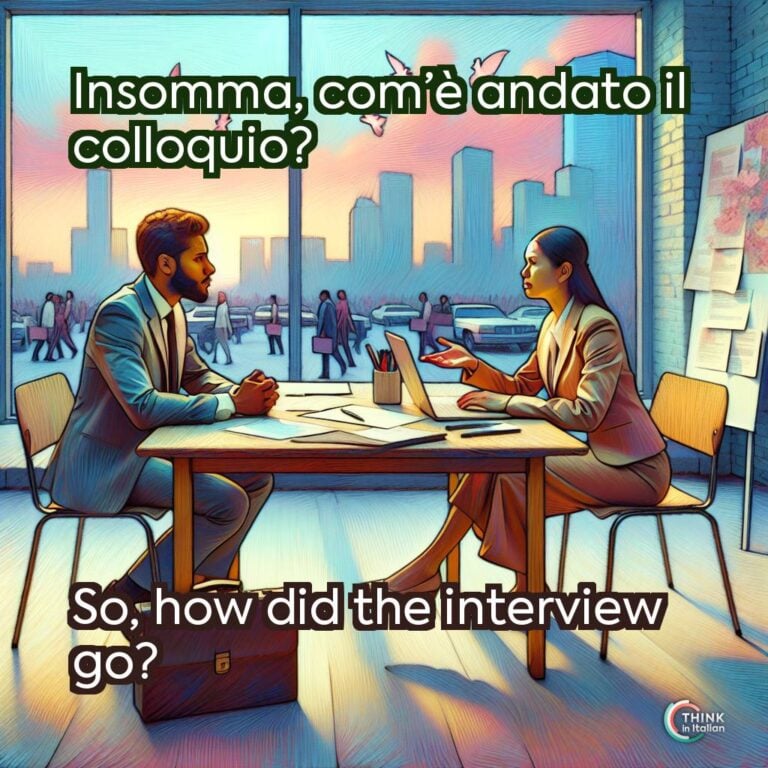
Insomma, com’è andato il colloquio?
🔊
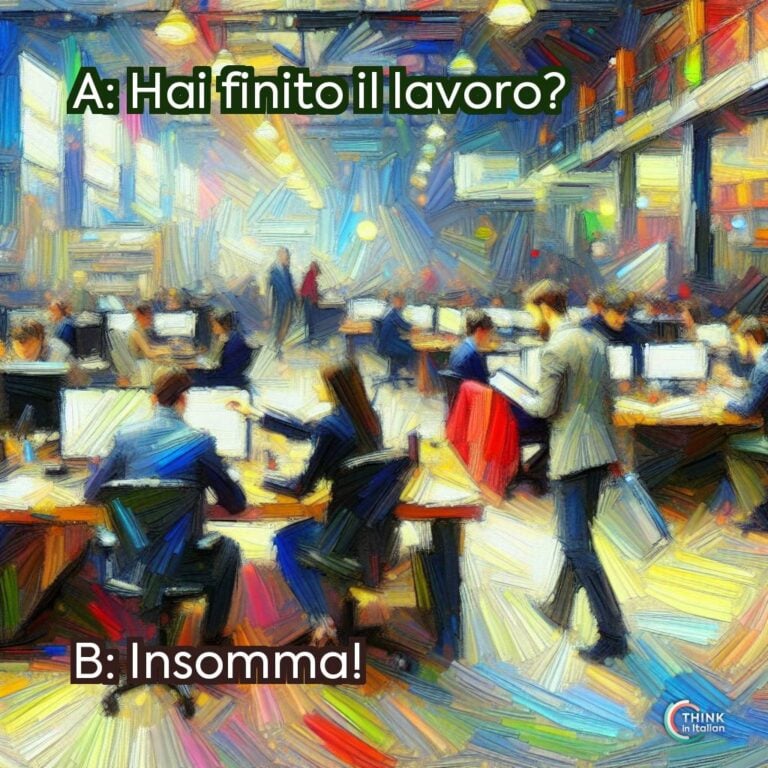
A: Hai finito il lavoro?

Audio lesson with 30 sentences to listen and repeat

Italian grammar video lesson

Stefano's video lesson

Main Article

“Insomma” in Italian

The word insomma is an Italian adverb that is use to introduce or request a conclusion that has became necessary in the conversation. It conveys a sense of conclusion or summary of what has been said.

This term comes from two Latin words: the preposition in and the noun summa (sum, total). Then, these two words have been connected and turned into insomma, reflecting the natural evolution of the Italian language from Latin.

Insomma in English can be translated in different ways, which shows the versatility of the Italian term. Have a look at its possible different translations:

  • in short, all in all
  • well
  • not too bad
  • for goodness’ sake!

Let me now show you how to use it.

How to use “Insomma”

“Insomma” as “in short”

If you want to wrap a conversation up, to summarize a key concept, or to cut it short, you can use insomma with the meaning of “in short”, “all in all”, or “basically”. The good thing about this is that you can choose the one you prefer.

Here are some examples:

Laura è simpatica, tenera, intelligente e brava. Insomma, è fantastica!

Laura is fun, sweet, intelligent, and nice! Basically, she’s fantastic!

Mi sono svegliata alle 6, sono andata in aeroporto e poi a lavorare. Insomma, sono stanchissima!

I woke up at 6, I went to the airport, and then I went to work. In short, I’m exhausted!

Mi piace la pizza, la pasta, la lasagna. Insomma, mi piace tutto!

I like pizza, pasta, lasagna. All in all, I like everything!

“Insomma” as “well”

Insomma might also mean “well”, “then”, or “so”. We usually use it to introduce a question or when we want to convey impatience, that is, we cannot wait to hear the answer.

Have a look at the sentences below to understand better:

Insomma, vieni con noi o no?

Well, are you coming with us or not?

Insomma, cosa vi hanno detto?

So, what did they say?

Insomma, cosa vuoi?

So, what do you want?

“Insomma” as “not too bad”

Insomma can also be the answer to a question. When we use it in these contexts, it means something like “so-so”, “not too bad”, “not really”. For instance, if you’re not feeling great, but you don’t want to say you’re feeling bad, you can just say insomma!

Here are some examples:

-Come stai oggi?
Insomma!

-How are you?
Not too bad!

-Com’è andata?
Insomma!

-How did it go?
So-so!

-Vi siete divertiti?
Insomma!

-Did you have fun?
Not really!

“Insomma” as for “goodness’ sake”

Last but not least, insomma can also be used with the meaning of “for goodness’ sake!” or “that’s enough!”. You can use it when you’re tired of something. I usually use it right after the conjunction ma (but) to express indignation, impatience, or exasperation.

Here are some examples:

Insomma! Smettete di urlare!

That’s enough! Stop shouting!

Ma insomma! Cosa hai fatto?

For goodness’ sake! What did you do?

Insomma, hai Capito?

So, did you understand?

The Italian insomma is a versatile word that is used in several different contexts. You can use it to summarize, to draw conclusions, to answer a question, or to express emotions like impatience.

It typically opens a sentence, and sometimes you can find it preceded by the conjunction ma.

Insomma, puoi usarlo in diverse frasi! (In sum, you can use it in different sentences!)

Key Terms and Concepts

Words

riassuntosummary
conclusioneconclusion
domandaquestion
impazienteimpatient
rispostaanswer
esclamazioneexclamation
esasperazioneexasperation
riassumereto summarize
introduzioneintroduction
contestocontext

Phrases

riassuntosummary
conclusioneconclusion
impazienteimpatient
rispostaanswer
così cosìso-so
esasperazioneexasperation
impazienzaimpatience
sintesisynthesis
nuancenuance
umoremood

Sentences

Insomma, alla fine abbiamo deciso di andare al cinema.

In short, in the end we decided to go to the movies.

Insomma, mi puoi dire se vieni o no?

Well, can you tell me if you're coming or not?

Come stai oggi? Insomma, non troppo male.

How are you today? So-so, not too bad.

Ma insomma, quanto ci vuole ancora?

But for goodness' sake, how much longer will it take?

Abbiamo provato di tutto e insomma, non ha funzionato.

We tried everything and in short, it didn't work.

FAQs

How do you use "insomma" in Italian?

"Insomma" is an Italian term that is often used to express different shades of meaning depending on the context. It can be used to convey a sense of mediocrity or ambiguity, such as when indicating that something is so-so or not too bad. It can also be used to express a lack of enthusiasm or agreement, as in the phrase not really. The precise meaning of "insomma" depends on the context in which it is used.

What is the difference between "insomma" and "beh"?

In Italian, the word "beh" is commonly used as a speech filler and can be translated as not sure or well. While, the word "insomma" is another useful speech word in Italian, which can be translated as "so", "well", or even "hey".

think in italian reddit

The comments section has moved to the Think In Italian Reddit community. Join today!

Italian word of the day
giocare
Vieni a giocare a tennis domani?
Are you going to play tennis with us tomorrow?

What's new

Social signup
"I've tried other apps like Babbel and Memrise. None made me fluent or made me feel like I was making much meaningful progress in learning a language."
testimonial 2
Ecem Topcu
Aug 7, 2025
Social login (faster)