“Dipende” in Italian
The word dipende in Italian is a versatile expression that directly translates to “it depends” in English. It is the first person singular of the verb dipendere, meaning “to depend”.
It is used in conversations to express uncertainty or when the outcome of a situation is variable. Just like in English, it introduces an indefinite answer.
It reflects the idea that the situation can change depending on certain circumstances, offering a flexible way to respond or explain choices.
It can be used as a standalone to answer a question, or followed by the preposition da to specify the factor that influences the result. Below, I will show you different ways to use dipende in Italian.
“Dipende” Standing Alone to Answer Questions
One of the most common uses of dipende is as a standalone response to a question. When someone asks a question where the answer isn’t straightforward, dipende is an excellent way to communicate that your answer isn’t sure.
This is probably the word that I use the most daily, because I am an eternally undecided! It is concise, yet effective!
Che cosa farai domani?
What will you do tomorrow?
Dipende.
It depends.
“Dipende” + Preposition Da
“Dipende da” + Noun
The most straightforward way to use dipende with da is by following it with a noun to indicate the factor that influences the situation. This construction is highly flexible and can be used in many contexts.
Non so se esco. Dipende dal tempo.
I do not know if I am going out. It depends on the weather.
Dipende dal prezzo.
It depends on the price.
Dipende dalla situazione.
It depends on the situation.
Of course, remember that whenever a preposition is followed by a definite article, they must combine together to form preposizione articolata.
“Dipende da” + Clause
In more complex sentences, dipende da can be followed by an entire clause that provides detailed information about the factors that influence the decision. This use is a more elaborated explanation about what the outcome depends on.
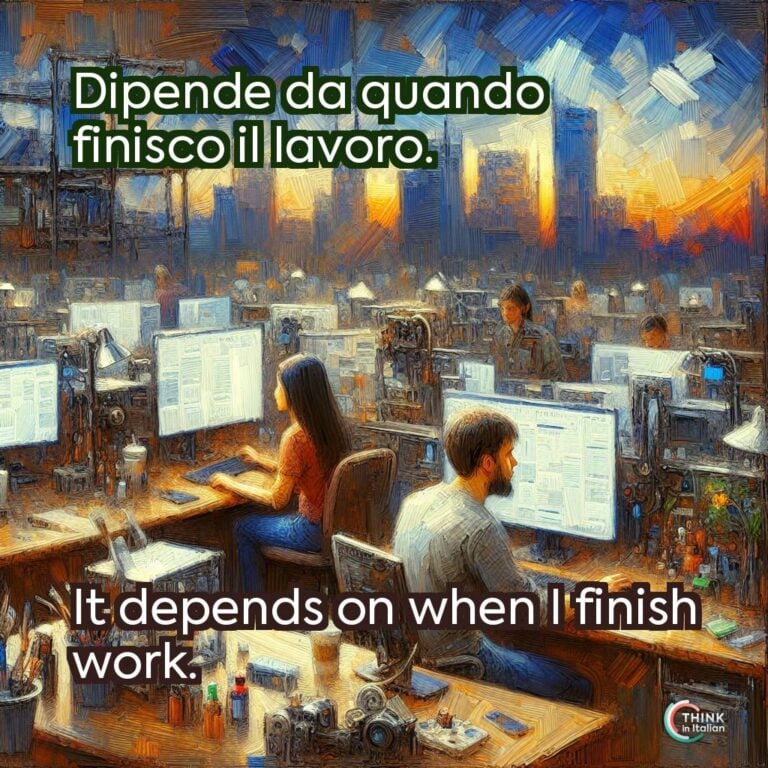
Dipende da come mi sento dopo il lavoro.
It depends on how I feel after work.
Dipende da quanto tempo abbiamo.
It depends on how much time we have.
Dipende da chi viene alla festa.
It depends on who comes to the party.