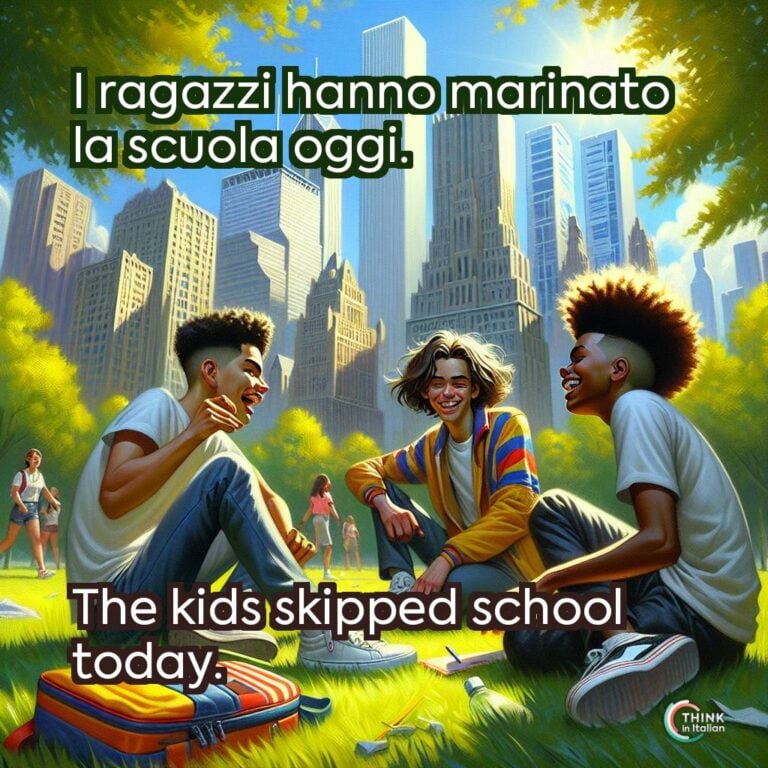

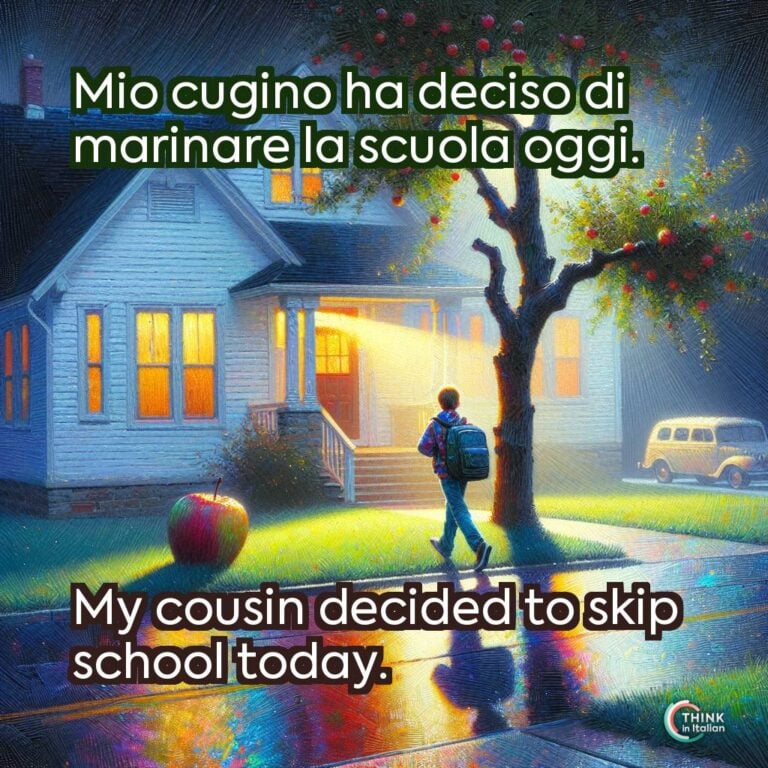
To skip school in Italian, the standard expression is marinare la scuola. In informal speech Italians also say bigiare, fare filone, fare sega and many other regional terms, and for skipping anything else, such as a class, a meal or a page, the verb is saltare.
How to Say “Skip” in Italian
There is no single Italian word for “skip”. Italian uses saltare (literally “to jump”) for most cases, and a set of slang verbs when the thing you skip is school:
| English | Italian |
| to skip school | marinare la scuola, bigiare, fare filone |
| to skip a class | saltare la lezione, bigiare la lezione |
| to skip a meal | saltare un pasto |
| to skip a page | saltare una pagina |
| to skip the queue | saltare la fila |
| to skip rope | saltare la corda |
“Skipping School” in Italian
Regional Flavors
Learning Italian is not just about memorizing words and grammar: it’s also about understanding the cultural nuances, the Italian dialects, and regional differences that shape the language.
One interesting example is how Italians express the concept of “skipping school”. While in English this expression is quite consistent, in Italian there are multiple ways to say it, depending on the region or area.
The Standard Expression: “Marinare la scuola”
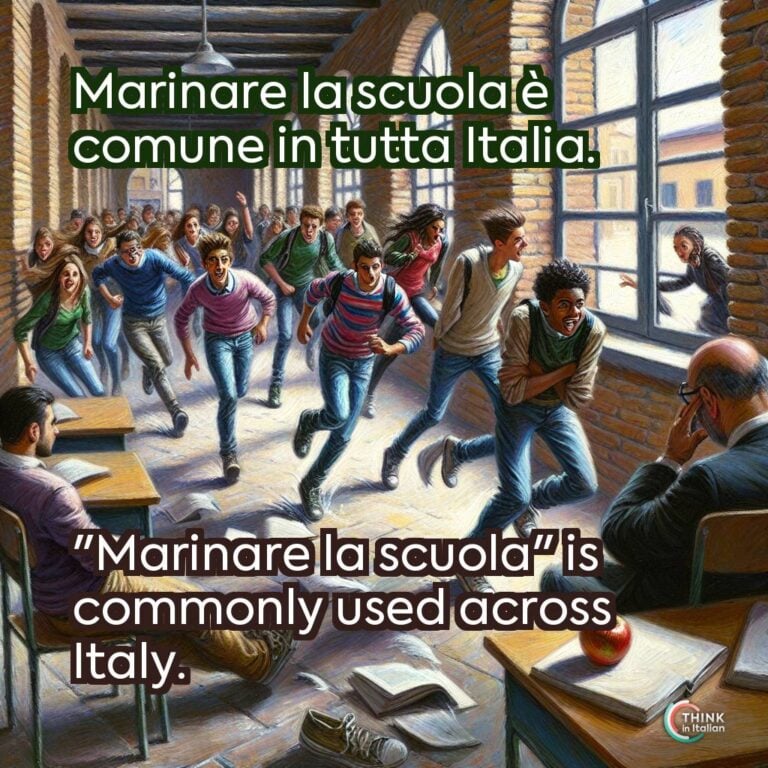
The most commonly recognized phrase for “skipping school” across Italy is marinare la scuola. This expression is very versatile, meaning you can use it in various settings, from casual conversations to written language.

However, some native speakers, including myself, find marinare la scuola somewhat old-fashioned. This is probably why each region, and sometimes even each area within each region, have different way to express this concept.
Marinare is a regular -are verb: io marino, tu marini, lui/lei marina, noi mariniamo, voi marinate, loro marinano. In the past, it takes avere: ho marinato. The same verb also means “to marinate” in cooking, as in marinare la carne.
Oggi ho marinato la scuola.
Today I skipped school.
Ho marinato la scuola per evitare l’interrogazione.
I skipped school to avoid the oral test.
Ieri Luca ha bigiato la lezione di matematica.
Yesterday Luca skipped maths class.
A Dive into Regional Expressions
As I mentioned, there are different regional alternatives to express the traditional concept of marinare la scuola. Here, I will list some of these examples, based on my personal experience and that of close friends or colleagues.
Notice that, although I will translate some of the words belonging to these expressions, their literal translation does not really play a role for the meaning of these idiomatic expressions.
- Napoli: fare filone
The word filone literally means a “long loaf of bread”, but here, of course, it is used with a different meaning. - Roma: andare a sega, also heard as fare sega
While sega literally means “saw”, it is often used with a quite vulgar meaning. - Toscana: fare forca
Forca means “pitchfork”. - Veneto: bruciare
The verb bruciare literally means “to burn”. This expression conveys a rebellious tone. - Emilia Romagna: fare fuga
The word fuga means “escape”. Sometimes, you can also find the expression fare buco, which translates to “make a hole”, where the “hole” metaphorically represents a gap in one’s school attendance. - Lombardia: balzare scuola
The verb balzare is the dialectal counterpart of saltare (to jump). This is a more modern expression, but a couple of decades ago people used to say bigiare, with the same meaning of today’s balzare. - Piemonte: tagliare
The verb tagliare means “to cut”.
These labels are a guide, not borders. Fare filone, for example, is also common in Lombardy and across northern and central Italy, and bigiare is widely used in the north, including Emilia-Romagna. Ask ten Italians and you may get ten different answers.
Domani facciamo filone?
Shall we skip school tomorrow?
Oggi non ho voglia di andare a scuola: faccio filone.
I don’t feel like going to school today: I’m skipping.
Synonyms and Slang
Italian is a language full of synonyms and slang, and “skipping school” is no exception. Depending on where you are in Italy—or even which generation you’re speaking to—you might hear a wide range of terms.

For instance: bucare, schissare, fare forca, scavallare, far cavalletta, brasare, cabottare, salare, and many more. Do you want to know something fun? I do not know these terms at all!
These variations provide valuable insights into Italy’s cultural diversity. For example, some terms may indicate a more urban slang from younger generations, while others might be deeply rooted in a specific regional dialect.
“Sega”: Handle With Care
People often search for what sega means in slang. The expression fare sega means “to skip school” (literally “to saw”). Outside this expression, though, sega is a vulgar word with a sexual meaning. Avoid fare sega with teachers, parents and in any formal situation, and use marinare la scuola or bigiare instead.
Vocabulary for Talking About Skipping School
- l’assenza – absence
- giustificare l’assenza – to explain an absence with a note
- l’interrogazione – oral test at school
- il compito in classe – written test in class
- il professore / la professoressa – the teacher
Devo giustificare l’assenza di ieri.
I have to explain yesterday’s absence.
Ho saltato la colazione e ho marinato la prima ora.
I skipped breakfast and I skipped first period.
For more everyday expressions like these, read my lists of Italian slang words and essential Italian slang expressions. If you are curious about the school system itself, see famous schools in Italy.