
There is no separate word for “my own” in Italian: with io, tu, noi and voi you just use the possessive, mio, tuo, nostro, vostro, and add emphasis in other ways. The word proprio means “one’s own” and is used with the third person and with impersonal sentences, while “on my own” is da solo (or da sola).
How to Say “My Own” in Italian
In English, “own” adds emphasis: “my car” becomes “my own car”. Italian does not need a special word for this. La mia macchina can mean both “my car” and “my own car”, and you add emphasis only when you need it:
| English | Italian | Example |
|---|---|---|
| my own (no special emphasis) | il mio / la mia | Ho la mia macchina. (I have my own car.) |
| my very own | tutto mio / tutta mia | Finalmente ho un appartamento tutto mio! (At last I have an apartment of my very own!) |
| my own personal… | personale | È la mia opinione personale. (It’s my own personal opinion.) |
| with my own eyes | con i miei (stessi) occhi | L’ho visto con i miei stessi occhi. (I saw it with my own eyes.) |
| of my own free will | di mia spontanea volontà | Ho scelto di mia spontanea volontà. (I chose of my own free will.) |
| in my own house | a casa mia | A casa mia si mangia alle otto. (In my own house, we eat at eight.) |
Remember that Italian possessives usually take the article (la mia macchina), except with a singular family member (mia madre). You can review this in my lesson on possessive adjectives and pronouns.
“On My Own” in Italian: Da Solo, Per Conto Mio, Di Testa Mia
“On my own” can mean three different things, and Italian has a different expression for each:
- da solo / da sola: alone, without help. It agrees with the person: da solo (man), da sola (woman), da soli (men or mixed group), da sole (women).
- per conto mio: by myself, in my own way, or as far as I am concerned.
- di testa mia: following my own head, without asking anyone.
Ho imparato l’italiano da solo.
I learned Italian on my own.
Mia sorella vive da sola.
My sister lives on her own.
Preferisco viaggiare per conto mio.
I prefer to travel on my own.
Ho deciso di testa mia.
I decided on my own.
The preposition in da solo is explained in my lesson on how to use da.
Proprio: the Italian Word for “One’s Own”
Unlike English, in Italian we have a specific word to say one’s own, and this word is proprio. Proprio is an adjective, and like all adjectives, it agrees in gender and number with the noun it refers to, as you can see below:
Ognuno ha i propri problemi.
Everyone has their own problems.
Sandra ha lavato la propria macchina ieri.
Sandra washed her own car yesterday.
| Singular | Plural | |
|---|---|---|
| Masculine | il proprio | i propri |
| Feminine | la propria | le proprie |
So propria is simply the feminine form of proprio, and it means “own” in English. Placed after a noun, the adjective can also mean “proper”, as in nome proprio (proper noun) and in senso proprio (in the literal sense).
How to Use Proprio for “One’s Own”
Third Person Possessive Adjectives
The Italian proprio is mainly used to disambiguate possible misunderstanding when using third person possessive adjectives.
In fact, it can be used in the third person, both singular and plural, to replace the possessive adjectives suo, sua, suoi, sue (his or her) and loro (their).
This happens because, unlike English, Italian does not distinguish the form of third-person possessive adjectives depending on the gender of the owner, but rather depending on the gender of the item that someone owns.
As a consequence, when saying something like Martina ha perso la sua sciarpa you might translate it as both “Martina lost her own scarf” and “Martina lost someone else’s scarf”.
Have a look at the examples below:
Mario ama il proprio lavoro. – Mario ama il suo lavoro.
Mario loves his own job.
Rimetti i libri al proprio posto. – Rimetti i libri al loro posto.
Put the books back in their (own) place.
Impersonal Constructions
Proprio can also be used as a possessive adjective with impersonal constructions. In this case, it literally means one’s own, since impersonal constructions do not exhibit a logical subject.
Si sta sempre bene a casa propria.
One always feels good at one’s own house.
È importante ricordarsi delle proprie radici.
It is important to remember one’s own roots.
Bisogna sempre dare la priorità al proprio benessere.
One must always prioritize one’s own well-being.
As you have probably noticed, the word proprio is preceded by a definite article when it is used as an adjective, while it requires no article when it is used as an adverb.
Note that proprio points back to the subject of the sentence, so it is used with the third person and with impersonal sentences. With io, tu, noi and voi, use mio, tuo, nostro and vostro:
Faccio il mio dovere.
I do my own duty.
Fare il proprio dovere.
To do one’s own duty.
Ognuno ha la propria opinione.
Everyone has their own opinion.
Also notice that in Italian the noun and its possessive must agree in gender and number.
Other Meanings of Proprio
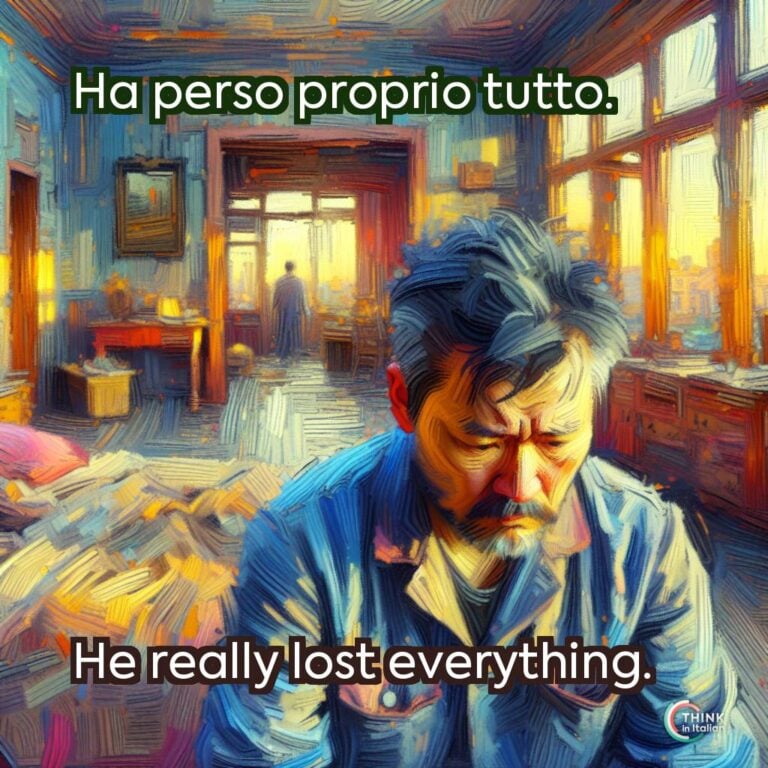
In Italian, proprio doesn’t only mean “one’s own”, but can also be used as an adverb, meaning “really“, “just“, or “exactly“, depending on the context. As an adverb, it never changes:
| Meaning | Example |
|---|---|
| really | È proprio bello! (It’s really beautiful!) |
| just, right | Ho finito proprio ora. (I have just finished.) |
| exactly | Proprio così! (Exactly!) |
| at all (in negative sentences) | Non mi piace proprio. (I don’t like it at all.) |
Learn more about the various meanings of proprio in Italian.
Test Yourself: How Would You Say It?
- I live on my own.
- I saw it with my own eyes.
- Everyone has their own opinion.
- Marco does everything his own way.
Answers: 1. Vivo da solo (or da sola); 2. L’ho visto con i miei occhi; 3. Ognuno ha la propria opinione; 4. Marco fa tutto di testa sua (or di testa propria).