

Italian Sign Language (Lingua dei Segni Italiana or LIS) is the visual-gestural language used by deaf individuals in Italy. It is a language in its own right, with its own grammar and vocabulary, and it is different from spoken Italian, American Sign Language (ASL) and British Sign Language (BSL). It plays a critical role in facilitating communication and bridging the gap between the deaf and hearing communities within the country. Sign language is essential for deaf individuals in Italy as it allows them to express themselves, engage in social interactions, and access information and services. Italy legally recognized LIS on 19 May 2021.
- Name: Lingua dei Segni Italiana (LIS)
- Tactile form: Lingua dei Segni Italiana Tattile (LIST), used by deafblind people
- Legal recognition: 19 May 2021
- Number of users: estimates range from about 40,000 to 90,000 people
- Typical word order: the verb comes last (subject-object-verb)
The history of Italian Sign Language is tied to the deaf communities that developed in various regions of Italy long before the language was described or had a name. The first school for deaf pupils opened in the late 18th century, but it was not until the 19th and 20th centuries that schools and researchers began to describe and formalize the language, and legal recognition only came in 2021. Italian Sign Language is influenced by local sign languages and various linguistic factors such as regional dialects and gestural communication.
Italian Sign Language has its own unique structure and grammar. It is a visual language that relies on handshapes, facial expressions, body movements, and spatial orientation. Just like any spoken language, Italian Sign Language has its vocabulary, syntax, and grammar rules that govern its usage. Learning Italian Sign Language can be a rewarding journey, however, it also comes with its challenges, including limited availability of resources and the need for immersion and practice.
In Italy, sign language interpreters play a vital role in facilitating communication between deaf and hearing individuals. They ensure that information is accurately conveyed in both directions, allowing for effective communication and equal access to services and opportunities. Becoming a sign language interpreter in Italy requires specific qualifications and training to ensure proficiency and adherence to ethical standards.
Italian Sign Language is also incorporated into the education system in Italy. It is used in schools and universities to provide deaf students with access to education in their native language. The inclusion of Italian Sign Language in educational settings promotes equal opportunities, language development, and social interaction for deaf students.
Understanding the intricacies and significance of Italian Sign Language can foster a more inclusive and accessible society in Italy, enabling better communication and understanding between the deaf and hearing communities.
What Is Italian Sign Language?
Italian Sign Language (Lingua dei Segni Italiana, LIS) is the visual-gestural language used by the Deaf community in Italy. It is a unique and distinct language, separate from spoken Italian, with its own grammar, vocabulary, and cultural nuances.
Key features of Italian Sign Language include:
- Manual Gestures: LSI relies on a combination of hand movements, facial expressions, and body language to convey meaning. These manual gestures form the foundation of communication in Italian Sign Language.
- Grammar: LSI has its own grammatical structure, which differs significantly from spoken Italian. It utilizes a combination of handshapes, movements, and spatial relationships to convey grammatical information such as word order, tense, and sentence structure.
- Vocabulary: Just like spoken languages, LSI has its own vocabulary. While some signs may be iconic, representing the object or action they represent, others are arbitrary and must be learned within the cultural context of the Deaf community.
- Cultural Nuances: Italian Sign Language is not only a means of communication but also an integral part of Deaf culture in Italy. It has its own cultural norms, expressions, and idiomatic phrases that are unique to the Deaf community.
- Regional Variations: Similar to spoken languages, Italian Sign Language may have regional variations. Different regions in Italy may have their own dialects or variations in signs, vocabulary, and cultural practices.
- Recognition and Status: Italian Sign Language has been legally recognized in Italy since 19 May 2021. It is protected by law, and efforts have been made to promote its use in education, media, and public services to ensure accessibility for the Deaf community.
Italian Sign Language plays a vital role in fostering communication and cultural identity within the Deaf community in Italy, enabling Deaf individuals to express themselves, connect with others, and participate fully in society.
What Sign Language Is Used in Italy?
Italy uses Italian Sign Language (LIS). Deafblind people use its tactile form, LIST (Lingua dei Segni Italiana Tattile), in which the signs are felt with the hands. Italy legally recognized both on 19 May 2021.
There is no universal sign language. LIS is not the same as ASL or BSL, and signers of different sign languages usually cannot understand each other without learning the other language. Even countries that share a spoken language, such as the United States and the United Kingdom, have different sign languages.
Signs can also differ from region to region inside Italy, a little like the spoken Italian dialects. And LIS is separate from the spoken languages of Italy too: if you are curious about those, see what language Italians speak.
The Importance of Sign Language in Italy
Sign language plays a vital role in Italy, and its importance can be understood through the following points:
- Inclusivity: Sign language is essential for creating an inclusive society in Italy by ensuring effective communication for individuals who are deaf or hard of hearing. It allows them to access information, express themselves, and participate fully in various aspects of life.
- Legal Recognition: On 19 May 2021, the Italian Parliament officially recognized Italian Sign Language (LIS, Lingua dei Segni Italiana) and its tactile form (LIST). This legal recognition acknowledges the importance of sign language as a means of communication.
- Education: Sign language plays a crucial role in the education of deaf individuals in Italy. It is used in schools and educational institutions to facilitate learning and ensure equal educational opportunities. Sign language interpreters are often employed to support communication between deaf students and hearing teachers.
- Cultural Identity: Sign language is not just a mode of communication; it is also an integral part of the cultural identity of the Italian deaf community. It allows for the expression of unique cultural perspectives, traditions, and experiences.
- Accessibility: Sign language contributes to making information and services more accessible to the deaf community in Italy. It is used in various settings, including healthcare facilities, government offices, public transportation, and cultural events, to ensure effective communication and equal access to services.
- Advocacy and Awareness: Sign language plays a crucial role in raising awareness about the rights and needs of the deaf community in Italy. It is used in advocacy efforts to promote accessibility, equal opportunities, and the recognition of sign language as a linguistic and cultural asset.
- Employment Opportunities: Proficiency in sign language opens up employment opportunities in sectors such as education, interpretation, translation, and community services. It allows deaf individuals to pursue careers where they can use their unique skills and contribute to society.
- Social Integration: Sign language facilitates social integration by bridging the communication gap between deaf and hearing individuals. It allows for meaningful interaction, fostering understanding, and promoting inclusive social connections.
The importance of sign language in Italy cannot be overstated. It is a powerful tool that promotes inclusivity, accessibility, and cultural preservation, ultimately contributing to a more equitable and diverse society.
How Does Sign Language Facilitate Communication for Deaf Individuals in Italy?
Sign language plays a crucial role in facilitating communication for deaf individuals in Italy. It enables them to express their thoughts, emotions, and needs effectively, allowing them to participate fully in social interactions, education, and employment opportunities. Sign language breaks down communication barriers between deaf and hearing individuals, promoting understanding and empathy. In Italy, sign language has been legally recognized since 2021, and the law promotes access to sign language interpretation services for deaf individuals in various settings. This ensures that they are not disadvantaged due to their hearing loss and can effectively communicate and receive necessary information. Maria, a deaf individual in Italy, shares how sign language has transformed her life. Sign language not only facilitated communication for Maria but also transformed her life, enabling her to lead a fulfilling and independent life.
History and Development of Italian Sign Language
The history and development of Italian Sign Language (Lingua dei Segni Italiana or LIS) can be traced back to the late 18th and early 19th centuries.
Origins:
Italian Sign Language emerged from a combination of local sign languages used by Deaf communities throughout Italy. These regional sign languages developed naturally within Deaf communities and were influenced by French Sign Language (LSF), which was introduced by French educators during the 18th century.
Deaf Education:
In the 19th century, the first schools for the Deaf were established in Italy, and educators began to standardize sign language to facilitate communication and education. The influence of LSF remained significant, but Italian Sign Language started to develop its unique characteristics and vocabulary.
Recognition and Standardization:
Italian Sign Language gained official recognition on 19 May 2021, when the Italian Parliament passed a law recognizing, promoting and protecting LIS and LIST. This recognition marked an important milestone in the promotion and preservation of Italian Sign Language.
Features and Grammar:
Italian Sign Language is a visual-gestural language that uses handshapes, facial expressions, body movements, and spatial references to convey meaning. It has its own grammatical structure, distinct from spoken Italian, with word order, facial expressions, and non-manual markers playing essential roles.
Community and Influence:
Italian Sign Language plays a vital role in the cultural identity and communication of the Italian Deaf community. It continues to evolve and adapt, influenced by the changing needs and experiences of the Deaf community in Italy.
Recognition and Advocacy:
Efforts are ongoing to raise awareness about Italian Sign Language, promote its inclusion in education and public services, and advocate for its recognition as an official language in Italy.
The history and development of Italian Sign Language reflect the rich linguistic heritage and cultural significance of Deaf communities in Italy.
When and How Was Italian Sign Language Developed?
Italian Sign Language (LIS) originated as a natural sign language used by deaf individuals in communities across Italy in the late 18th century and early 19th century. Its development was shaped primarily through spontaneous interactions and communication among deaf people, without any formal regulations or standards during its early stages.
The emergence of LIS was influenced by various factors, including the diverse regional sign languages used in different parts of Italy. These regional sign languages played a crucial role in the formation of a unified Italian Sign Language, which allowed deaf individuals from different regions to communicate effectively. Additionally, the vocabulary and grammar of Italian Sign Language were influenced significantly by the French Sign Language.
Over time, Italian Sign Language continued to evolve and develop as the deaf community in Italy used and refined it. Presently, LIS is legally recognized in Italy and serves as the primary means of communication for deaf individuals.
It is essential to note that Italian Sign Language is distinct and separate from the spoken Italian language. Although they may exhibit some similarities, they differ in terms of grammatical structures and modes of expression. Italian Sign Language plays a vital role in promoting communication and inclusivity within the deaf community in Italy.
What Are the Influences on Italian Sign Language?
Italian Sign Language (LIS) has been shaped by a variety of factors that have influenced its development. These influences have had an impact on the vocabulary, grammar, and culture surrounding LIS.
Historically, French Sign Language (LSF) played a significant role in the development of LIS. Introduced to Italy in the 19th century, LSF became an integral part of deaf education and contributed to the formation of LIS.

Regional influences have also played a crucial role in the evolution of LIS. Different regions of Italy have their own dialects and variations of the language, influenced by local customs and traditions. These regional influences have enriched the diversity of LIS and contributed to its development.
LIS has also been influenced by the Italian spoken language. The structure and grammar of LIS have been shaped by Italian syntax, word order, and vocabulary, reflecting the linguistic influences of the spoken language.
The cultural context of Italy has left a lasting impact on LIS. Italian gestures and non-manual markers have been incorporated into the language, reflecting the cultural identity of the deaf community in Italy.
Additionally, international sign languages like American Sign Language (ASL) and British Sign Language (BSL) have influenced LIS. Interactions with the international deaf community through conferences and collaborations have introduced new signs and concepts to LIS.
Understanding the influences on Italian Sign Language is essential in recognizing its unique characteristics and cultural significance. These influences have shaped the language into what it is today, providing the deaf community in Italy with a means of effective communication and expression.
It is truly fascinating to observe how various factors have influenced the development of Italian Sign Language. Historical, regional, linguistic, cultural, and international influences have all contributed to its richness and diversity. By acknowledging and appreciating these influences, we can deepen our understanding of the language and its importance in Italian society.
Legal Recognition of LIS in Italy
On 19 May 2021, the Italian Parliament recognized LIS and LIST. The recognition came through article 34-ter of the “Sostegni” decree (decree-law 41/2021), which was converted into law 69/2021. Italy is often described as the last country in Europe to recognize its national sign language.
The law does three things:
- It recognizes, promotes and protects LIS and LIST.
- It recognizes LIS and LIST interpreters as professionals.
- It left the training routes for interpreters to a later decree, published in 2022.
Before that, sign language had a difficult history in Italy. After the Milan Congress of 1880 declared the oral method superior, sign language was pushed out of deaf education for decades, but it survived among deaf people themselves.
The Structure and Grammar of Italian Sign Language
Italian Sign Language (Lingua dei Segni Italiana or LIS) has its own unique structure and grammar. Here are some key aspects of the structure and grammar of Italian Sign Language:
- Word Order: In LIS, the verb typically comes last, so the basic word order is usually described as Subject-Object-Verb (SOV), unlike spoken Italian, which is normally Subject-Verb-Object (SVO). LIS also allows flexibility in word order to emphasize different elements of a sentence.
- Facial Expressions and Body Movements: Facial expressions and body movements play a crucial role in conveying meaning in LIS. They are used to express various grammatical features, such as tense, aspect, and mood.
- Non-Manual Markers: Non-manual markers, including facial expressions, head movements, and body postures, are used to indicate grammatical information, such as negation, question formation, and conditionals.
- Iconicity: LIS exhibits a high degree of iconicity, meaning that signs often resemble the objects or actions they represent. This iconicity contributes to the visual and expressive nature of the language.
- Classifier Construction: LIS uses classifiers, which are handshapes that represent categories or classes of objects. Classifiers are used to describe movements, locations, and appearances of objects within a signed sentence.
- Verb Agreement: Verbs in LIS can agree with the subject and object in terms of person and number, not gender as in spoken Italian. This agreement is indicated through specific handshapes, movement, and location.
- Role Shifting: Role shifting is a feature of LIS where the signer takes on different spatial locations or perspectives to indicate different participants in a narrative or conversation.
- Temporal Aspect: LIS has various strategies to express temporal aspect, including the use of specific signs, facial expressions, and body movements to indicate past, present, and future events.
- Spatial Grammar: Spatial grammar is an important aspect of LIS, where the signer uses the space around them to represent different referents, locations, or actions. Spatial relationships and movements convey meaning.
- Gesture Incorporation: LIS incorporates gestures from Italian spoken language and other gestural systems. These gestures add meaning and enhance the expressiveness of the signed communication.
Understanding the structure and grammar of Italian Sign Language is essential for effective communication and comprehension within the Italian Deaf community.
The Italian Sign Language Alphabet
Italian Sign Language has a manual alphabet, called alfabeto dattilologico, with a handshape for each letter. The traditional Italian manual alphabet mixes one-handed and two-handed letters.
Fingerspelling is used mainly for names, places and foreign words. Most everyday words have their own signs and are not spelled out letter by letter, so the alphabet is a starting point, not a shortcut to fluency.
The letters follow the Italian alphabet: 21 letters, plus J, K, W, X and Y for foreign words. My guide to the Italian alphabet covers the written letters and their names. To learn the handshapes themselves, use a video or a Deaf teacher rather than a still image, because hand position and movement matter.
Learning Italian Sign Language
If you are interested in learning Italian Sign Language, here are some steps you can follow:
- Find Learning Resources: Look for online courses, textbooks, or video tutorials specifically designed for learning Italian Sign Language. These resources can provide you with the necessary vocabulary, grammar, and cultural context.
- Join a Sign Language Class: Enroll in a sign language class or workshop taught by a qualified instructor. This will allow you to practice signing with others and receive feedback on your progress.
- Practice with Native Signers: Seek opportunities to interact with native Italian Sign Language users. This can be done by attending sign language meetups, events, or workshops where you can practice your skills and learn from experienced signers.
- Immerse Yourself in the Language: Immerse yourself in Italian Sign Language by watching videos, movies, or TV shows in sign language. This exposure will help you improve your comprehension and fluency.
- Practice Regularly: Dedicate time each day to practice signing. Consistency is key to developing your skills and retaining what you have learned.
- Learn the Alphabet and Basic Signs: Begin by learning the Italian Sign Language alphabet and basic signs. This foundation will allow you to build your vocabulary and communicate more effectively.
- Expand Your Vocabulary: Gradually expand your vocabulary by learning new signs and phrases. Practice using these in different contexts to improve your expressive abilities.
- Seek Feedback: Ask for feedback from native signers or your instructor. This will help you identify areas for improvement and refine your signing skills.
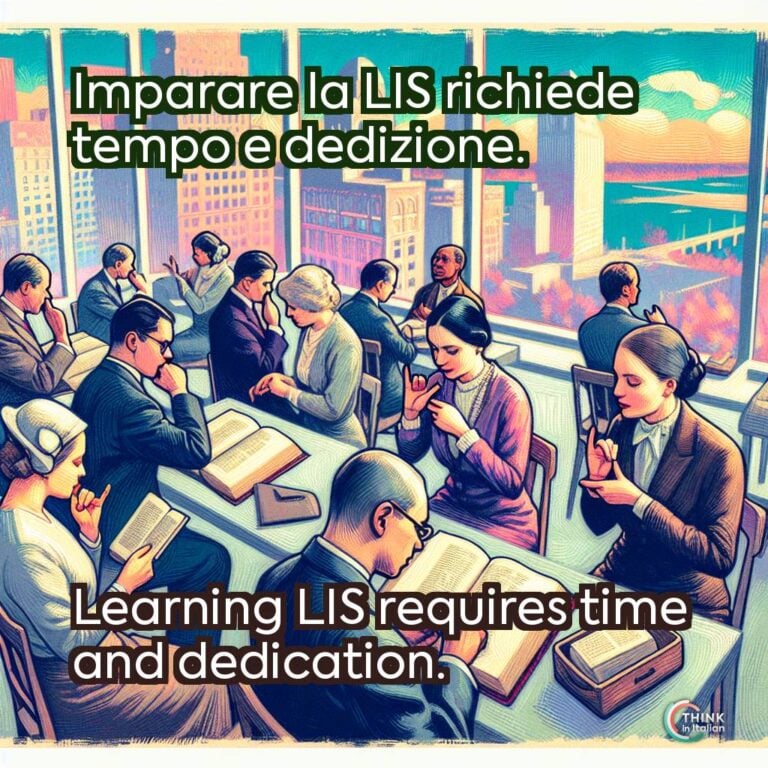
- Be Patient and Persistent: Learning a new language takes time and effort. Be patient with yourself and maintain a positive attitude as you progress in your journey to learn Italian Sign Language.
- Stay Updated: Keep up with developments and changes in Italian Sign Language by staying connected with the deaf community and participating in relevant forums or online groups.
By following these steps and immersing yourself in the world of Italian Sign Language, you can develop proficiency and effectively communicate with Italian Sign Language users.
Are there Resources Available for Learning Italian Sign Language?
There are indeed resources available for learning Italian Sign Language. There are numerous online platforms and websites that offer courses and tutorials specifically designed to help individuals learn Italian Sign Language. These resources provide a wide range of learning materials, including video lessons, vocabulary lists, and interactive exercises. They are carefully crafted to support learners in practicing and improving their signing skills. Additionally, there are books and textbooks available that cover the fundamentals of Italian Sign Language, including grammar rules and vocabulary. These valuable resources can be obtained in both physical and digital formats, ensuring easy accessibility for all learners. Furthermore, community centers, schools, and organizations frequently offer in-person classes and workshops for those interested in learning Italian Sign Language. These classes provide invaluable hands-on practice with fluent signers and create a supportive and inclusive environment for learners to interact with others. By making use of these resources, individuals can develop their proficiency and greatly enhance their ability to communicate with the deaf community in Italy.
What Are the Challenges of Learning Italian Sign Language?
Learning Italian Sign Language can present certain challenges to individuals who are not familiar with the language or the deaf community. Here are some of the challenges one may face when learning Italian Sign Language:
1. Cultural and Linguistic Differences: Italian Sign Language has its own unique grammar, vocabulary, and cultural nuances. Understanding and adapting to these differences can be challenging for beginners.
2. Limited Resources: Finding comprehensive resources to learn Italian Sign Language can be difficult, especially for those living outside of Italy. While there are some online courses and videos available, the options may be limited compared to other widely taught languages.
3. Limited Exposure to Native Signers: Immersion plays a crucial role in language learning. Individuals learning Italian Sign Language may have limited opportunities to interact with native signers, making it challenging to practice and improve their skills.
4. Spatial Awareness and Visual Perception: Sign languages rely heavily on visual cues and spatial awareness. Developing these skills can take time and practice, especially for those who are not used to communicating in a visual-spatial language.
5. Access to Qualified Instructors: Finding qualified instructors or tutors who can teach Italian Sign Language may be challenging, especially in areas with a limited deaf community or educational resources.
Despite these challenges, learning Italian Sign Language is a rewarding and valuable skill that can enhance communication and foster inclusivity within the deaf community. With dedication, practice, and consistent exposure to the language, individuals can overcome these challenges and become proficient in Italian Sign Language.
Italian Words for Sign Language and Deafness
If you are learning Italian, these are the words you will meet when reading or talking about LIS:
| Italian | English | Note |
|---|---|---|
| la lingua dei segni italiana (LIS) | Italian Sign Language | The proper name of the language. |
| la lingua dei segni | sign language | “Linguaggio dei segni” is also heard in everyday speech, but “lingua” stresses that sign languages are full languages. |
| sordo, sorda | deaf (person) | The word the Deaf community uses for itself. |
| non udente | hearing-impaired (“not hearing”) | More formal. Some deaf people prefer “sordo”. |
| sordomuto | deaf-mute | Outdated. Italian law has used “sordo” instead since 2006. |
| l’interprete LIS | LIS interpreter | A professional who interprets between LIS and spoken Italian. |
| l’alfabeto dattilologico | manual alphabet | Used to fingerspell names and foreign words. |
| la comunità sorda | the Deaf community |
A few examples:
- Conosci la LIS? means “Do you know LIS?”
- Mia sorella è sorda e usa la LIS. means “My sister is deaf and uses LIS.”
Sign Language Interpreters in Italy
In Italy, sign language interpreters play a vital role in facilitating communication for individuals who are deaf or hard of hearing. Here are some key aspects of sign language interpreters in Italy:
- Training and Certification: Sign language interpreters in Italy undergo specialized training to develop proficiency in both Italian Sign Language (LIS) and spoken Italian. They acquire the necessary skills to effectively interpret between deaf individuals and hearing individuals.
- Professional Associations: Interpreters often join professional associations like ANIOS (Associazione Interpreti di Lingua dei Segni Italiana) or ANIMU (Associazione Nazionale Interpreti di Lingua dei Segni) to stay updated on best practices, receive support, and access professional development opportunities.
- Interpretation Settings: Sign language interpreters work in various settings such as educational institutions, healthcare facilities, legal settings, conferences, and public events. They provide interpretation services during meetings, lectures, medical appointments, court proceedings, and other situations where effective communication is crucial.
- Code of Ethics: Interpreters abide by a code of ethics, which includes principles such as confidentiality, impartiality, accuracy, and cultural sensitivity. They ensure that they maintain professional boundaries and respect the privacy of the individuals they work with.
- Qualifications and Experience: Interpreters possess a combination of formal education, practical training, and experience. Many interpreters hold degrees in interpretation or related fields and may have specialized knowledge in specific subject areas, such as medical or legal terminology.
- Continuing Education: Interpreters engage in continuous professional development to enhance their skills and stay updated on new developments in the field. They attend workshops, conferences, and training programs to expand their knowledge and improve their practice.
- Collaboration: Sign language interpreters collaborate with other professionals, such as educators, healthcare providers, and legal personnel, to ensure effective communication and provide equal access for deaf individuals in various settings.
- Advocacy: Interpreters may engage in advocacy work to promote awareness, accessibility, and the rights of individuals who are deaf or hard of hearing. They contribute to initiatives that aim to create inclusive environments and improve communication access for all.
- Continuous Improvement: Interpreters strive for continuous improvement in their skills and knowledge. They actively seek feedback, reflect on their practice, and engage in self-assessment to provide the best possible interpretation services.
- Legal Framework: Italy has legal provisions that recognize the rights of individuals who are deaf or hard of hearing to access sign language interpretation services. These laws help ensure equal opportunities and accessibility for the deaf community. Since 2021, the law also recognizes LIS and LIST interpreters as professionals.
How Do Sign Language Interpreters Assist in Communication?
Sign language interpreters play a vital role in assisting communication for individuals who are deaf. They bridge the gap between the deaf and hearing communities by effectively conveying messages between the two parties.
Interpreters utilize their knowledge of sign language and spoken language to accurately and fluently interpret conversations, presentations, and other forms of communication. They actively listen to the speaker and then translate the information into sign language for the deaf individual, ensuring that they have access to the same information as everyone else.
In addition to interpreting spoken language into sign language, interpreters also interpret sign language into spoken language for hearing individuals who may not understand sign language. This two-way interpretation allows for effective and inclusive communication between both parties.
Sign language interpreters have the necessary skills to accurately assist in communication, interpreting complex concepts, technical vocabulary, and emotions. They are able to capture the nuances of human expression and effectively convey the meaning behind the words being spoken.
To be successful in their role, interpreters must possess strong communication skills, cultural competence, and a deep understanding of both sign and spoken language. They continuously strive to maintain neutrality and confidentiality while ensuring that the message is conveyed accurately and without bias.
Sign language interpreters play a crucial role in breaking down communication barriers and promoting inclusivity for individuals who are deaf. They ensure that deaf individuals have equal access to information and can actively participate in various settings, including educational, professional, and social environments.
What Are the Qualifications and Training Required to Become a Sign Language Interpreter in Italy?
To become a sign language interpreter in Italy, individuals must meet certain qualifications and undergo specific training. These requirements ensure that interpreters have the necessary skills and knowledge to effectively facilitate communication for deaf individuals.
1. Education: After the 2021 law, a ministerial decree published in April 2022 set out the routes into the profession, including a new professionally oriented bachelor’s degree in LIS and LIST interpreting. This educational background provides a strong foundation in sign language linguistics and interpreting techniques.
2. Language proficiency: Sign language interpreters working with deaf individuals must have a high level of proficiency in both Italian sign language and spoken Italian. This proficiency enables them to accurately interpret spoken language into sign language and vice versa.

3. Certification: Interpreters can also qualify through an attestation issued by a professional association such as ANIOS or ANIMU, under the rules set by the decree. The requirements and deadlines have been changing, so check the current rules with the Ente Nazionale Sordi (ENS) or a professional association before you enroll in a course.
4. Continuing education: Members of professional associations such as ANIOS follow a mandatory continuing-education program to keep up with industry standards. This may involve attending workshops, conferences, and other professional development opportunities.
5. Ethical standards: Interpreters must adhere to a code of ethics that governs their professional conduct. This includes maintaining confidentiality, impartiality, and professionalism while providing interpretation services.
By fulfilling these qualifications and undergoing the necessary training, aspiring sign language interpreters in Italy can develop the skills and knowledge needed to effectively facilitate communication for deaf individuals.
The Role of Italian Sign Language in Education
Italian Sign Language (LIS) plays a crucial role in education for individuals who are deaf or hard of hearing in Italy. Here are key aspects highlighting the role of Italian Sign Language in education:
- Inclusive Education: Italian Sign Language promotes inclusive education by ensuring effective communication for students who are deaf or hard of hearing. It allows them to fully participate in classroom activities, engage with teachers and peers, and access educational content.
- Language Development: Italian Sign Language serves as the primary language for many deaf individuals in Italy. It plays a vital role in their language development, enabling them to acquire literacy skills, express themselves, and comprehend complex concepts.
- Communication Access: Italian Sign Language provides a means of communication between deaf or hard of hearing students and their teachers, classmates, and other school staff. It facilitates effective communication and fosters a positive learning environment.
- Bilingual Approach: Italian Sign Language, along with written and spoken Italian, forms a bilingual approach in education for deaf individuals. This approach recognizes the importance of both sign language and the national spoken language, supporting the students’ overall language proficiency.
- Curriculum Adaptation: Italian Sign Language allows for the adaptation of the curriculum to meet the needs of deaf or hard of hearing students. It ensures that educational materials are accessible and presented in a way that aligns with their language and communication abilities.
- Empowerment and Identity: Italian Sign Language plays a crucial role in fostering a sense of empowerment and identity among deaf individuals. It helps them connect with the deaf community, express their cultural and linguistic identity, and develop a positive self-image.
- Professional Development: Italian Sign Language is also important for educators working with deaf or hard of hearing students. Training in sign language enables teachers to effectively communicate, understand the needs of their students, and employ appropriate teaching strategies.
- Social Integration: Italian Sign Language promotes social integration by facilitating communication between deaf and hearing individuals. It helps break down barriers, foster understanding and acceptance, and create inclusive social environments.
- Advocacy and Awareness: Italian Sign Language plays a role in advocating for the rights and inclusion of deaf individuals in society. It raises awareness about the linguistic and cultural rights of the deaf community and promotes equal opportunities in education and beyond.
How Is Italian Sign Language Incorporated in Schools and Universities?
Italian Sign Language is incorporated in schools and universities in Italy to ensure equal access to education for deaf students. Schools and universities recognize the importance of providing a conducive learning environment for all students, including those who are deaf.
In schools and universities, Italian Sign Language is integrated into the curriculum as a primary mode of communication for deaf students. It is taught alongside spoken and written Italian, allowing deaf students to fully participate in class discussions and activities. Italian Sign Language classes are also offered to hearing students as an optional course, promoting inclusivity and fostering a greater understanding of deaf culture.
In universities, Italian Sign Language is similarly incorporated to accommodate the needs of deaf students. Lectures and presentations are often interpreted into sign language by qualified interpreters, enabling deaf students to access the same information as their hearing peers. Universities also offer Italian Sign Language courses for both deaf and hearing students, allowing for greater communication and interaction within the campus community.
Educational institutions provide additional resources and support services to ensure the success of deaf students. These may include note-takers, captioning services, and accessible materials in Italian Sign Language. Accessibility features are also incorporated into classrooms and facilities, such as visual alarms and vibrating devices, to ensure that deaf students can fully participate in all aspects of university life.
By incorporating Italian Sign Language into schools and universities, Italy promotes inclusivity, equal access to education, and a more inclusive society for deaf individuals.
Frequently Asked Questions
What is Italian Sign Language (LIS)?
Italian Sign Language (LIS), also known as Lingua dei Segni Italiana, is the visual language used by deaf people in Italy. It has little in common with spoken Italian but shares some features with non-Indo-European oral languages.
What sign language is used in Italy?
Italy uses Italian Sign Language (LIS). Deafblind people use its tactile form, LIST (Lingua dei Segni Italiana Tattile). Italy legally recognized both on 19 May 2021.
How many people use LIS?
Estimates vary. Some sources put the number of people who use LIS as their main language at around 40,000, while others estimate that 60,000 to 90,000 deaf people in Italy use it.
Is there an Italian sign language alphabet?
Yes. Italy has a manual alphabet (alfabeto dattilologico) with a handshape for each letter. It is used mostly to spell names and foreign words, because most everyday words have their own signs.
What are some unique features of LIS?
The language structure of LIS includes features such as agreement between nouns, adjectives, and verbs based on place, rather than gender. Facial expressions replace voice intonation in marking interrogative sentences, imperatives, and relative clauses. Other features include classifiers, dual, trial, and plural forms, and inflected verbs.
What is the history of LIS?
The history of LIS dates back to the Middle Ages when deaf people faced restrictions and discrimination. The first Italian school for the deaf was founded in the late 18th century, influenced by the signing method used in France. However, after the Conference of Milan in 1880, the focus shifted to teaching the spoken word, and sign language was neglected.
Is Italian Sign Language the same as American Sign Language?
No. LIS and ASL are different languages with different vocabulary and grammar, and a signer of one usually cannot understand the other without learning it. There is no universal sign language.
Can LIS be learned online?
Partly. There are video courses and dictionaries online, but a sign language is best learned from Deaf teachers and signing partners. Local sections of the Ente Nazionale Sordi (ENS) and other Deaf associations often run LIS courses in person.