
How to say “I Love you too” in Italian?

An interactive lesson guiding you from key takeaways to expert insights. Comes with Q&A, useful vocabulary, interactive audio, quizzes and games.

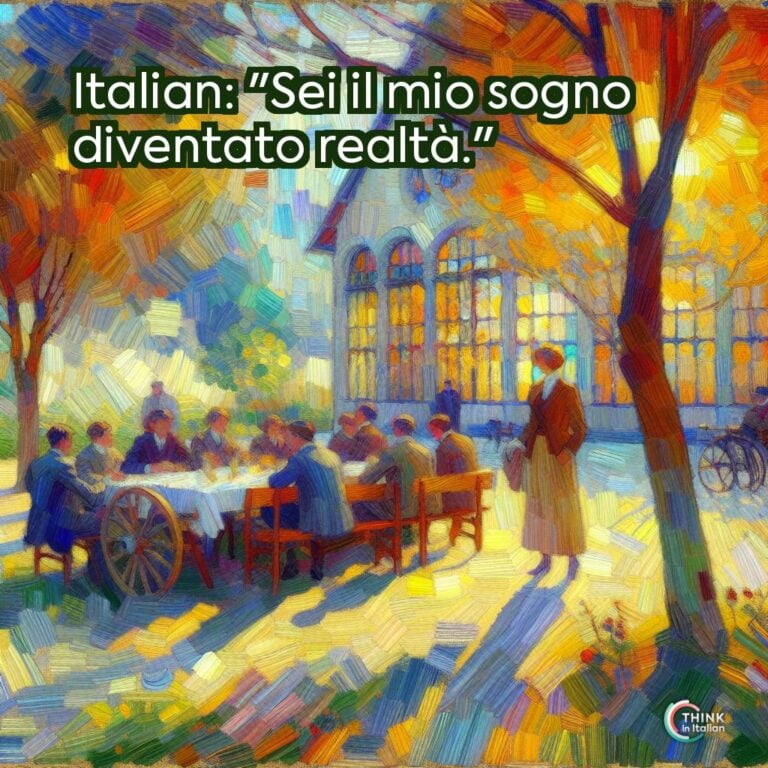
Italian: "Sei il mio sogno diventato realtà."
Published Oct 14, 2023
Updated Dec 26, 2024
Written by
Italian language tutor, course author. MEng, MBA. Member of the International Association of Hyperpolyglots (HYPIA). After learning 12 languages, I can tell you that we all master languages by listening and mimicking. I couldn’t find an app to recommend to my students, so I made my own one. With my method, you’ll be speaking Italian from Lesson 1.
Reviewed by
No data was found

Key Takeaways

  • Responding to love: Say "Anch'io ti voglio bene" to express mutual feelings when someone says they love you.
  • Understanding love expressions: “Ti voglio bene” means 'I care about you', while “Ti amo” signifies romantic love.
  • Romantic phrases: Use expressions like “Sei la mia anima gemella” to convey deep affection and connection with your partner.
  • Compliments and promises: Compliment your partner with “Tu sei bellissimo/a” and make promises like “Ti amerò per sempre” to express commitment.
  • Common misconceptions: The phrase “Mi Amor” is Spanish; in Italian, say “Amore Mio” for 'my love'.

Stefano's Insights

Play to see captions...
Ah, l’amore in italiano! Non è solo un'altra lingua, ma un mondo di sfumature. Dire 'ti amo' è riservato a chi fa battere il cuore come un tamburo, mentre 'ti voglio bene' è per chi riempie la tua vita di calore, come un abbraccio in una giornata fredda. Ricordo una volta, un amico mi ha detto 'ti voglio bene' e io, confuso, ho risposto con un 'ti amo'. Imbarazzo totale! Quindi, attenzione: la distinzione è importante. E se vuoi davvero impressionare, usa frasi come 'sei la mia anima gemella' o 'mi hai rubato il cuore'. Fidati, farai colpo! E no, 'Mi Amor' non è italiano, ma 'Amore Mio' sì, e suona come una melodia. L'amore è un linguaggio universale, ma in italiano è un'opera d'arte!
Ah, love in Italian! It's not just another language, but a world of nuances. Saying 'ti amo' is for those who make your heart beat like a drum, while 'ti voglio bene' is for those who fill your life with warmth, like a hug on a cold day. I remember once, a friend said 'ti voglio bene' and I, confused, replied with 'ti amo'. Total embarrassment! So, be careful: the distinction is important. And if you really want to impress, use phrases like 'sei la mia anima gemella' or 'mi hai rubato il cuore'. Trust me, you'll make an impression! And no, 'Mi Amor' isn't Italian, but 'Amore Mio' is, and it sounds like a melody. Love is a universal language, but in Italian, it's a masterpiece!

Quick facts

How do you express "I love you too" in Italian?

You can express "I love you too" in Italian as "Anch'io ti voglio bene".

What is the difference between "Ti voglio bene" and "Ti amo"?

"Ti voglio bene" is like saying 'I care about you', while "Ti amo" is like saying 'I'm in love with you passionately'.

How to use "Ti voglio bene" in a sentence?

"Ti voglio bene" can be used in sentences like "Ciao, non ti ho visto da tanto tempo! Ti voglio bene" which means, "Hi, I haven't seen you in a long time! I care about you."

In what context is "Ti amo" used?

"Ti amo" is used in romantic relationships to express deep affection, for example, "Ti amo più di qualsiasi altra persona al mondo," means "I love you more than anyone else in the world."

How to express deep connection in Italian?

"Sei la mia anima gemella" is a beautiful Italian phrase to express a deep connection, translating to "You are my soulmate."

Does "Mi Amor" have a place in Italian love expressions?

No, "Mi Amor" is Spanish. In Italian, you would say "Amore Mio", which translates to "My love".

How to compliment someone's beauty in Italian?

You can say "Tu sei bellissimo/bellissima" to express "You are so beautiful/handsome."

How to express missing someone in Italian?

You can say "Mi manchi tanto" which means "I miss you so much."

Could you make a passionate promise in Italian?

Yes, you can say "Ti amerò per sempre," which translates to "I will love you forever."

What is the Italian phrase for "You are my joy"?

The Italian phrase for "You are my joy" is "Tu sei la mia gioia."

Audio images

🔊
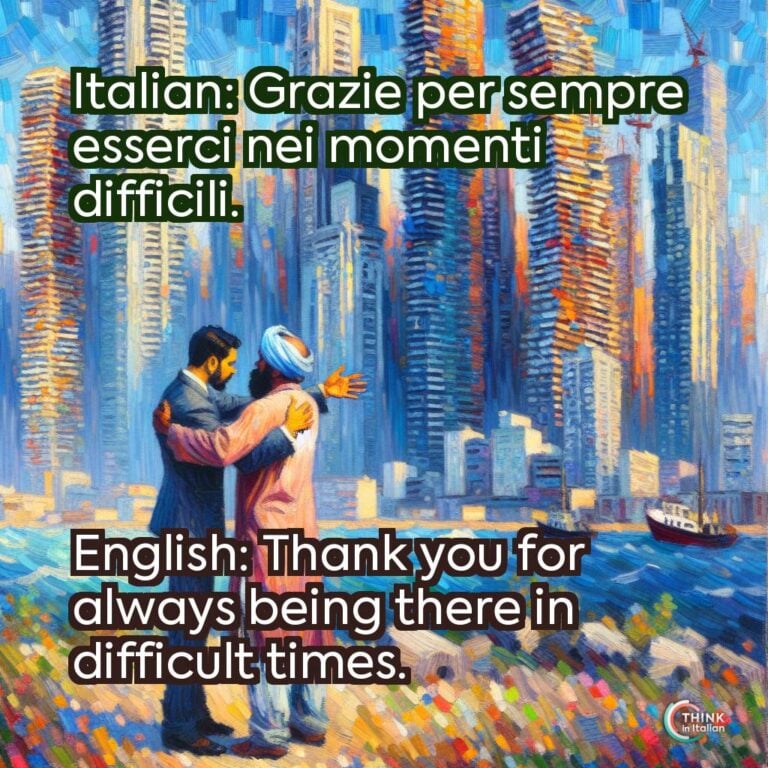
Italian: Grazie per sempre esserci nei momenti difficili.
🔊
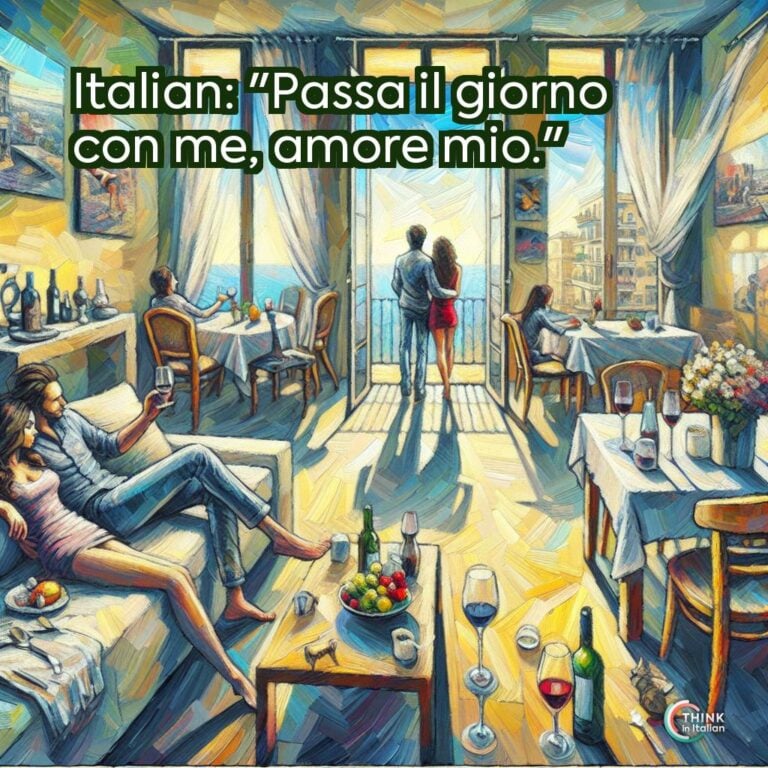
Italian: "Passa il giorno con me, amore mio."
🔊
Italian: "Sei il mio sogno diventato realtà."
Learn on the go
Install the FREE Think In Italian app for faster loading, offline mode, and quick access anytime.
No registration needed. Works on all devices. Ready in 1 click and 3 seconds.

Main Article

How to Express Love in Italian

Italian is often celebrated as one of the most romantic languages in the world, and expressing love in Italian feels natural and heartfelt.

We have different ways to express our love and affection to people, but these expressions may vary depending on a main factor: whether you mean a romantic love or just a friendly one.

For the first situation, ti amo is what you’re looking for. It carries a deep, romantic meaning, and is reserved for situations that convey profound, intimate love, typically between partners or spouses.

For the second situation, use ti voglio bene. Although it can be literally translated as “I love you” as well, it actually conveys a nuance of “I care about you”.

It differs in tone and usage from the more intense and romantic ti amo, and is rather often used to express a softer, more affectionate form of love that is perfect for a variety of relationships.

But how do you respond when someone says “I love you” in Italian? Whether it’s romantic, platonic, or familial love, there are specific phrases to express “I love you too” in the right context.

Let me guide you through the nuances and cultural insights to help you master this beautiful expression.

How to say “I Love you too” in Italian

Regardless of the type of love you are experiencing, the easiest way to respond is by using the expression anche io. As simple as it is, anche means “also” and can therefore be used anytime you want to emphasize an additional element in a sentence.

Free Guide
How to Learn Languages Fast

For example:

Volevo qualcosa di dolce, quindi ho comprato anche il gelato.

I wanted something sweet, so I bought also the ice-cream.

In the context of this topic, anche can be used to respond to someone who shares their love with you.

Ti voglio bene.

I care about you/I love you.

Anch’io ti voglio bene.

I care about you too/I love you too.

Share your Feelings

Saying “I love you too” in Italian is not only a linguistic approach, but it must be approached culturally. Italian allows beautifully specific ways of saying both Eros- and Philos-based feelings.

Equipped with all these phrases, you shall be set to respond in Italian declarations of love as deeply and sincerely as befits loved ones.

Key Terms and Concepts

Ti amo

This phrase translates to 'I love you' in English, expressing deep romantic affection. It's used in romantic relationships to convey passionate love.

Ti voglio bene

Translates to 'I care about you' and reflects a less intense, more affectionate love, used among friends, family, and close acquaintances.

Anch'io ti voglio bene

Means 'I care about you too,' used to reciprocate feelings of care and affection towards someone.

Amore Mio

This Italian phrase means 'My love,' used to affectionately address a loved one, similar to 'Mi Amor' in Spanish.

Anima gemella

Translates to 'soulmate,' indicating a deep, unique connection with a romantic partner, suggesting a belief in destined, eternal love.

Test your knowledge in 10 quick questions

Words

amorelove
animasoul
cuoreheart
passionepassion
bellezzabeauty
desideriodesire
abbracciohug
baciokiss
felicitàhappiness
vitalife

Phrases

TesoroDarling
BaciamiKiss me
Sei bellissimaYou are beautiful
Cuore mioMy heart
Sei il mio tuttoYou are my everything
Sei specialeYou are special
Mi manchiI miss you
Vivo per teI live for you
Sono pazzo di teI'm crazy about you
Ti adoroI adore you

Sentences

Sei il mio tutto.

You are my everything.

Non posso vivere senza di te.

I can't live without you.

Ogni giorno ti amo di più.

I love you more each day.

Sei la luce dei miei occhi.

You are the light of my eyes.

Ti desidero con tutto il cuore.

I desire you with all my heart.

Match the Phrases

Memory game

Flip the cards to find matching pairs!

Crossword

Across
Down
Answers

FAQs

How do I respond when someone says "Ti voglio bene" in Italian?

You can respond with "Anch'io ti voglio bene," which means "I care about you too." It's a way to express mutual feelings.

What's the difference between "Ti voglio bene" and "Ti amo" in Italian?

"Ti voglio bene" is similar to saying 'I care about you' and is used for friends, family, and close acquaintances. In contrast, "Ti amo" means 'I love you romantically' and is reserved for romantic relationships.

think in italian reddit

The comments section has moved to the Think In Italian Reddit community. Join today!

Italian word of the day
d’oliva
È finito l’olio d’oliva. Dovremo comprarne ancora.
We ran out of olive oil. We’ll have to buy some more.

What's new

stefano lodola italian teacher (1)
30 Free Courses to Get You Started ($40 Value)
italian audio lesson preview
italian audio reading preview
italian ai tutor preview
"I've tried other apps like Babbel and Memrise. None made me fluent or made me feel like I was making much meaningful progress in learning a language."
testimonial 2
Ecem Topcu
Aug 7, 2025