

“Since When” and “How Long” in Italian
“How long” in Italian is da quanto tempo (or just da quanto) when something started in the past and is still going on, and “since when” is da quando. To say “since” or “for” in the answer, use the preposition da: da tre anni (for three years), dal 2017 (since 2017).
Other kinds of “how long”, such as how long something takes or lasts, use different words, and you will find them further down the page.
In Italian, just like in English, you can decide whether you want to gain information about the duration of an event, or the moment when that event started.
These two expressions are, respectively, da quanto tempo (how long) and da quando (since when).
The first one is used to inquire about the amount of time an action or event has been going on, while the second one is used to ask about the starting point of an action or event.
You will notice throughout this article that in both expressions da quando and da quanto tempo, the verbs that are used are conjugated in the present tense, because the expressions are used to refer to actions or events that are still going on in the present.
Since When or How Long?
“Since When” in Italian
The expression da quando is used to ask about the moment when an action or event has started, and it is translatable with the English expression “since when”.
This use determines the point in time when something began, usually referring to ongoing situations or actions. For example, you might ask:
Da quando sei in Italia?
Since when have you been in Italy?
“How Long” in Italian
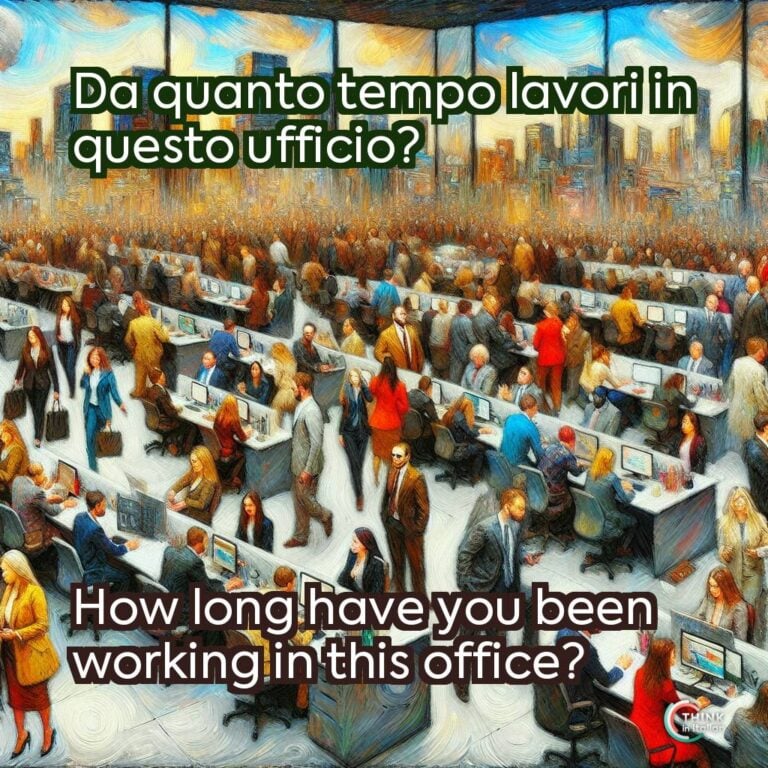
The expression da quanto tempo is used to ask questions about quantity of time and duration, and corresponds to the English expression “for how long”.
For example:
Da quanto tempo studi italiano?
For how long have you been studying Italian?
This expression is particularly useful in probing the length of time something has been ongoing.
How to use “Da Quanto Tempo” and “Da quando”
Da Quanto Tempo?
As we said, this expression is used to ask about the duration of an activity or state.
In Italian, we use da quanto tempo, da quanto, or da quanto è che + verb and we can omit the word tempo (time) because it’s pretty obvious you’re talking about time.
Here are some examples:
Da quanto tempo parli inglese?
For how long have you been speaking Italian?
Da quanto (tempo) abiti in Spagna?
For how long have you been living in Spain?
Da quanto (tempo) è che siete insieme?
For how long have you been together?
Da Quando?
As mentioned, this expression is used to inquire about the starting point of an activity or condition.
Here are some examples:
Da quando lavori qui?
Since when do you work here?
Da quando sei diventato vegetariano?
Since when have you become vegetarian?
Da quando abiti in Spagna?
Since when do you live in Spain?
Answering Questions
Both phrases help to frame questions about time, with da quanto tempo focusing on the duration of an ongoing activity and da quando pinpointing the initiation of a change or an activity.
Understanding when to use each will help you converse more naturally and clearly in Italian, especially when discussing temporal aspects of life and experiences.
To answer questions with these expressions, in Italian we need the preposition da followed by either the amount of time or the specific moment in time.
Let’s now have a look at some possible answers:
Parlo inglese da 3 anni / Parlo inglese dal 2017.
I’ve spoken English for 3 years. / I’ve spoken English since 2017.
Abito in Spagna da un anno. / Abito in Spagna dall’anno scorso.
I’ve lived in Spain for a year. / I’ve lived in Spain since last year.
Stiamo insieme da 5 anni. / Stiamo insieme dal 2015.
We’ve been together for 5 years. / We’ve been together since 2015.
Other Ways to Say “How Long” in Italian
The English “how long” covers several ideas, and Italian uses a different structure for each one:
| Idea | Italian | Example |
| Still going on | Da quanto tempo + present | Da quanto tempo studi italiano? How long have you been studying Italian? |
| Planned or finished period | Per quanto tempo + future or past | Per quanto tempo resti a Roma? How long are you staying in Rome? |
| How long it takes | Quanto tempo ci vuole? | Quanto tempo ci vuole per arrivare? How long does it take to get there? |
| How long it lasts | Quanto dura? | Quanto dura il film? How long is the film? |
| Physical length | Quanto è lungo? | Quanto è lungo questo tavolo? How long is this table? |
“Since” in Italian
The English “since” has three uses, and Italian handles them differently:
- Since a point in time: da + the moment, as in da lunedì (since Monday) or dal 2017 (since 2017). For the preposition da with time, see my lesson on how to use “da”.
- Since + a clause: da quando + verb, as in Da quando vivo qui, sto meglio (Since I have lived here, I feel better).
- Since meaning “because”: siccome, dato che or visto che. Read more about giving reasons in my lesson on why and because.
Non mangio carne da due anni.
I haven’t eaten meat for two years.
Siccome piove, resto a casa.
Since it is raining, I am staying at home.
Visto che sei qui, ti presento mio fratello.
Since you are here, let me introduce you to my brother.
Da Quanto Tempo! (Long Time No See)
Da quanto tempo! is also a very common greeting when you meet someone after a long time, like the English “long time no see”. You can extend it with a second part.
Ciao Marco, da quanto tempo!
Hi Marco, long time no see!
Da quanto tempo non ci vediamo!
It’s been so long since we saw each other!
Notice that a negative sentence keeps the present tense in Italian: Non ti vedo da un anno means “I haven’t seen you for a year”. For more on time expressions like this, read the lesson on “in” and “ago” as expressions of time.