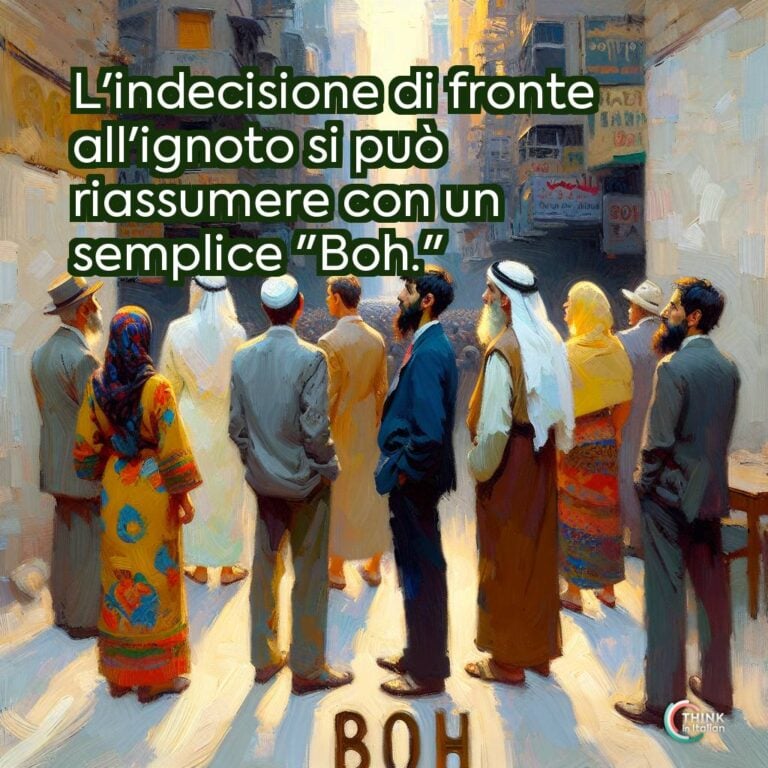

Boh means “I don’t know” in Italian. It is an informal interjection, like English “dunno” or “no idea”, and Italians almost always say it with a shrug.
What’s the meaning of boh? Is it even a real Italian word?
Well, you could consider it as such, although it would be fairer to call it an interjection – an exclamation used to express sudden emotions, like: “Ouch!” or “Hey!”.
For many Italians, boh is such an instinctive reaction that they use it even when speaking in other languages, confusing everyone else.
So, what should you deduce when you hear someone saying it? Let’s find out!
How do you use Boh in Italian? | Dunno in Italian
The meaning of boh is easily explained: boh is the most informal way to say “I don’t know” in Italian. It’s kind of like when we say “dunno.”
A: “Dove sarà Grazia ora?” B: “Boh. L’ultima volta che l’ho sentita viveva a Berlino”
A: “I wonder where Grazia is now” B:” Dunno. Last time I’ve heard from her, she was living in Berlin.”
Boh can also mean “I don’t care” or “I don’t want to talk about it” – always in a conversational way. More generally, it means that the speaker is feeling some kind of indifference or reticence.
A: “Che film vuoi vedere stasera?” B: “Boh… tu hai qualche idea?”
A: “Which movie do you want to see tonight?” B: “I have no preference. Do you have any ideas?”
“Boh… io ti ho dato il mio consiglio, ora fai come ti pare.”
“Dunno… I’ve given you my advice, now do what you want.”
Italians even have a gesture to say boh. It consists of thrusting the chin forward and pulling the lips down while opening the arms. Surely you’ve seen this before in some movie or in real life. It is one of the best-known Italian hand gestures, and it can replace the word completely.
More Examples of Boh
Most of the time boh is a full answer on its own. It can also sit in the middle of a sentence, where it works like “well” or “I don’t know”:
Quanti anni ha il figlio di Maria? Boh, non lo so.
How old is Maria’s son? No idea, I don’t know.
Boh, magari domani il tempo sarà migliore.
Who knows, maybe the weather will be better tomorrow.
Ho molto da studiare e poi, boh, non ho voglia di uscire.
I have a lot to study and then, well, I don’t feel like going out.
In every case the speaker signals that they do not know, do not have a strong opinion, or would rather not commit. The tone tells you which: a short boh with a shrug means “no idea”, while a long, flat one with a raised chin means “I don’t know and I’m not sure I care”.
How to Pronounce and Spell Boh
Boh is one short syllable, pronounced boh with a pure Italian o, without the “oh-w” glide that English adds to words like “go”. The final h is silent.
The standard spelling is boh. In quick messages you will also see bo, which means the same thing. Bho is not correct. The word is probably onomatopoeic: it imitates the sound people make when they are not sure.
Boh vs Mah vs Non lo so
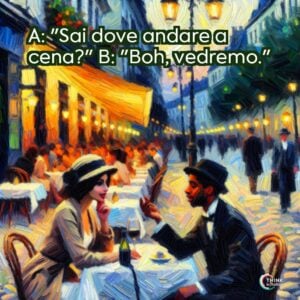
Italian has several ways to say you are not sure, and they do not all sound the same. Boh is the most casual. Mah expresses doubt more than lack of information, as in Mah, vedremo (Well, we’ll see). Here is how they compare:
| Expression | Meaning | Register |
|---|---|---|
| Boh | dunno, no idea | very informal, spoken and in texts |
| Mah | hmm, who knows (doubt or hesitation) | informal |
| Chi lo sa? | Who knows? | informal to neutral |
| Non lo so | I don’t know | neutral |
| Non ne ho idea | I have no idea | neutral |
| Non saprei | I wouldn’t know, I couldn’t say | polite, formal |
When Not to Use Boh
Boh is informal and spoken. It is fine with friends, family and classmates, but it sounds too casual in a job interview, in an email to a professor or with a customer. In those situations, say Non saprei (I couldn’t say) or Non lo so, mi informo (I don’t know, I’ll find out). Boh is only one of many everyday words Italians use in casual speech: see our list of Italian colloquial words.
Boh: Frequently Asked Questions
What does boh mean in Italian?
It means “I don’t know”, like English “dunno”. Depending on the tone, it can also mean “I have no idea”, “I’m not sure” or “I don’t really care”.
Is boh a real Italian word?
Yes. It is an interjection, and Italian dictionaries list it. Italians use it constantly in speech, but you will rarely see it in formal writing.
What does bo mean in Italian?
Bo is just a shorter, informal spelling of boh. The meaning is the same.
Is boh rude?

Not really, but it is casual. Used with someone you do not know, or in answer to a serious question, it can sound dismissive.
Living the Boh Life
The meaning of boh wraps so many words and emotions into one single syllable – how awesome is that?
And it has such a peaceful sound….
Boh isn’t just a word, interjection, or whatever – it’s a way of life:
- “Am I good enough for this? Boh…I’ll find out as I go.“
- “What happens if I fail? Boh…but I’ll get through it!“
- “When will the next post come ou… – no, wait! This example doesn’t fit. 😀
I’ll be back very soon to teach you new Italian words, so don’t forget to check this blog. See you next time!
Learn more about the Italian word Tesoro.