Was Christopher Columbus Italian?

An interactive lesson guiding you from key takeaways to expert insights. Comes with Q&A, useful vocabulary, interactive audio, quizzes and games.

Gli storici concordano ampiamente che Colombo nacque a Genova.
Published Dec 31, 2021
Updated Nov 14, 2024
Written by
Italian language tutor, course author. MEng, MBA. Member of the International Association of Hyperpolyglots (HYPIA). After learning 12 languages, I can tell you that we all master languages by listening and mimicking. I couldn’t find an app to recommend to my students, so I made my own one. With my method, you’ll be speaking Italian from Lesson 1.
Reviewed by
No data was found

Key Takeaways

  • Christopher Columbus was likely born in Genoa, which was an independent city-state in northwestern Italy during his time.
  • Columbus spent significant time in Portugal, marrying a noblewoman and becoming a Portuguese citizen, which fuels debate about his origins.
  • Many believe he was Spanish due to his fluency in Castilian and his service to the Spanish crown, but this doesn't confirm his birthplace.
  • There are theories suggesting he might have Portuguese origins, possibly as the illegitimate son of a noble, but evidence remains inconclusive.
  • Current research, including DNA studies, aims to clarify Columbus's origins, but as of now, his exact background remains uncertain.

Stefano's Insights

Play to see captions...
Ah, Cristoforo Colombo, un personaggio che ha attraversato l'Atlantico per scoprire il Nuovo Mondo e ha lasciato dietro di sé un mare di mistero sulle sue origini. La maggior parte degli storici concorda sul fatto che Colombo sia nato a Genova nel 1451, ma il suo stile di vita avventuroso e le sue numerose residenze in vari paesi europei hanno alimentato molte teorie. Alcuni lo vogliono spagnolo, altri portoghese, ma i documenti storici più accreditati lo indicano come genovese. Io stesso, durante un viaggio a Genova, mi sono trovato a discutere animatamente con un locale su questo tema. Alla fine, forse non sapremo mai con certezza, ma possiamo dire che Colombo era un cittadino del mondo, un po’ come tutti noi oggi.
Ah, Christopher Columbus, a figure who crossed the Atlantic to discover the New World and left behind a sea of mystery about his origins. Most historians agree Columbus was born in Genoa in 1451, but his adventurous lifestyle and multiple residences in various European countries have fueled many theories. Some claim he was Spanish, others Portuguese, but the most credible historical documents indicate he was Genoese. I myself, during a trip to Genoa, found myself in a heated discussion with a local about this topic. In the end, we may never know for sure, but we can say Columbus was a citizen of the world, much like all of us today.

Quick facts

Where was Christopher Columbus born according to most historians?

Most historians agree Columbus was born in Genoa, an independent republic in northwestern Italy, around 1451.

Why is Columbus' biography considered vague and confusing?

His adventurous life, multiple residences, and varied language skills contribute to the confusion about his origins.

Did Columbus ever claim his Genoese origin in his writings?

Yes, documents like notarial acts show Columbus claimed to be born in Genoa.

What major event happened to Columbus in 1476?

Pirates attacked Columbus's ship, after which he floated to the Portuguese shore and made his way to Lisbon.

How did Columbus' life in Portugal influence his future plans?

In Portugal, he married a noblewoman, became a citizen, and developed his idea to reach Asia by crossing the Atlantic.

Why did Columbus first approach Portuguese and English monarchs?

Columbus sought funding for his voyage from Portuguese and English monarchs, who ultimately rejected his proposal.

How did Columbus eventually secure funding for his voyage?

After initial refusals, Spanish monarchs King Ferdinand and Queen Isabella accepted Columbus's proposal to fund his Atlantic voyage.

What evidence suggests Columbus might have been Spanish?

Columbus was fluent in Castilian, signed in Spanish, and used the name Cristóbal Colón, leading some to believe he was Spanish.

Why do some historians think Columbus was Portuguese?

Columbus lived in Portugal, married a Portuguese noblewoman, and possibly referred to Portugal as his homeland, suggesting Portuguese origins.

What ongoing efforts aim to determine Columbus's exact origins?

An international team of scientists is studying Columbus's DNA at the University of Granada to precisely determine his origins.

Audio images

🔊
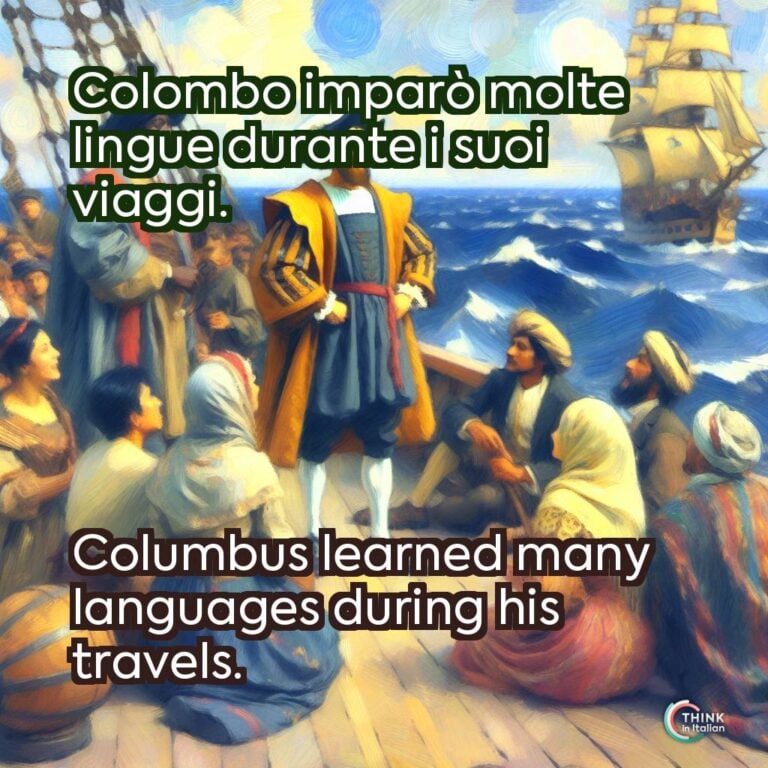
Colombo imparò molte lingue durante i suoi viaggi.
🔊
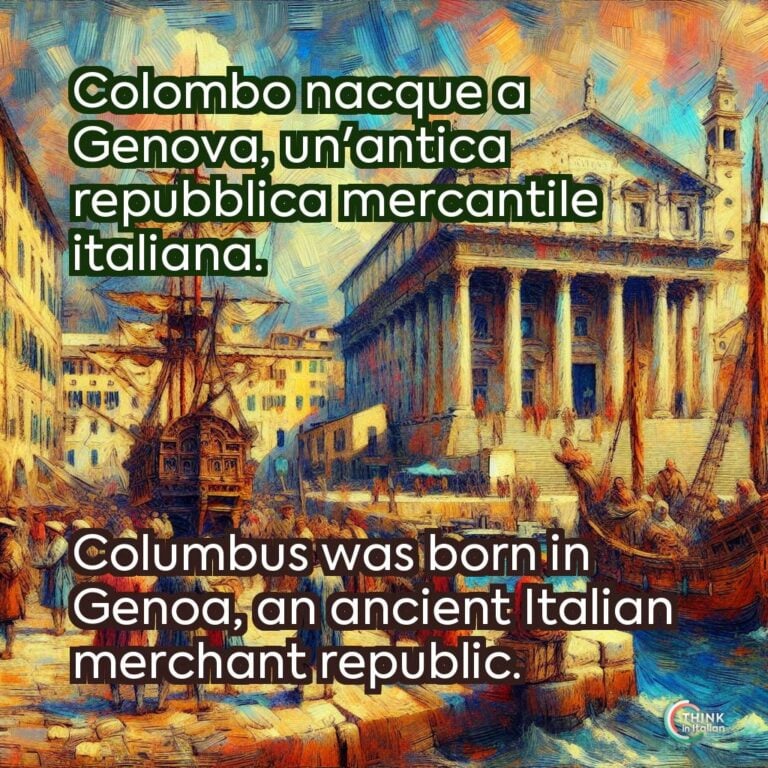
Colombo nacque a Genova, un'antica repubblica mercantile italiana.
🔊
Gli storici concordano ampiamente che Colombo nacque a Genova.

Main Article

Who was Christopher Columbus?

Christopher Columbus (Cristoforo Colombo in Italian) is a figure of immense historical significance. Yet, the question of his origins remains a topic of fascination and controversy.

Most historians agree that Columbus was born in 1451 in Genoa, an independent maritime republic in modern-day Italy. He was the son of Domenico Colombo and Susanna Fontanarossa.

Genoa’s thriving trade and seafaring culture likely inspired Columbus’ fascination with exploration: he began his maritime career as a teenager, participating in trading expeditions across the Mediterranean.

In 1476, he arrived in Portugal, where he married Filipa Moniz Perestrelo and settled for several years. This marriage strengthened his ties to Portugal, where he also refined his navigational skills and developed his plan to reach Asia by sailing west.

After being turned down by the courts of Portugal and England, Columbus secured support from Spain’s Catholic Monarchs, Ferdinand and Isabella.

Under the Spanish flag, he embarked on the voyage across the Atlantic Ocean in 1492, which marked the beginning of European exploration and colonization of the Americas, reshaping global history.

Was Christopher Columbus Italian?

As I mentioned before, the strongest evidence suggests that Christopher Columbus was born in Genoa. Legal documents from Genoa support this claim.

These records identify a Cristoforo Colombo born in 1451 to Domenico Colombo and Susanna Fontanarossa and include property deeds and a will, aligning with key details of Columbus’ life.

Learn Italian on the go
Learn in the car with Think in Italian

There also exists a letter sent in 1498 to the Spanish monarchs where Columbus referred to Genoa as his birthplace, stating: “From there I came, and there I was born”.

This evidence, including his own direct acknowledgment, further solidify the theory of Cristoforo Colombo’s Italian heritage.

Alternative Theories

Was Christopher Columbus Spanish?

Despite the evidence of Columbus’ Genoese heritage, alternative theories suggest he may have been Spanish. He spent much of his life in Spain, serving the Spanish crown, writing in Castilian (medieval Spanish), and often signing documents as Cristóbal Colón.

However, it might be the case that Columbus likely adopted Castilian due to his long residence in Spain and his need to communicate with Spanish officials. Linguistic preferences alone are insufficient to prove his birthplace.

Was Christopher Columbus Portuguese?

Columbus married into Portuguese nobility, a union that some argue would have been unlikely if he were a foreign commoner. A theory even suggests he was the illegitimate son of a Portuguese noble and changed his identity after a naval battle.

There is no concrete evidence linking Columbus to Portuguese nobility. His time in Portugal is more plausibly explained by his career as a sailor and merchant.

Other Theories

The 15th century was a time of poor record-keeping, and many documents from Columbus’ era have been lost or destroyed. This lack of evidence leaves room for competing theories.

Some claim Columbus was Catalan, citing his use of Catalan phrases and customs, while other theories link him to Greece, although these are based on cultural or linguistic evidence that lacks substantial support.

Recent advances in science may offer new insights into Columbus’ origins: in 2021, researchers at the University of Granada launched a project to analyze Columbus’ DNA.
Free Guide
How to Learn Languages Fast

By comparing his genetic material with populations from Genoa, Spain, Portugal, and other regions, scientists hope to resolve the question of his ancestry definitively.

Christopher Columbus: Italian by Birth, a Citizen of the World

While the debate over Columbus’ origins continues, his impact on history transcends national boundaries. He is an iconic figure, particularly among Italian-Americans who celebrate Columbus Day as a tribute to his contributions to global history.

Based on available evidence, Christopher Columbus was most likely born in Genoa. However, his life as a sailor and his service to the Spanish crown led him to adopt multiple cultural identities, reflecting the fluid nature of nationality during his time.

Columbus’ story is not just about his origins: it’s about an era of discovery that transformed the world. As scientific and historical research continues, the mystery of his birthplace may one day be solved.

Until then, Columbus remains a testament to humanity’s enduring curiosity and ambition, embodying the complexities of history and the interconnectedness of our world.

Key Terms and Concepts

Genoa

A historic maritime republic in north-western Italy. It was an independent city-state during Columbus' time and played a significant role in trade and exploration.

City-state

A sovereign city which functions independently, not part of any country. Genoa was a city-state during Columbus' birth, with extensive trading routes.

Cristóbal Colón

The Spanish version of Christopher Columbus' name, reflecting his strong ties and service to the Spanish crown.

Maritime trade

The exchange of goods across sea routes. Genoa and other city-states thrived on maritime trade, which influenced Columbus' early life.

DNA Study

A scientific attempt to determine Columbus' origins by analyzing genetic material, potentially resolving longstanding debates about his birthplace.

Navigator

An expert in planning and directing the course of a ship. Columbus was a skilled navigator, enabling his transatlantic voyages.

Test your knowledge in 10 quick questions

Words

GenovaGenoa
nascitabirth
patronatopatronage
monarchiamonarchy
origineorigin
storiahistory
teoriatheory
cittadinocitizen
repubblicarepublic
DNADNA

Phrases

navigatorenavigator
patronopatron
monarchiamonarchy
GenovaGenoa
nobilenoble
origineorigin
storiahistory
patriahomeland
cittadinanzacitizenship
esploratoreexplorer

Sentences

Cristoforo Colombo è nato nella Repubblica di Genova nel 1451.

Christopher Columbus was born in the Republic of Genoa in 1451.

Colombo ha trascorso molti anni in Portogallo ed è diventato cittadino portoghese.

Columbus spent many years in Portugal and became a Portuguese citizen.

Ha ricevuto il sostegno finanziario dai monarchi spagnoli per le sue esplorazioni.

He received financial support from the Spanish monarchs for his explorations.

Nonostante le teorie alternative, la maggior parte degli storici concorda che Colombo fosse genovese.

Despite alternative theories, most historians agree that Columbus was Genoese.

Studi attuali, inclusi quelli sul DNA, cercano di determinare definitivamente le origini di Colombo.

Current studies, including DNA research, aim to definitively determine Columbus' origins.

Match the Phrases

Memory game

Flip the cards to find matching pairs!

Crossword

Across
Down
Answers

FAQs

Was Christopher Columbus Italian?

The majority of historians agree that Christopher Columbus was born in Genoa, Italy. He left at a very young age to work on trading ships and learned several foreign languages while taking part in trading voyages.

Why is there so much controversy about where Christopher Columbus was from?

Columbus lived in different countries, traveled to several lands, and spoke various languages. His unconventional and adventurous life made it hard to determine his origins. Additionally, he spent much of his life serving different European monarchs, which further complicates the matter.

think in italian reddit

The comments section has moved to the Think In Italian Reddit community. Join today!

Italian word of the day
ammalarti
Finirai per ammalarti per colpa del fumo!
You’ll end up getting sick because of smoking!

What's new

stefano lodola italian teacher (1)
30 Free Courses to Get You Started ($40 Value)
italian audio lesson preview
italian audio reading preview
italian ai tutor preview
"I've tried other apps like Babbel and Memrise. None made me fluent or made me feel like I was making much meaningful progress in learning a language."
testimonial 2
Ecem Topcu
Aug 7, 2025