
Italian sayings about life are short, traditional expressions that sum up a piece of common wisdom, such as Chi va piano va sano e va lontano (“slow and steady wins the race”). On this page you will find more than 50 of them, grouped by theme (life, love, friendship, work, food), each with its English equivalent, the literal meaning when it differs, and advice on when to use it in conversation.
If you are looking for quotes by named authors such as Dante or Leopardi, they are in my guide to Italian quotes by famous Italians. This page is about the anonymous sayings that Italians use in everyday talk.
Download 15 Beautiful Images of Italian Inspirational Quotes
Share your feelings with your loved ones with Italian quotes!
I collected 5 Italian inspirational quotes in 3 formats (desktop, mobile, social) for you to share with friends or to set as your desktop or mobile background images.
Just submit this form to receive the images in your mailbox.
Italian Sayings
A saying, also known as proverb, is a short, commonly used expression that conveys a lesson, traditional knowledge, or a universal truth.
Italian sayings are a treasure of popular wisdom. Nothing defines a culture as distinctly as its language, and sayings are the linguistic element that best encapsulates a society’s values.
These expressions often use metaphorical language to express ideas that have been recognized and validated through generations. They reflect the historical and cultural circumstances in which they have evolved, and provide insight into the collective experiences and beliefs of the people.
With this list of Italian sayings, you can show off your wisdom and understanding of the Italian culture during your next conversation with a native speaker, and add color to the language, sounding competent and comfortable.
Sayings, Proverbs and Idioms: What Is the Difference?
In Italian, a proverb is a proverbio, a saying is a detto and an idiom is a modo di dire. The first two overlap: both are complete sentences that give advice, like Chi dorme non piglia pesci. An idiom is different, because it is a figurative phrase that you fit into your own sentence, like avere le mani in pasta (“to have a finger in many pies”). You will find both kinds below. For a longer list of the traditional ones, read my Italian proverbs, and for the figurative phrases, my guide to Italian idioms.
Famous Italian Sayings That Italians Really Use
Italian Phrases About Life
Something that I am good at doing, is lighten up heavy situations with some sarcasm. I believe it is a typical trait of Italian people, which might explain why we have so many sayings about different situations that might occur in life.
The Italian sayings below all convey some sort of truth in a direct, sometimes witty, manner that makes this kind of message powerful.
Tutto è bene ciò che finisce bene.
All is well that ends well.
La gatta frettolosa ha fatto i gattini ciechi.
Haste makes waste.
Literally: The hasty cat gave birth to blind kittens.
A buon intenditor poche parole.
A nod’s as good as a wink.
Literally: Few words to a good listener.
Non tutte le ciambelle riescono col buco.
Not all doughnuts come out with a hole.
Literally: Not everything turns out as planned.
Rosso di sera, bel tempo si spera.
Red sky at night, shepherd’s delight.
Literally: Red sky in the evening, one hopes for good weather.
Mal comune, mezzo gaudio.
A trouble shared is a trouble halved.
Literally: Common bad, half rejoice.
L’erba del vicino è sempre più verde.
The grass is always greener on the other side.
Literally: Neighbor’s grass is always greener.
Feeding your mind with inspiring sayings daily is a great practice to boost your positivity.
Short Italian Sayings
Many Italian sayings can result in long, tricky, and intricate sentences. Here, I will list short Italian sayings you might want to learn to start mastering this metaphorical language.
Meglio tardi che mai.
Better late than never.
Quel ch’è fatto, è fatto.
What is done is done.
Tempo al tempo.
All in good time.
Literally: Time to time.
La vita è bella.
Life is beautiful.
Chi cerca trova.
Seek and you shall find.
Non c’è due senza tre.
Things come in threes.
Literally: There is no two without three.
Piano piano si va lontano.
Little by little, you go far.
Italian Sayings About Food
Of course, Italians could not avoid creating some sayings about food. This really shows how deeply rooted the Italian cuisine is.
Cercare il pelo nell’uovo.
To be picky, to nitpick.
Literally: to look for hair in the egg.
Essere in un bel pasticcio.
To be in a pickle.
Literally: to be in a nice pie.
Avere le mani in pasta.
To have a finger in many pies.
Literally: to have your hands in the dough.
Tutto fa brodo.
Every little bit helps.
Literally: everything makes broth, soup.
Italian Sayings About Life’s Ups and Downs
These sayings help you accept a change of plans, stay hopeful or cheer up a friend.
Finché c’è vita c’è speranza.
While there’s life, there’s hope.
Il mondo è bello perché è vario.
Variety is the spice of life.
Literally: The world is beautiful because it is varied.
Fare di necessità virtù.
To make a virtue of necessity.
Il tempo è galantuomo.
Time will tell.
Literally: Time is a gentleman. It means that, with time, the truth comes out.
Ride bene chi ride ultimo.
He who laughs last laughs best.
Chi si contenta gode.
Be happy with what you have.
Literally: Whoever is content, enjoys.
Ogni lasciata è persa.
You snooze, you lose.
Literally: Every chance you leave behind is lost.
Italian Sayings About Love
These sayings talk about the heart, first love and finding someone who is like you.
Al cuor non si comanda.
The heart wants what it wants.
Literally: You cannot give orders to the heart.
L’amore è cieco.
Love is blind.
Il primo amore non si scorda mai.
You never forget your first love.
Chiodo scaccia chiodo.
One nail drives out another. A new love helps you forget the old one.
Chi si somiglia si piglia.
Birds of a feather flock together.
Literally: Those who resemble each other get together.
Italian Sayings About Friendship and Family
Friends and family are a favourite subject of Italian proverbs, and these are among the best known.
Chi trova un amico trova un tesoro.
A true friend is a treasure.
Literally: He who finds a friend finds a treasure.
Meglio soli che male accompagnati.
Better alone than in bad company.
L’unione fa la forza.
United we stand.
Literally: Union makes strength.
Tale padre, tale figlio.
Like father, like son.
I panni sporchi si lavano in famiglia.
Don’t wash your dirty laundry in public.
Literally: Dirty clothes are washed in the family.
Italian Sayings About Patience and Hard Work
Use these when someone is in a hurry, feels discouraged or needs a push to start.
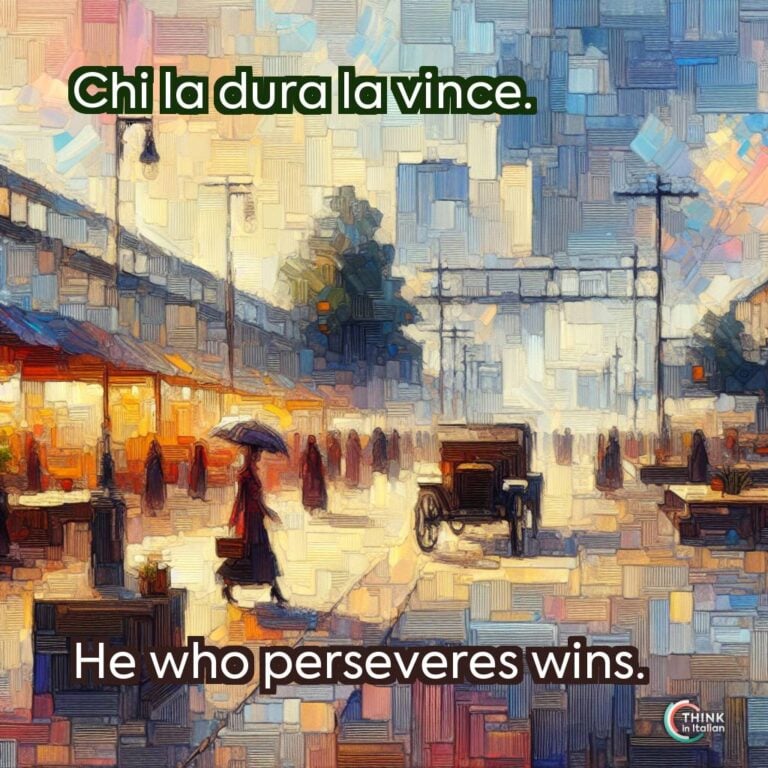
Chi la dura la vince.
Persistence pays off.
Literally: He who endures it, wins it.
Roma non è stata costruita in un giorno.
Rome wasn’t built in a day.
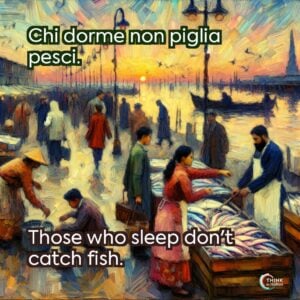
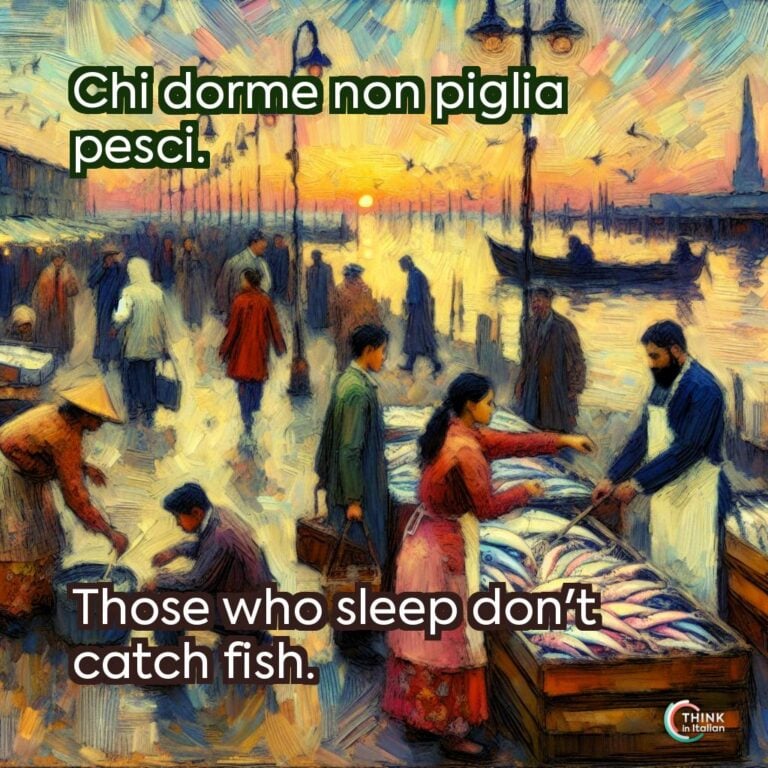
Chi dorme non piglia pesci.
The early bird catches the worm.
Literally: He who sleeps doesn’t catch fish.
Volere è potere.
Where there’s a will, there’s a way.
Literally: To want is to be able.
Chi fa da sé fa per tre.
If you want something done well, do it yourself.
Literally: He who does it by himself does it for three.
Batti il ferro finché è caldo.
Strike while the iron is hot.
Chi ben comincia è a metà dell’opera.
Well begun is half done.
Literally: He who begins well is halfway through the work.
Italian Sayings About Wisdom and Common Sense
These are the sayings people use to warn, advise or remind someone to keep a cool head.
L’abito non fa il monaco.
Don’t judge a book by its cover.
Literally: The habit doesn’t make the monk.
Non tutto quel che luccica è oro.
All that glitters is not gold.
Can che abbaia non morde.
His bark is worse than his bite.
Literally: A dog that barks doesn’t bite.
La notte porta consiglio.
Sleep on it.
Literally: The night brings advice.
Meglio un uovo oggi che una gallina domani.
A bird in the hand is worth two in the bush.
Literally: Better an egg today than a hen tomorrow.
A caval donato non si guarda in bocca.
Don’t look a gift horse in the mouth.
Errare è umano, perseverare è diabolico.
To err is human, to persist in error is diabolical.
When to Use Sayings in Italian?
In Italian culture, sayings are used frequently in conversations, by people of all ages, from children to elderly people. This demonstrates that Italian quotes are integrated into various facets of Italian communication, from daily conversations to literature and educational settings, enriching language and cultural understanding.

There are different situations when you can make use of Italian sayings.
- Giving advice: Italians often use sayings to offer advice in a wise and authoritative way. For example, “Chi va piano, va sano e va lontano” (The one who goes slowly, goes safely and far) might be used to advise someone to take their time and not rush.
- Making a point: Sayings can be used to emphasize a point or to reinforce an argument. “Non tutto il male viene per nuocere” (Not all that is bad comes to harm) could be used to highlight the silver lining in a bad situation.
- During storytelling: Sayings add flavor and depth to stories and anecdotes, often serving as a moral or punchline.
- In casual conversations: Italians might sprinkle sayings into dialogue to express something in a more impactful way, relating common experiences with cultural flair.
Using sayings appropriately requires an understanding of both the literal and deeper meanings of the phrases, as well as sensitivity to the cultural context in which they are used.
A natural way to introduce a saying is come si dice (“as they say”) or come dice il proverbio (“as the proverb says”). Here is how it sounds in a short exchange:
Scusa, sono arrivato in ritardo.
Sorry, I arrived late.
Non ti preoccupare, meglio tardi che mai!
Don’t worry, better late than never!
Non so se accettare il lavoro.
I don’t know whether to accept the job.
La notte porta consiglio, ne riparliamo domani.
Sleep on it, we’ll talk about it tomorrow.
Come si dice, chi dorme non piglia pesci.
As they say, the early bird catches the worm.
Ready to Use These Beautiful Italian Phrases
Italian sayings are more than just idiomatic expressions; they are the essence of centuries-old wisdom passed down through generations.
These sayings enrich everyday language, offering insights into Italian culture, values, and traditions. Whether used to impart wisdom, provide comfort, or simply add flavor to a conversation, Italian sayings are a proof of the rich linguistic history of Italy.
By embracing and understanding these sayings, you will enhance your linguistic skills and deepen your appreciation of the Italian way of life.
Next time you find yourself conversing with a native speaker or exploring Italy, remember to sprinkle some of these sayings into your dialogue, and I promise they’ll enrich your interactions and bring you closer to the heart of Italian culture.