“A Parte” in Italian
The Italian a parte is a versatile expression with different meanings that highly depend on the context. By understanding its multiple uses and common expressions, you’ll add sophistication and depth to your Italian communication.
The phrase a parte originates from Latin. It is composed of the preposition a and the noun parte, derived from the Latin pars, partis meaning “part” or “side”.
If you translate it literally, it means “from the part” or “to the side”, but it evolved first into an expression to indicate physical separation, and then also metaphorical and idiomatic meanings.
How to use “a Parte”
Separate or Different
A parte is often used to describe something distinct, unique, or set apart.
Questo progetto è davvero a parte.
This project is truly unique.
Tonia vive in un mondo a parte.
Tonia lives in a different world.
Il vino è a parte, non è compreso nel prezzo.
The wine is separate. It’s not included in the price.
Except
When expressing exceptions, a parte functions similarly to “except” or “apart from”.
Sono venuti tutti, a parte lui.
They all came, except him.
Non sto vedendo nessun’altro, a parte te.
I’m not seeing anyone else except you.
A parte Giovanni, nessuno è venuto alla festa.
Apart from Giovanni, no one came to the party.
Aside or Apart
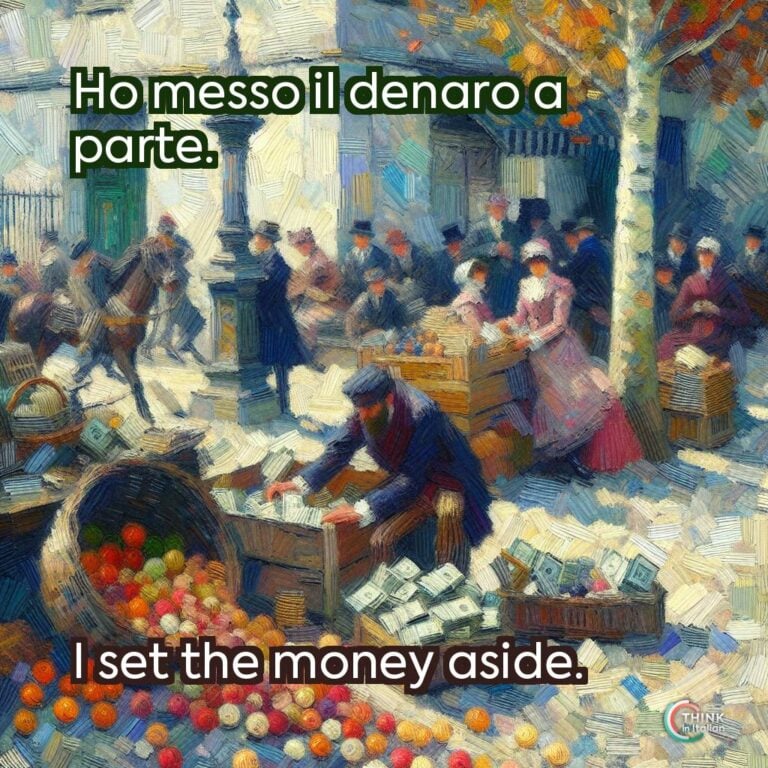
This use is common when putting something metaphorically or literally aside.
Metti il piatto a parte, per favore.
Set the plate aside, please.
Modestia a parte, le mie torte sono insuperabili!
Modesty aside, my cakes are unbeatable!
Scherzi a parte, dobbiamo decidere cosa fare.
Jokes aside, we need to decide what to do.
Reserved or Exclusive
In formal or professional contexts, a parte can imply something reserved or private.
Vorremmo un tavolo a parte, grazie.
Wed like a private table, please.
Abbiamo discusso il problema a parte per trovare una soluzione.
We discussed the issue in private to find a solution.
Questo argomento lo teniamo a parte per domani.
Let’s reserve this topic for tomorrow.
Idiomatic Phrases
A parte shines in idiomatic expressions, specifically as a fixed expression that makes conversations more fluid and natural.
- A parte il fatto che: this means “apart from the fact that” or “leaving aside the fact that”. It is commonly used to introduce a topic that the speaker might imply, but which is necessary for the following statement.
A parte il fatto che non voglio uscire, non ci sono treni per arrivare in centro.
Apart from the fact that I do not want to go out, there are no trains to get to the centre.
A parte il fatto che il film è troppo lungo, la storia è interessante.
Apart from the fact that the movie is too long, the story is interesting.
- A parte che: a shortened version of a parte il fatto che, this is more common in spoken Italian.
A parte che è difficile, ci proverò comunque.
Aside from the fact that it’s difficult, I’ll try anyway.
Non sappiamo niente, a parte che dobbiamo studiare.
We don’t know anything except that we have to study.
- Scherzi a parte: this is a widely recognized phrase meaning “jokes aside” or “all kidding aside”. Used when the interlocutor wants to bring the conversation back to a serious tone.
Scherzi a parte, cosa ti ha detto?
Jokes aside, what did he tell you?
Other Ways to say “a Parte” in Italian
There are some other alternative expressions that you can use to convey the meaning that is carried by a parte. These are eccetto (except), tranne (except for), and oltre (besides).
If you want to express exceptions, you can use eccetto and tranne:
Eccetto Giovanni, tutti sono venuti.
Except for Giovanni, everyone came.
Tranne il vino, tutto è incluso.
Except for the wine, everything is included.
In contexts where a parte implies “in addition to” or “besides”, oltre works well:
Oltre a questo, non ho altro da dire.
Besides this, I have nothing else to say.
While a parte often conveys physical or metaphorical separation, these synonyms provide more targeted ways to refine your meaning.
A Parte: Essential for Learners
A parte is far more than just a prepositional phrase: it’s a powerful tool for nuanced expression in Italian. Learn how to use it effectively to naturally express exceptions and add conversational asides, in both formal and informal contexts.
To avoid overuse, consider synonyms like eccetto or tranne for variety, and pay close attention to context to capture its subtle contrasts.
Mastering a parte and its set phrases will elevate your Italian skills, allowing you to add versatility to your conversations. Let a parte become your key to sounding fluent and confident, just like a native speaker!