How to Express Future in the Past: Italian Grammar Lesson

An interactive lesson guiding you from key takeaways to expert insights. Comes with Q&A, useful vocabulary, interactive audio, quizzes and games.

Sarei andato al mare, ma ha piovuto.
Published Sep 14, 2020
Updated Apr 2, 2025
Written by
Italian language tutor, course author. MEng, MBA. Member of the International Association of Hyperpolyglots (HYPIA). After learning 12 languages, I can tell you that we all master languages by listening and mimicking. I couldn’t find an app to recommend to my students, so I made my own one. With my method, you’ll be speaking Italian from Lesson 1.
Reviewed by
A linguist specializing in psycholinguistics and Italian language education. I hold a Research Master’s in Linguistics and teach Italian, passionately connecting research with practical teaching.

Key Takeaways

  • To express the future in the past, use the condizionale passato in Italian, combining an auxiliary verb with a past participle.
  • The past conditional is formed with the present conditional of essere or avere plus the past participle of the main verb.
  • Examples include expressing desires, opinions, and doubts from a past perspective, enhancing narrative depth.
  • When using essere, ensure the past participle agrees in gender and number with the subject.
  • Practice the past conditional to improve your Italian storytelling skills and enrich your communication.

Audio images

🔊
Sarei andato al mare, ma ha piovuto.
🔊
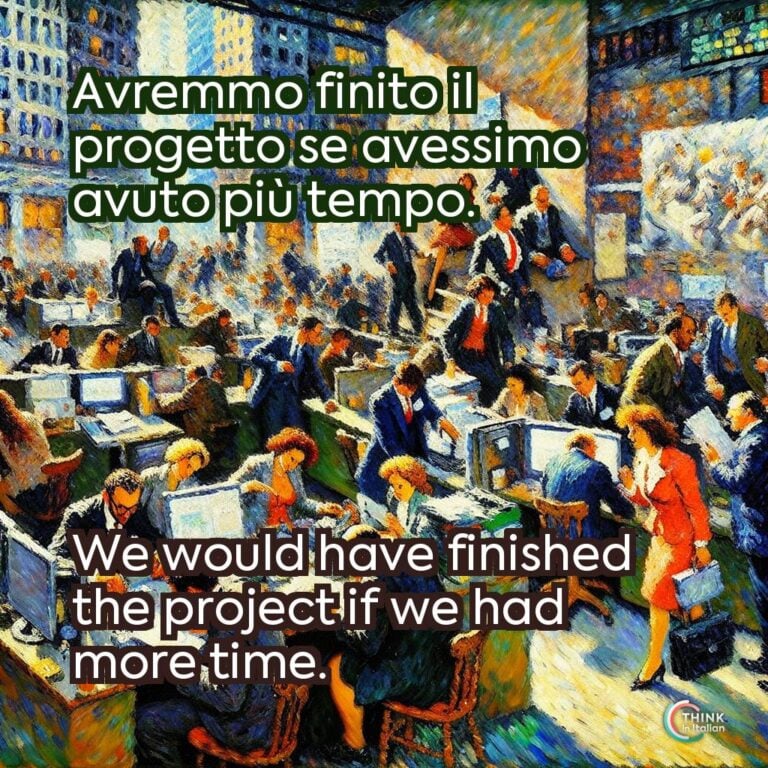
Avremmo finito il progetto se avessimo avuto più tempo.
🔊
Mi ha promesso che avrebbe chiamato.

Audio lesson with 30 sentences to listen and repeat

Italian grammar video lesson

Main Article

How to Express Future in the Past in Italian

The Conditional Mood

To express the future in the past in Italian, we use the past conditional (condizionale passato). Along with the present conditional (condizionale presente), these two verb tenses create the conditional mood.

The conditional mood in Italian is used to express politeness, possibility, wish, or hypothetical scenarios, and its structure is the following:

Present conditional of the auxiliary verb (essere/avere) + past participle of the verb.

Present Conditional

The present conditional is used to express:

  • Polite requests or offers:

Vorrei un caffè.

I would like a coffee.

  • Hypothetical scenarios:

Se avessi tempo, leggerei un libro.

If I had time, I would read a book.

Past Conditional

The past conditional is used for:

  • Present events from a past viewpoint:

Marco mi ha detto che sarebbe venuto.

Marco told me he would have come.

  • Hypothetical scenarios in the past:

Avrei viaggiato, se avessi avuto i soldi.

I would have traveled, if I had had the money.

Future in the Past: Examples

Now let’s look at some examples to understand how it’s created and used.

  • Expressing a desire in the past.

Mi sarebbe piaciuto fare foto ma non avevo il cellulare.

I would have loved to take pictures, but I did not have my phone.

  • Personal opinion in the past.

Mi dispiace che l’evento sia stato cancellato. Sarebbe stato interessante.

I’m sorry that the event got canceled. It would have been interesting.

  • Giving advice in the past.

Non avresti dovuto lasciarla andare!

You shouldn’t have let her go!

  • Expressing a doubt in the past.

Cosa avrei potuto fare per fermarli?

What could I have done to stop them?

Il bambino sarebbe stato avvistato al confine con la Spagna.

The kid would have been seen at the Spanish border.

  • Future in the past.

Mi ha detto che avrebbe fatto presto.

He told me he would’ve been early.

How to Create the Past Conditional

Auxiliary Avere

Let’s revise together the conjugation of the past conditional with the auxiliary verb avere. Remember, this is used with transitive verbs.

  • Io avrei comprato – I would have bought
  • Tu avresti comprato – You would have bought
  • Lui/Lei avrebbe comprato – He/She would have bought
  • Noi avremmo comprato – We would have bought
  • Voi avreste comprato – You would have bought
  • Loro avrebbero comprato – They would have bought

Auxiliary Essere

Let’s revise together the conjugation of the past conditional with the auxiliary verb essere. Remember, this is used with intransitive verbs, and it is essential that the past participle agrees with the subject in terms of gender and number.

  • Io sarei venuto/a – I would have come
  • Tu saresti venuto/a – You would have come
  • Lui/Lei sarebbe venuto/a – He/She would have come
  • Noi saremmo venuti/e – We would have come
  • Voi sareste venuti/e – You would have come
  • Lorosarebbero venuti/e -They would have come

Practice Makes it Perfect

In Italian, expressing the future in the past is an essential grammatical structure that allows you to reflect on expectations, intentions, or possibilities that were considered in the past.

Here, you have learned how to use the past conditional to do so, in order to communicate what was anticipated or planned at an earlier time.

This verb tense will add depth to narratives: it’s particularly useful in storytelling, historical recounts, and reflective writing. Practice this structure to improve your Italian, and enrich both your spoken and written communication!

Key Terms and Concepts

Words

condizionaleconditional
passatopast
futurofuture
ausiliareauxiliary
transitivotransitive
intransitivointransitive
verboverb
participioparticiple
intenzioneintention
possibilitàpossibility

Phrases

condizionale passatopast conditional
avrei compratoI would have bought
sarei venuto/aI would have come
futuro nel passatofuture in the past
aspettativeexpectations
intenzioniintentions
possibilitàpossibilities
verbi transitivitransitive verbs
verbi intransitiviintransitive verbs
struttura grammaticalegrammatical structure

Sentences

Pensavo che lui avrebbe comprato una nuova macchina.

I thought he would have bought a new car.

Sapevamo che saresti arrivato in ritardo.

We knew you would have arrived late.

Credevano che avreste finito il lavoro entro venerdì.

They believed you would have finished the work by Friday.

Immaginavo che avremmo passato le vacanze al mare.

I imagined we would have spent the holidays at the beach.

Era sicura che sarebbero tornati a casa per cena.

She was sure they would have returned home for dinner.

FAQs

What is the future in the past?

The future in the past is one of the forms in the Conditional mood. It is used for expressing situations and events considered as potential or subordinated to a condition.

What is the structure of the future in the past?

The Present conditional of essere/avere verbs and the Past participle of the main verb

think in italian reddit

The comments section has moved to the Think In Italian Reddit community. Join today!

Italian word of the day
senti
Da quando non senti Elena? Da gennaio.
How long has it been since you heard from Elena? Since January.

What's new

Social signup
"I've tried other apps like Babbel and Memrise. None made me fluent or made me feel like I was making much meaningful progress in learning a language."
testimonial 2
Ecem Topcu
Aug 7, 2025
Social login (faster)