You can find Italian short stories as free PDFs in two legal places: stories written for learners by sites that publish them for free, and public-domain classics whose copyright has expired, such as Le avventure di Pinocchio on Project Gutenberg. The collections below are made for beginners, and if you want to read something right now, there is a short A1 story further down this page.
The Best Short Italian Stories
1. Bite-sized Stories by Think in Italian

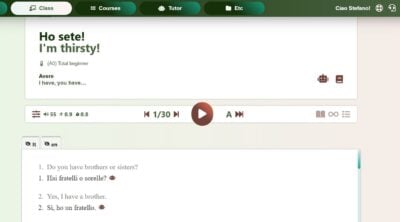
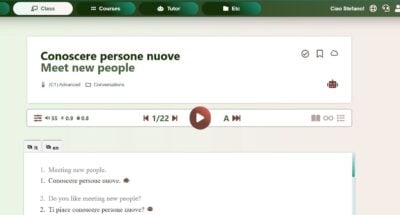
Think in Italian offers a collection of Italian reading materials tailored for learners at various proficiency levels. You can read over 1,200 bite-sized, 1-minute reads complete with Italian and English audio and transcripts.
This collection accompanies texts with audio recordings, vocabulary lists, and comprehension questions. It is designed to enhance reading skills, improve vocabulary, and boost comprehension through engaging and level-appropriate stories.
You will find captivating stories, news articles, real-life dialogues, jokes, and songs that will make your Italian learning process engaging and educational.
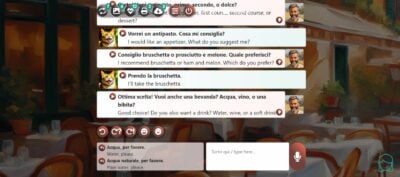
You can even take your comprehension to the next level by discussing your readings with our AI tutor; engage in personalized conversations and delve into the text’s subtleties to deepen your grasp of the Italian language.
2. Racconti Italiani per Principianti by Olly Richards
This book is a highly recommended Italian short story collection for beginners. It is specifically designed for beginners, offering simplified stories that are accessible for learners who have just started their language journey.
The stories cover a wide range of themes, including everyday life and daily routines, travel and exploration, and relationships and romance.
Each story is written in clear and concise language, allowing you to understand and follow along without feeling overwhelmed. It also includes vocabulary lists and exercises to help learners practice and reinforce their understanding of the Italian language.
Check our review of Olly Richards’ language app
3. Italian Short Stories for Beginners by Lingo Mastery
This is a valuable resource for people who just started learning Italian. Its stories are specifically designed for beginners, given their simple and straightforward language which allows learners to understand and follow along with the plot more easily.
The stories cover a variety of interesting topics and themes, are accompanied by vocabulary lists, grammatical explanations, and exercises, as well as audio recordings of the stories, which learners can listen to while reading. This helps improve listening skills, pronunciation, and overall comprehension.
4. Easy Italian Reader: L’Italiano Facile by Riccarda Saggese
This is a highly recommended book for beginner Italian learners. It features multiple short stories written in simplified Italian, making it suitable for new learners.
Its stories cover varied themes related to everyday life, travel, and relationships, and also includes vocabulary and comprehension exercises to aid learning and enhance language proficiency.
Read a Short Italian Story Now (A1)
Here is a very short story in the present tense. Read it once without the translation, then check it.
Il gatto di Marta
Marta ha un gatto. Il gatto si chiama Micio. Ogni mattina Micio ha fame e miagola vicino alla cucina. Marta si alza, apre una scatoletta e dà da mangiare al gatto. Poi prepara il caffè. Micio mangia, beve un po’ d’acqua e dorme sul divano tutto il giorno.
Marta has a cat. The cat is called Micio. Every morning Micio is hungry and meows near the kitchen. Marta gets up, opens a tin of cat food and feeds the cat. Then she makes coffee. Micio eats, drinks a little water and sleeps on the sofa all day.
Words to notice:
- avere fame – to be hungry (literally “to have hunger”)
- alzarsi – to get up (Marta si alza)
- dare da mangiare a – to feed
Now test yourself:
Come si chiama il gatto?
What is the cat called? (Micio)
Che cosa prepara Marta?
What does Marta make? (Il caffè, coffee)
Dove dorme Micio?
Where does Micio sleep? (Sul divano, on the sofa)
Where to Find Free Italian Short Stories and PDFs
- Stories written for learners. Learn-italian-online.net publishes adapted stories and classics from A1 to C1 as free PDFs. MeloLingua has free A1 stories to read online, with audio and comprehension questions.
- Public-domain originals. Project Gutenberg and Italian Wikisource host books whose copyright has expired, for example Carlo Collodi’s Le avventure di Pinocchio. The language is 19th-century Italian, so it is best from B1, with a dictionary next to you.
- My own readings. If you want stories, news and conversations as a PDF with audio, my pack of 36 readings covers levels from total beginner to B1, with slow audio, transcripts and translations. It is a paid download, not a free one. For more free PDFs, see my guide to learning Italian with PDF resources.
Some people search for the PDF of one specific book, such as Non è sempre la solita storia: dal nord al sud (Italian Stories, Level 3) or a paid collection like the ones listed above. Those are commercial books. Copies found on file-sharing sites are usually not authorised, so buy the ebook, borrow it through a library app or read the sample chapter on the publisher’s website.
Italian Stories for Beginners
Why Read Italian Short Stories?
When I started learning Russian, one of the most magical experiences was diving into Russian stories. That’s why I suggest you read Italian narratives, that are filled with rich culture and vibrant characters, which bring the language to life in ways textbooks cannot.
Beginner stories are crafted with learners in mind, using simple language and structures. This makes them perfect for grasping the basics. For instance, a story might start with:
Oggi è domenica. Luca si sveglia tardi e fa colazione con calma.
Today is Sunday. Luca wakes up late and has a relaxed breakfast.
Also, reading stories helps in naturally expanding your vocabulary. Each new word is presented in context, which aids memory retention.
Stories are an excellent tool for improving comprehension. They require you to grasp the main idea without getting overwhelmed by every unfamiliar word. I remember the satisfaction of grasping the plot of a story, even if I didn’t understand every single word.
For instance, consider a sentence like:
Il cielo era grigio e sembrava che stesse per piovere.
The sky was gray and it looked like it was about to rain.
Even if you don’t know the word sembrare (to seem), you can understand its meaning from the context of the weather description.
Finally, if you are an Italian language learner, Italian stories will offer you a window into the culture, traditions, and daily life of Italy.
Practical Tips for Reading Italian Stories
- Start Simple
Begin with short stories designed for beginners, with simple vocabulary and grammar structures, and gradually progress to more complex texts as your proficiency improves. Children’s book are perfect for this: they are designed with simple language and colorful illustrations to help you understand the context.
- Use Bilingual Books
Use bilingual books that feature Italian and English (or your native language) translations side by side. This will help you grasp the meaning of unfamiliar words or phrases without losing the narrative flow or, if you are impatient like me, without getting frustrated!
- Listen and Read
Practice reading Italian aloud to improve pronunciation and fluency. If possible, include audio recordings of the stories in your reading practice to enhance listening skills and familiarize yourself with native Italian accents and intonations.
- Take Notes and Review Vocabulary
Keep a vocabulary journal to write down new words and expressions you encountered while reading. Review and revise the vocabulary regularly to reinforce learning and expand your language repertoire.
A Three-Pass Method for Reading a Story
- Read for the gist. Go through the whole story without stopping to look up words. Ask yourself who the characters are and what happens.
- Read again and mark the words you don’t know. Look up only the ones that block the meaning, about five to ten per page.
- Read a last time out loud. Use the translation to check the parts you weren’t sure about, and try to retell the story in your own words.
Which Level Should You Start With?
| Your level | What to read |
| A1 | Very short stories in the present tense, with a vocabulary list and an English translation next to the text |
| A2 | Graded readers with past tenses, short dialogues and comprehension questions |
| B1 | Adapted classics, fairy tales and longer graded readers with a glossary |
| B2 and above | Original short stories and novels by Italian authors, with a dictionary |
Popular Italian Short Stories Authors
The authors below write literary Italian, so they suit intermediate readers (B1 to B2) better than complete beginners. If you are at A1 or A2, start with the collections above and come back to these authors later. For more names, see my list of famous Italian writers.
Giovanni Verga
Giovanni Verga was an influential Italian author, famous for his short stories that are suitable for beginners. He is known for his realistic and naturalistic style, and for his stories that offer a deep insight into Italy’s everyday life during the late 19th century.
I personally really like Verga’s stories, because they depict various aspects of life, including the struggles of peasants, the hardships of rural living, and the complexities of human relationships, exploring important themes of poverty and social injustice.
With his stories, beginners can enhance their language learning skills by immersing themselves in authentic Italian literature. You will also cultivate a better understanding of Italian history and culture through his vivid and descriptive storytelling.
Italo Calvino
Another important Italian writer I love is Italo Calvino, recognized for his unique writing style and inventive storytelling techniques. Calvino’s works often explore complex themes and combine elements of fantasy and reality.
Italo Calvino’s stories can be a great choice for beginners looking to expand their Italian language skills. His writing style is accessible, making it easier for language learners to understand and appreciate the Italian language.
Calvino’s writing has been praised for its thought-provoking nature and philosophical undertones. If you, like me, enjoy exploring deep philosophical concepts and unconventional narratives, you will love Calvino’s works and appreciate his ability in pushing the boundaries of storytelling.
Elsa Morante
Elsa Morante’s works are invaluable for beginners thanks to her rich and deep writing style, which, for me, make her one of the most able Italian novelist in merging together complex narratives and vivid descriptions.
Her rich vocabulary and complex sentence structures provide learners with a chance to see Italian used in varied and expressive ways, while evoking intense emotions and provoking critical thinking.
Morante’s works often explore themes of social issues, identity, and complexities of human relationships. Through her novels, beginners can improve their language skills while gaining a profound understanding of the country’s heritage.
Reading as a learning tool
Reading Italian short stories is a great way for beginners to improve their language skills. It allows for practicing vocabulary and grammar patterns in a more engaging and practical context. Short stories also provide exposure to correct grammar and sentence structure, helping beginners absorb the language more effectively.
Discuss the stories you read
Discussing the stories with tutors, teachers, or language partners is important for effective learning as it allows beginners to practice speaking and listening skills. It provides an opportunity to practice real-life conversation and receive feedback on language usage. Additionally, discussing the stories can deepen understanding, clarify any misunderstandings, and offer insights into cultural aspects associated with the language.
re-reading short stories
Re-reading short stories multiple times over a few months can be highly beneficial for language learning. It helps in retaining vocabulary and reinforcing newly acquired knowledge. Repeated exposure to the same stories also aids in internalizing grammar patterns, sentence structures, and idiomatic expressions, leading to improved comprehension and fluency.
Recommended resources for beginners
For beginners, websites like “Noi parliamo italiano” and “Favole della buonanotte” offer easy-to-navigate resources with practical examples and simplified Italian short stories. These platforms provide convenient formats such as audio and PDF files, allowing beginners to read online or put away their reading practice options for later use.
Short story books for beginners
There are short story books available that beginners can use to boost their Italian language skills. Books like “Grimm Stories” offer a collection of Grimm fairy tales in Italian, providing an opportunity to read in both English and Italian through side-by-side comparison. Ercole Guidi’s Parallel Texts offer Italian and English versions of popular short stories and excerpts from longer works by famous authors, catering to the needs of beginners.
LingQ platform
LingQ is a recommended platform that stores various Italian short stories and related content in one place. It offers professionally created lessons and the ability to import your own content, providing a wide range of reading materials and flexibility. LingQ’s features like easy vocabulary look-up, vocabulary saving and review using LingQ’s SRS (Spaced Repetition System), a mobile app for on-the-go learning, and more, enhance the learning experience for beginners.