How I test and score
I sift through the plethora of language apps, delivering reviews based on deep expertise in language learning and teaching.
My review process starts with an initial walk-through, using the app for at least 15 minutes to capture first impressions and usability.
I then conduct a criteria-based evaluation focusing on key features like spaced repetition, user customization, and the balance between educational content and gamification.
My reviews are thorough, with a scoring system that emphasizes course quality (70%) over user experience (20%) and price (10%).
Importantly, I do not receive payment for these reviews.
Learn more on my review policy and process page.
Summary
Course quality
User experience
Pricing
Pros
- Real-time feedback improves speaking accuracy
- Interactive AI conversations feel natural
- Customizable topics and difficulty
- Practical real-life scenarios
- Available on mobile devices
Cons
- Requires stable internet connection
- Limited focus on grammar explanations
- Voice recognition can be inconsistent
- Less structured learning path
- Limited depth in some areas
Best suited for
Learners who want to improve Italian speaking through real conversations
At a glance

App name
Univerbal
Made by
Univerbal (formerly Quazel)
User base
Sentiment
- Helpful for speaking practice
- Feedback improves grammar awareness
- Easy to use interface
- Voice recognition sometimes inaccurate
- Lacks structured lessons
Concept
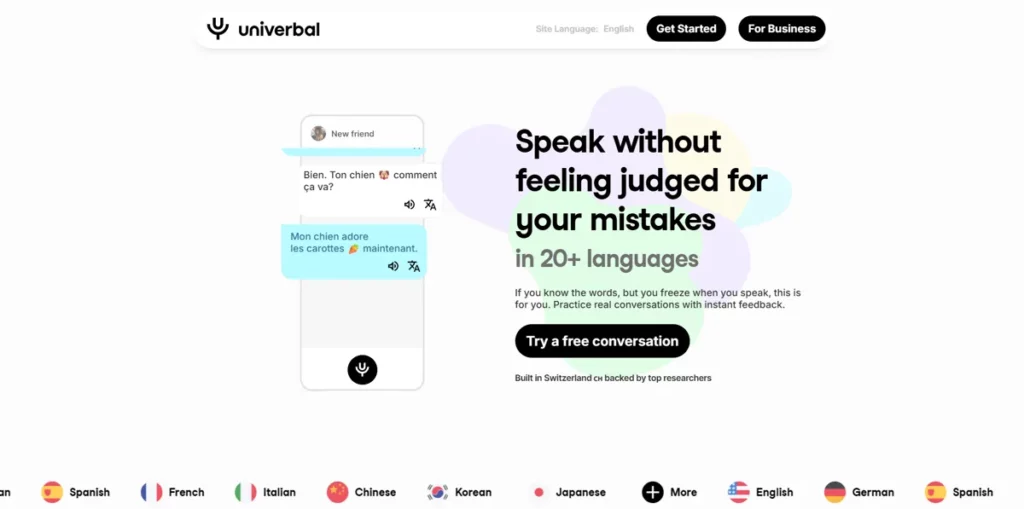
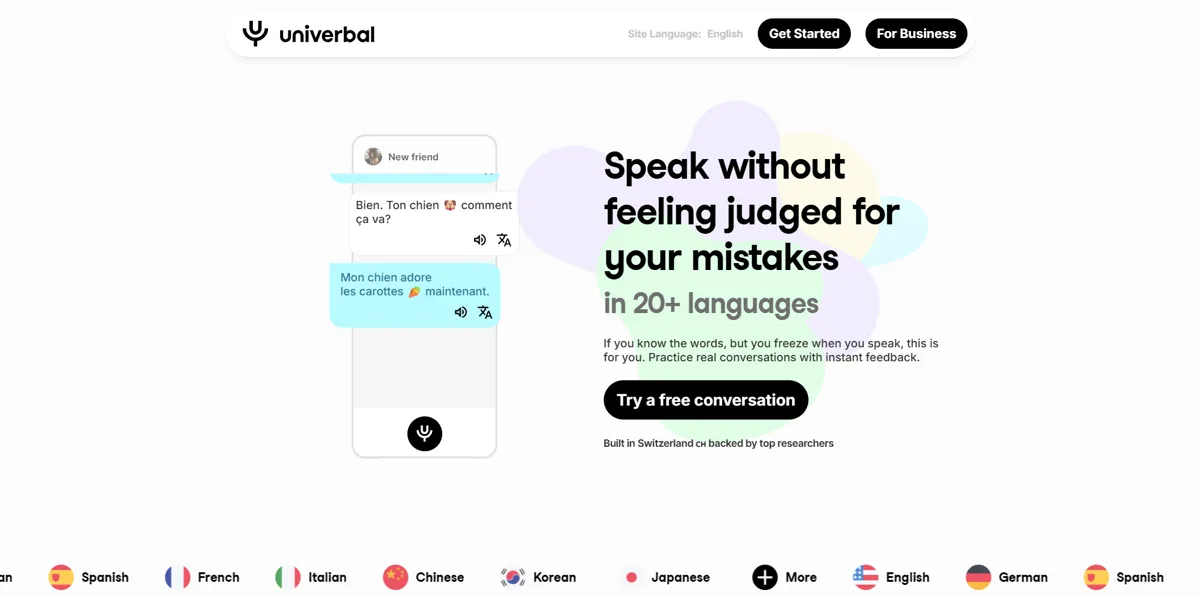
AI app for learning languages through real-time conversation practice
Available on
iOS, Android, Web
Levels covered
(A1) Beginner, (A2) Elementary, (B1) Intermediate, (B2) Upper-intermediate
20 languages taught
Italian, English, Spanish, French, German, Japanese, Chinese, Russian, Turkish
Pricing, free trial, refunds
Pricing
Free trial
Refunds
First-hand review
Walk-through
Explanation of Features
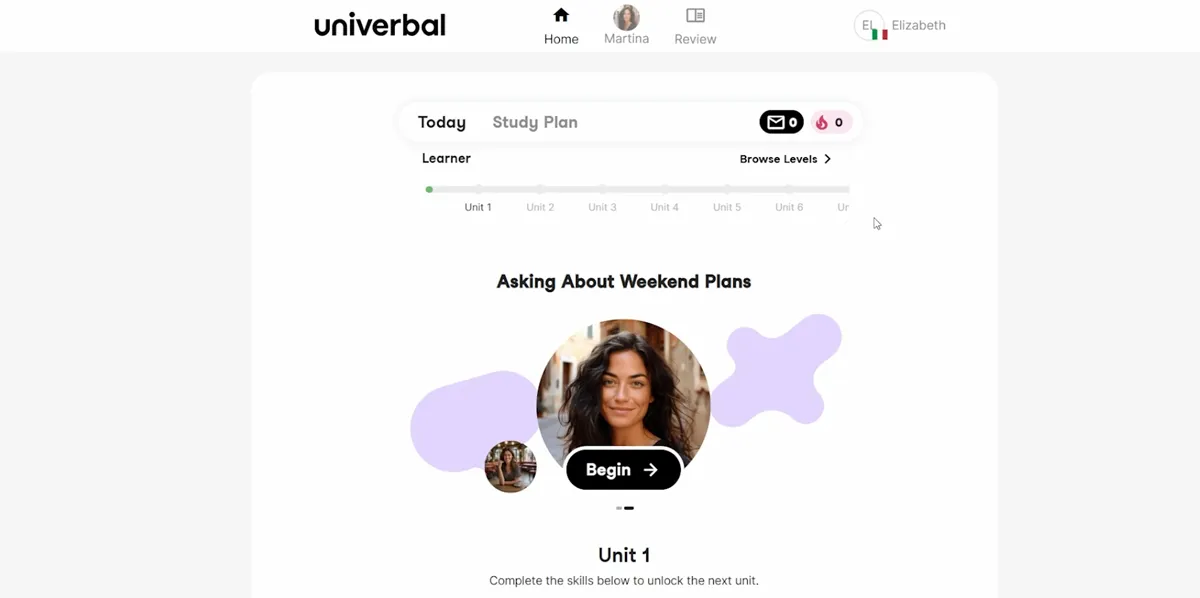
One of the main things that stood out to me is how adaptive it is. The app starts by assessing your level and then creates personalized conversations based on your goals. You can pick scenarios like ordering at a restaurant or asking for directions, and the AI will simulate that situation with you — entirely in Italian.
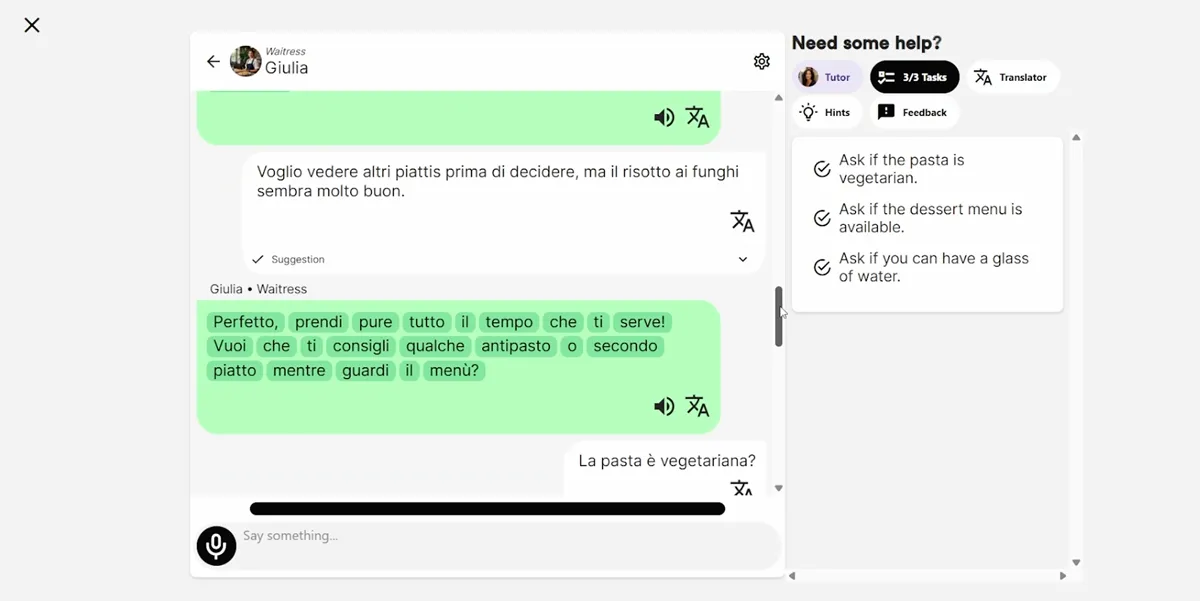
If you make a mistake — and I did plenty — the app gives you real-time feedback. For example, I once conjugated a verb incorrectly, and it showed me the right form, explained why, and let me try again without any pressure.
Tutor Mode
There’s also this feature called Tutor Mode, which I found helpful when I got stuck. I could just ask, “How do I say this in Italian?” and get a quick explanation before jumping back into the conversation. It helped me stay in the flow without feeling overwhelmed.
Visually, the app is clean and super intuitive. I didn’t have to dig around to find what I needed — everything from starting a conversation to tracking progress is laid out clearly. It also works on mobile, which was a big plus when I wanted to sneak in some practice on the go.
Customization and Progress Tracking
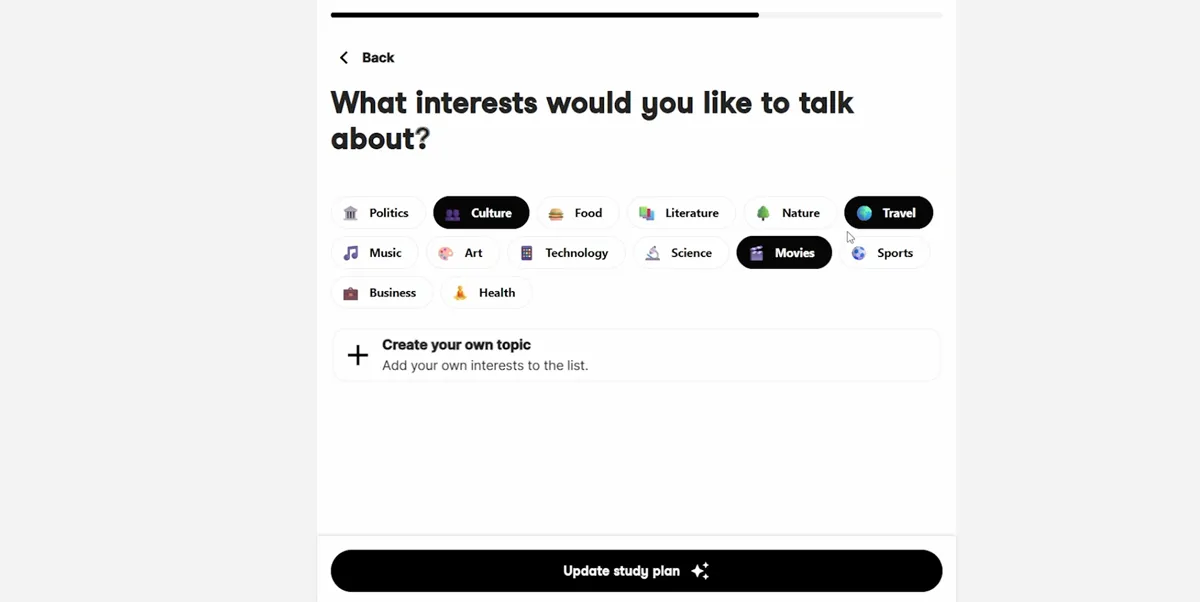
What I really appreciated is the amount of control you have. You can select topics that interest you, change the difficulty, and even get graded on different skills at the end of each conversation. It’s kind of like having a coach who adapts to your pace and goals.
Now, there were a couple of hiccups with voice recognition. Sometimes, it didn’t catch what I said correctly even though I felt my pronunciation was clear. Not a deal-breaker, but something to keep in mind. Also, you do need a stable internet connection — it won’t work offline.
Features
Spaced repetition
Does the app offer plenty of repetition to acquire vocab and grammar naturally?
Customization
Can users customize settings, interface, content, etc.?
Focus on learning
Is the interface and content focused on the course content instead of fluff and gamification?
Personalization
Are the materials automatically tailored to the user’s profile?
Sentence accuracy
Are sentences free from typos, grammar errors? Do they sound natural?
Sentence relevance
Are sentences realistic and useful?
Variety and depth
Is there enough variety of materials in terms of topics, formats and levels?
Audio quality
Are audio materials easy to listen to in terms of recording quality and speech rate?
Speaker's quality
Do speakers speak correctly, clearly and naturally?
Speaking practice
Does the app offer plenty of speaking practice?
Ease of use
Is the app easy to set up, use and navigate?
Interface and design
Is the user interface neat and visually appealing?
Performance
Does the app load fast? Is it free from glitches and crashes?
Grammar notes
Do the courses come with grammar notes?
Learning path
Do the courses follow a well defined path?
Speech recognition
Does the app recognize user speech?
User-generated courses
Can users actively generate materials from their interests?
Offline access
Are the courses available offline?
Conclusions
Would I take these courses?
Yes, especially to improve Italian speaking skills through realistic conversations and instant feedback.
How to get the most out of the app
Focus on daily conversations, repeat scenarios, and actively apply feedback to improve accuracy and confidence.
Alternatives
Think In Italian is better than Univerbal to master Italian
Think In Italian is the only app that gets your to speak Italian all the time. It comes with hundreds of grammar lessons and readings to listen and repeat, plus an AI tutor to review the courses and practice conversation. See the full review.
FAQs
Is Univerbal good for beginners?
Yes, it adapts to beginner level with simple conversations.
Does Univerbal teach grammar?
It gives feedback, but lacks structured grammar lessons.
Can I use Univerbal offline?
No, it requires an internet connection.
Is Univerbal focused on speaking?
Yes, it mainly focuses on conversation practice.
A better choice: Think In Italian
Create a free lifetime account to get access to all the free courses and other resources.
Rave Reviews
★★★★★
Rated 4.9/5 based on 170+ reviews