How I test and score
I sift through the plethora of language apps, delivering reviews based on deep expertise in language learning and teaching.
My review process starts with an initial walk-through, using the app for at least 15 minutes to capture first impressions and usability.
I then conduct a criteria-based evaluation focusing on key features like spaced repetition, user customization, and the balance between educational content and gamification.
My reviews are thorough, with a scoring system that emphasizes course quality (70%) over user experience (20%) and price (10%).
Importantly, I do not receive payment for these reviews.
Learn more on my review policy and process page.
Summary
Course quality
User experience
Pricing
Pros
- Excellent pronunciation feedback from real coaches
- Large library of native audio sentences
- Flexible practice modes and customization
- Strong speaking-focused training
- Free version offers substantial value
Cons
- Not ideal for complete beginners
- Limited grammar explanations
- Interface feels outdated
- No real-time conversation practice
- Accent corrections not clearly highlighted
Best suited for
Learners improving pronunciation and speaking after basic Italian knowledge
At a glance

App name
Speechling

Made by
Speechling Education Corporation
User base
Sentiment
- Helpful pronunciation feedback
- Great for speaking practice
- Free version is very useful
- Interface could be better
- Not beginner-friendly
Concept
Language app focused on improving pronunciation with human feedback.
Available on
Web, iOS, Android
Levels covered
(A1) Beginner, (A2) Elementary, (B1) Intermediate, (B2) Upper-intermediate, (C1) Advanced, (C2) Proficient
13 languages taught
Italian, Spanish, French, German, Portuguese, Russian, Japanese, Korean, Chinese (Mandarin), Cantonese, English (American), English (British)
Pricing, free trial, refunds
Pricing
Free trial
Refunds
First-hand review
Walk-through
Intro
Hi everyone! In today’s video, I’ll be reviewing Speechling, a platform designed to help improve your speaking skills in different languages. Since I’m focusing on Italian, I’ll walk you through how Speechling works, what I experienced using it, and some of the pros and cons I noticed along the way.
Getting Started
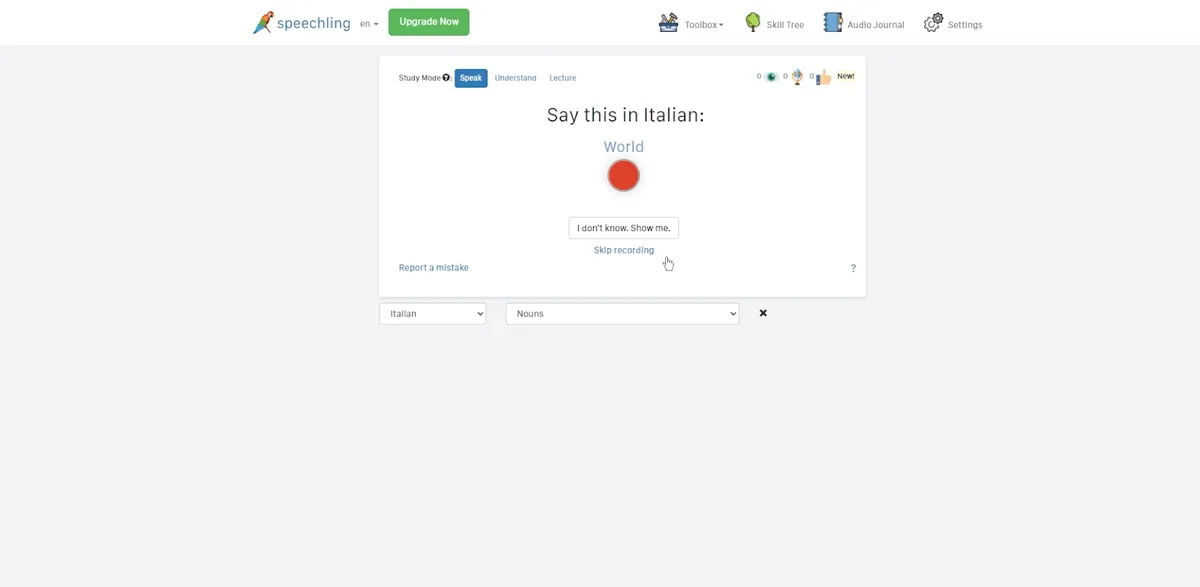
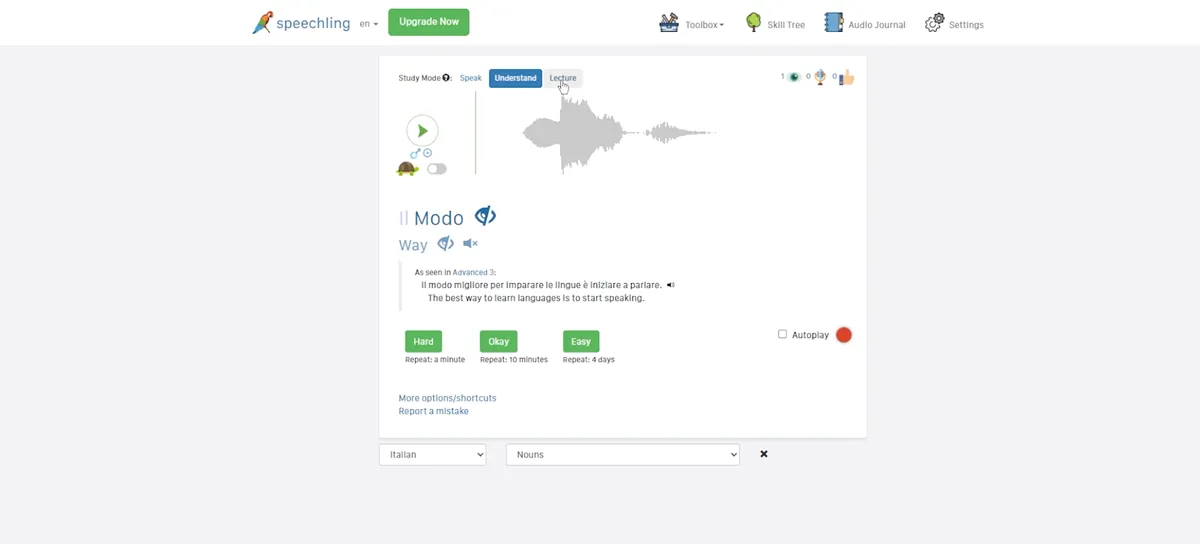
When I first joined Speechling, I saw a very simple interface. It’s not flashy, but it gets straight to the point. I was able to select Italian as my target language, and from there, I could choose different ways to practice—like speaking, listening, or even combining both.
One of the first things I noticed is that Speechling gives me thousands of native Italian sentences, recorded by both male and female speakers. I can listen, repeat, and record myself to compare how close I sound to the original.
How It Works
The main idea is pretty straightforward:
- I hear a sentence in Italian.
- I record myself saying it.
- Then, I can play both recordings back-to-back.
If I choose, I can also submit my recordings to a coach. Within 24 hours, I get personalized feedback on my pronunciation. That feedback is usually color-coded—green if I’m good, yellow if I need some work, and so on. Over time, it builds up a kind of “audio journal,” which is nice for tracking progress.
Practice Modes
What I like is the variety of practice options:
- Dictation – I listen to an Italian sentence and type it out, which trains both my listening and writing.
- Flashcards & Quizzes – Good for quick reviews, though I try not to rely too much on translations.
- Fill-in-the-blank – Great for catching smaller details in sentences.
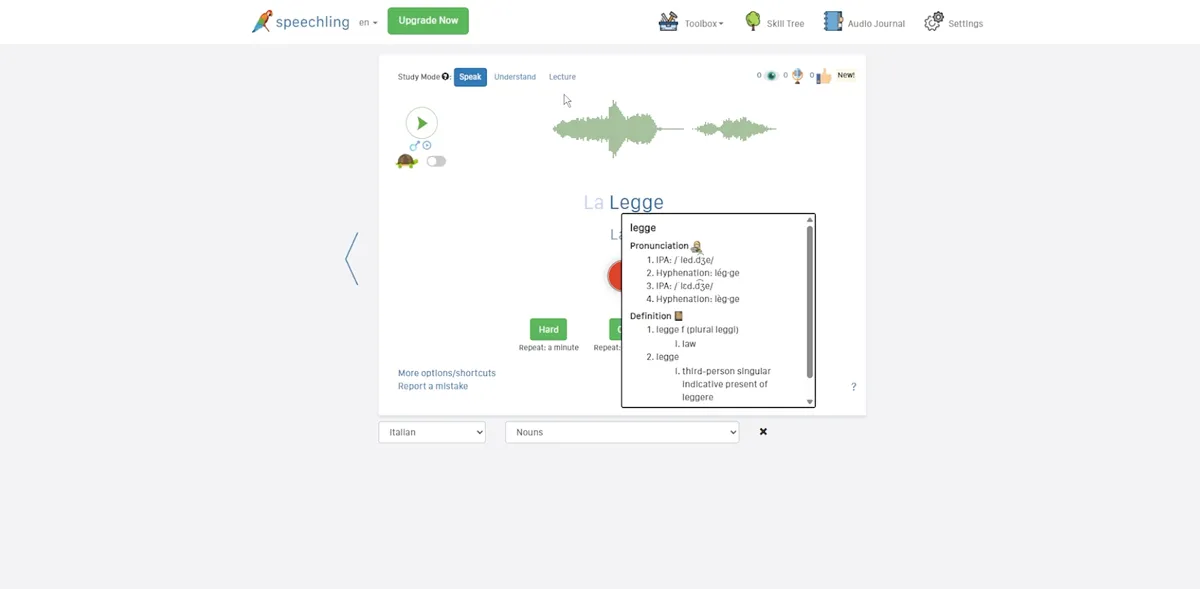
- Freestyle – This one is interesting: I can answer a question, describe an image, or just speak freely in Italian. It feels more natural, almost like I’m creating my own mini conversation.
Pros I Noticed
One of the biggest strengths I found in Speechling is the sheer amount of Italian audio available. There are over 10,000 sentences, which means I never run out of material to practice. Another huge advantage is the feedback from coaches. Sometimes I didn’t even realize I was mispronouncing a word until I got a correction back, and that was really helpful. I also appreciated how flexible the system is—I can slow down the audio, repeat it as many times as I want, and if I have the paid plan, I can even download materials for offline practice. It makes the whole process very adaptable to my learning style.
Cons I Noticed
At the same time, there are a few drawbacks. If you’re a complete beginner in Italian, Speechling might feel a bit overwhelming. It doesn’t really guide you through the sounds of the language step by step—you’re expected to mimic right away. The interface itself could also use some improvement. It works, but sometimes it took me longer than I’d like to find the settings I wanted. And although the free version is pretty generous, the number of corrections from coaches is limited, so to really get the most out of it, upgrading to the Unlimited plan feels almost necessary.
Pricing
There’s a free version where you can use most of the content, plus a limited number of coach reviews each month. The paid plan, called Unlimited, gives you unlimited feedback, offline resources, and extra tools.
Final Thoughts
Overall, Speechling is a solid option if you want to practice speaking and pronunciation in Italian at your own pace. It works best if you already know a little Italian and want to polish your fluency.
Features
Spaced repetition
Does the app offer plenty of repetition to acquire vocab and grammar naturally?
Customization
Can users customize settings, interface, content, etc.?
Focus on learning
Is the interface and content focused on the course content instead of fluff and gamification?
Personalization
Are the materials automatically tailored to the user’s profile?
Sentence accuracy
Are sentences free from typos, grammar errors? Do they sound natural?
Sentence relevance
Are sentences realistic and useful?
Variety and depth
Is there enough variety of materials in terms of topics, formats and levels?
Audio quality
Are audio materials easy to listen to in terms of recording quality and speech rate?
Speaker's quality
Do speakers speak correctly, clearly and naturally?
Speaking practice
Does the app offer plenty of speaking practice?
Ease of use
Is the app easy to set up, use and navigate?
Interface and design
Is the user interface neat and visually appealing?
Performance
Does the app load fast? Is it free from glitches and crashes?
Grammar notes
Do the courses come with grammar notes?
Learning path
Do the courses follow a well defined path?
Speech recognition
Does the app recognize user speech?
User-generated courses
Can users actively generate materials from their interests?
Offline access
Are the courses available offline?
Conclusions
Would I take these courses?
Yes, especially to improve pronunciation and speaking accuracy, but I would combine it with a more structured course.
How to get the most out of the app
Use it daily for speaking practice, submit recordings for feedback, and combine it with a structured grammar-based resource.
Alternatives
Think In Italian is better than Speechling to master Italian
Think In Italian is the only app that gets your to speak Italian all the time. It comes with hundreds of grammar lessons and readings to listen and repeat, plus an AI tutor to review the courses and practice conversation. See the full review.
FAQs
Is Speechling free?
Yes, with limited coaching feedback.
Does Speechling teach grammar?
No, it focuses mainly on speaking and pronunciation.
Is Speechling good for beginners?
Not ideal without prior basics.
How fast is feedback from coaches?
Usually within 24 hours.
Can I use Speechling offline?
Yes, with premium features.
A better choice: Think In Italian
Create a free lifetime account to get access to all the free courses and other resources.
Rave Reviews
★★★★★
Rated 4.9/5 based on 170+ reviews