How I test and score
I sift through the plethora of language apps, delivering reviews based on deep expertise in language learning and teaching.
My review process starts with an initial walk-through, using the app for at least 15 minutes to capture first impressions and usability.
I then conduct a criteria-based evaluation focusing on key features like spaced repetition, user customization, and the balance between educational content and gamification.
My reviews are thorough, with a scoring system that emphasizes course quality (70%) over user experience (20%) and price (10%).
Importantly, I do not receive payment for these reviews.
Learn more on my review policy and process page.
Summary
Course quality
User experience
Pricing
Pros
- Encourages active language production
- Fun and engaging gameplay loop
- Works with many languages
- Flexible sentence complexity
- Free to use
Cons
- No structured lessons
- No speaking practice
- Feedback not guaranteed
- Slow response times possible
- Not beginner-friendly
Best suited for
Intermediate learners practicing writing and sentence construction
At a glance

App name
Polygloss

Made by
Polygloss
User base
Sentiment
- Fun and addictive learning method
- Great for writing practice
- Simple but effective concept
- Needs speaking features
- Feedback can be inconsistent
Concept
Multiplayer image-based game to practice writing in a foreign language
Available on
iOS, Android
Levels covered
(A2) Elementary, (B1) Intermediate, (B2) Upper-intermediate
20 languages taught
Italian, English, Spanish, French, German, Portuguese, Arabic, Japanese, Korean, Chinese, Dutch, Polish, Russian, Norwegian, Hebrew, Icelandic, Irish, Welsh, Vietnamese, Esperanto, Catalan
Pricing, free trial, refunds
Pricing
Free trial
Refunds
First-hand review
Walk-through
Intro
Hi everyone! In this video, I’ll be reviewing Polygloss App, a unique language learning tool that works a bit differently from traditional apps. If you’re learning Italian, this might be something that sparks your interest.
How Polygloss Works
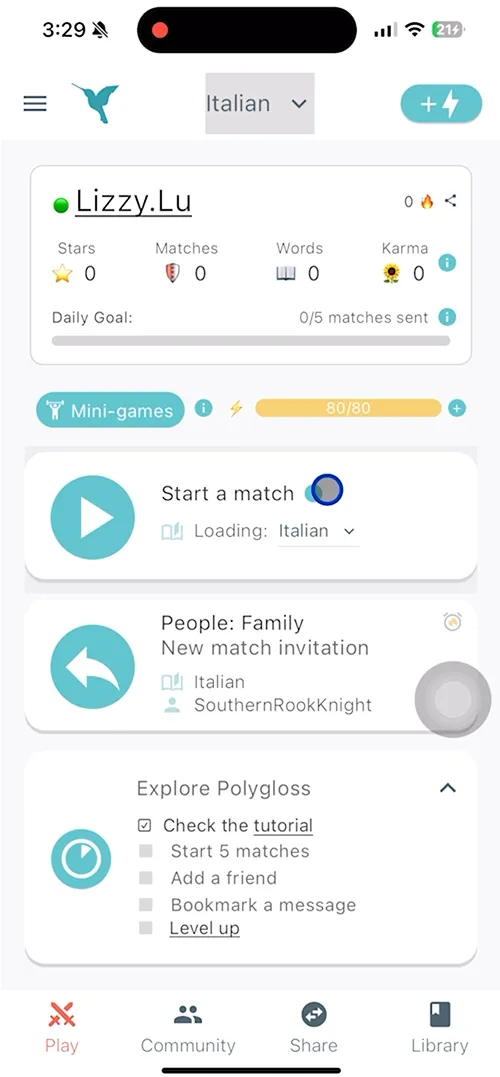
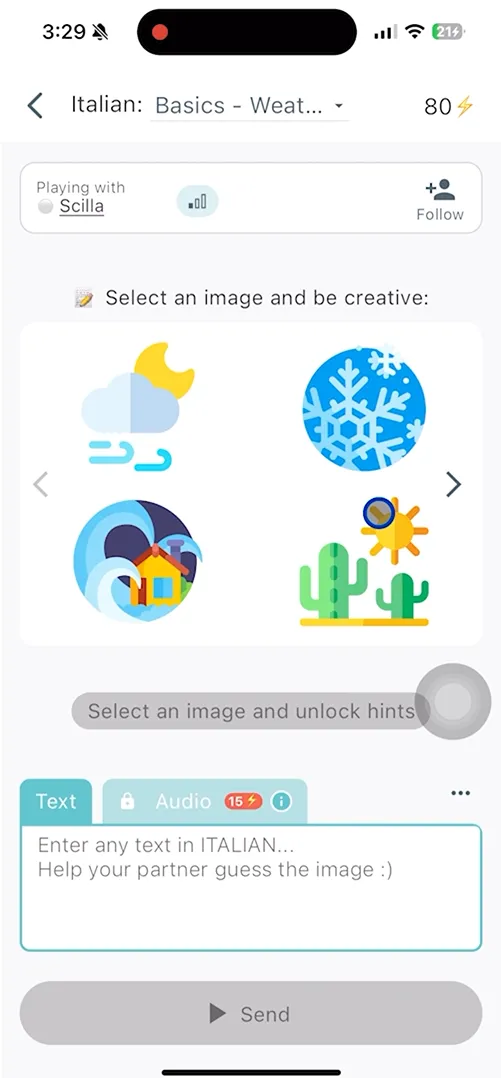
After creating a free account, I was taken straight into a short tutorial. It felt simple, because the app itself is really straightforward. The idea is: you start a match, pick one image out of four, and then write a sentence in Italian to describe that image. Once I submitted my sentence, my partner had three days to read it and guess which picture I was talking about.
Then, it flips—my partner writes a sentence, and I have to guess their image. It’s basically a back-and-forth guessing game, but in Italian. I liked how easy it was to just keep going, writing more and more sentences without even realizing how much practice I was getting.
Practice Style
What stood out to me is that Polygloss doesn’t give you pre-written phrases. Instead, I had to use the Italian I already know. For example, I might write something as simple as “Mi piacciono i gatti” or something a little more complex like “Quest’animale può vivere in casa, ma si trova anche in natura.” Both work as long as the other person can guess the picture.
It feels flexible, because I get to decide how much vocabulary and grammar to use, depending on my level. That said, Polygloss does recommend being at least an intermediate learner. So if you’re a total beginner in Italian, it might be a little too open-ended.
Motivation & Features
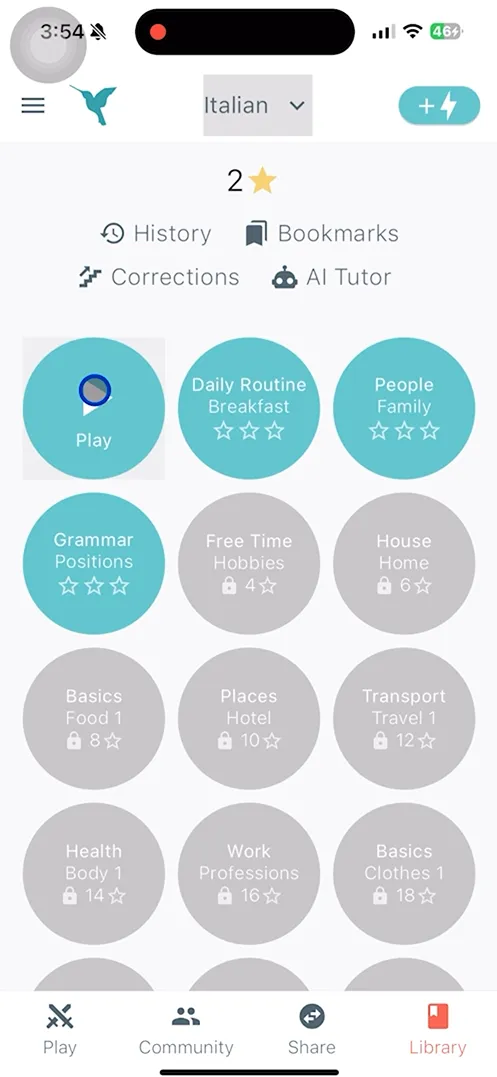
To keep things interesting, the app uses stars, karma, and energy. I earned stars when I completed matches, and those unlocked new topics. The Library tab also let me review my past sentences, which was actually useful to see how my Italian writing improved over time.
I could even go back and notice things like how I used certain grammar forms differently after a few weeks of playing. It’s definitely motivating without being overwhelming.
Pros and Cons
On the positive side, I really enjoyed how creative and flexible Polygloss is. It pushes me to produce Italian actively, rather than just tapping multiple-choice answers. I also liked that it works for many different languages, including Italian, as long as you can find a partner.
On the downside, I noticed two things. First, feedback isn’t guaranteed. Sometimes partners correct you, sometimes not, and you might wait a couple of days for them to reply. Second, there’s no speaking practice yet—it’s all writing. So if speaking Italian is your main goal, you’d need to combine Polygloss with another tool.
Wrap-Up
Overall, I think Polygloss is a fun way to practice Italian writing in a low-pressure, creative environment. It’s free to try, with optional paid features, and it can definitely keep you motivated to use Italian more actively.
Features
Spaced repetition
Does the app offer plenty of repetition to acquire vocab and grammar naturally?
Customization
Can users customize settings, interface, content, etc.?
Focus on learning
Is the interface and content focused on the course content instead of fluff and gamification?
Personalization
Are the materials automatically tailored to the user’s profile?
Sentence accuracy
Are sentences free from typos, grammar errors? Do they sound natural?
Sentence relevance
Are sentences realistic and useful?
Variety and depth
Is there enough variety of materials in terms of topics, formats and levels?
Audio quality
Are audio materials easy to listen to in terms of recording quality and speech rate?
Speaker's quality
Do speakers speak correctly, clearly and naturally?
Speaking practice
Does the app offer plenty of speaking practice?
Ease of use
Is the app easy to set up, use and navigate?
Interface and design
Is the user interface neat and visually appealing?
Performance
Does the app load fast? Is it free from glitches and crashes?
Grammar notes
Do the courses come with grammar notes?
Learning path
Do the courses follow a well defined path?
Speech recognition
Does the app recognize user speech?
User-generated courses
Can users actively generate materials from their interests?
Offline access
Are the courses available offline?
Conclusions
Would I take these courses?
I would use it as a complementary tool to practice writing, but not as a main learning platform.
How to get the most out of the app
Use it consistently for writing practice, review past sentences, and combine it with structured learning tools.
Alternatives
Think In Italian is better than Polygloss to master Italian
Think In Italian is the only app that gets your to speak Italian all the time. It comes with hundreds of grammar lessons and readings to listen and repeat, plus an AI tutor to review the courses and practice conversation. See the full review.
FAQs
Is Polygloss good for beginners?
Not ideal, requires basic vocabulary knowledge.
Does Polygloss teach grammar?
No, it focuses on practice, not explanations.
Can I practice speaking?
No, only writing is supported.
Is Polygloss free?
Yes, with optional paid features.
How fast is feedback?
It can take up to three days.
A better choice: Think In Italian
Create a free lifetime account to get access to all the free courses and other resources.
Rave Reviews
★★★★★
Rated 4.9/5 based on 170+ reviews