
How I test and score
I sift through the plethora of language apps, delivering reviews based on deep expertise in language learning and teaching.
My review process starts with an initial walk-through, using the app for at least 15 minutes to capture first impressions and usability.
I then conduct a criteria-based evaluation focusing on key features like spaced repetition, user customization, and the balance between educational content and gamification.
My reviews are thorough, with a scoring system that emphasizes course quality (70%) over user experience (20%) and price (10%).
Importantly, I do not receive payment for these reviews.
Learn more on my review policy and process page.
Summary
Course quality
User experience
Pricing
Pros
- Learn from real native content
- One-click flashcard creation
- Strong spaced repetition system
- Highly customizable learning
- Context-rich vocabulary learning
Cons
- Limited structured grammar teaching
- Requires high self-discipline
- Best features desktop-only
- Not focused on speaking practice
- Learning curve for beginners
Best suited for
Self-motivated learners who enjoy learning through videos, shows, and real-world content.
At a glance

App name
Migaku
Made by
Migaku
User base
Sentiment
- Great for immersion learning
- Flashcards feel very effective
- Setup can be confusing initially
- Powerful for serious learners
- Not ideal for beginners alone
Concept
Learn languages through real content using immersion and spaced repetition.
Available on
iOS, Android, Web
Levels covered
(A1) Beginner, (A2) Elementary, (B1) Intermediate, (B2) Upper-intermediate, (C1) Advanced
11 languages taught
Cantonese, English, French, German, Italian, Japanese, Korean, Mandarin, Portuguese, Spanish, Vietnamese
Pricing, free trial, refunds
Pricing
Free trial
Refunds
First-hand review
Walk-through
Intro
Today I’m reviewing Migaku, a platform that tries to make language learning more immersive by letting you learn directly from the content you already enjoy. If you’ve been looking for a tool to help you learn Italian using real videos, websites, and natural speech instead of textbook-style lessons, Migaku is probably one of the names you’ve seen around. I decided to give it a try to see how it actually works in practice.
Setup
What immediately stands out about Migaku is that it’s designed around immersion.
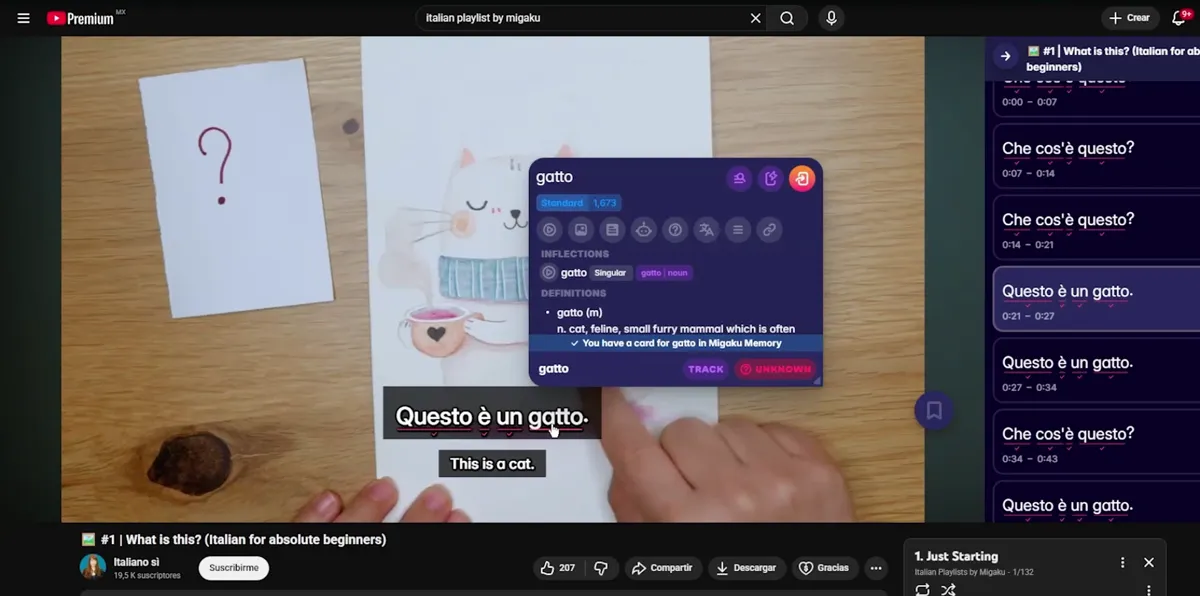
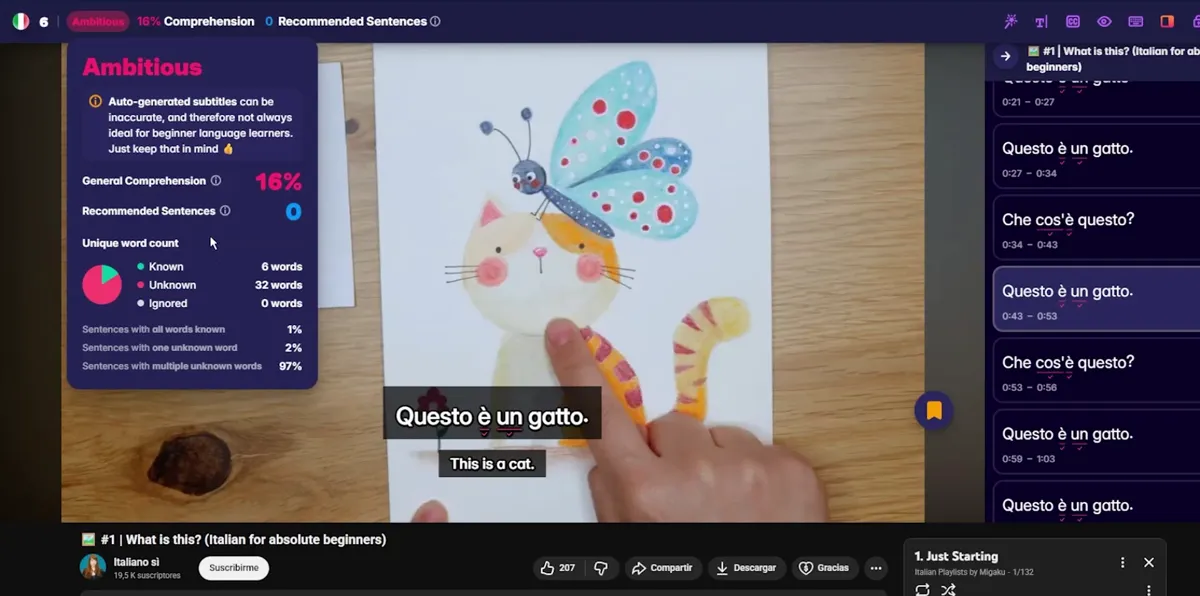
Instead of presenting predefined units or themed vocabulary lists, it connects to the content you’re already consuming. I installed the Chrome extension, opened some Italian videos on YouTube and Netflix, and suddenly everything became interactive. I could click on any Italian word in the subtitles, and Migaku instantly showed me the meaning, audio, and context, and created a flashcard without interrupting the video. That alone changed the way I went through content, because I didn’t have to pause every few seconds to look things up.
Overall Thoughts
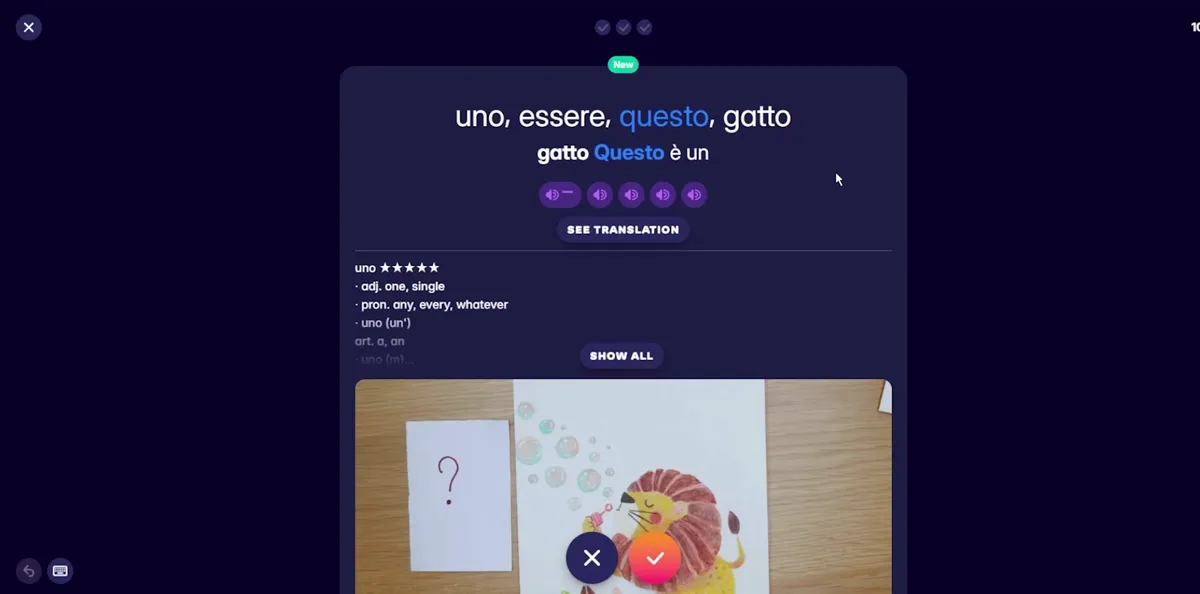
While watching Italian shows, I was able to save vocabulary with a single click. Migaku captures the audio from the scene, the sentence, and even a screenshot. Reviewing these cards felt much more memorable because the words weren’t isolated—they were tied to something I had actually watched. The built-in SRS also keeps everything scheduled so I review what I learned at the right time.
Another thing I noticed is that Migaku tries to help you choose the right material. It shows an estimate of how much of a video or webpage you understand based on the words you already know. It’s not perfect, but it gave me a sense of whether I was watching content that was too easy or too advanced.
There were moments when videos didn’t have subtitles, and Migaku offered AI-generated ones. They’re still improving, but when they worked, they made a big difference. What Migaku doesn’t really do, though, is teach grammar in a structured way. For Italian, the experience is mainly vocabulary and comprehension through immersion, so if someone prefers guided lessons, this might not be enough on its own.
The platform works best on Chrome, since that’s where all the interactive features live. On mobile, I was mostly reviewing flashcards rather than using the full immersion tools.
Pricing includes a monthly subscription or a lifetime option, which can feel high depending on how committed you are to this method of learning. If you enjoy learning Italian through real content and want a tool that simplifies the process of saving and reviewing vocabulary, Migaku fits well into that style.
Outro
Overall, Migaku offers a different way of learning Italian—less structured, more immersive, and very focused on real-life content. It won’t cover everything, but it can be a helpful tool depending on your learning style. And if you’re exploring options, there is another tool that I would also recommend checking out…
Features
Spaced repetition
Does the app offer plenty of repetition to acquire vocab and grammar naturally?
Customization
Can users customize settings, interface, content, etc.?
Focus on learning
Is the interface and content focused on the course content instead of fluff and gamification?
Personalization
Are the materials automatically tailored to the user’s profile?
Sentence accuracy
Are sentences free from typos, grammar errors? Do they sound natural?
Sentence relevance
Are sentences realistic and useful?
Variety and depth
Is there enough variety of materials in terms of topics, formats and levels?
Audio quality
Are audio materials easy to listen to in terms of recording quality and speech rate?
Speaker's quality
Do speakers speak correctly, clearly and naturally?
Speaking practice
Does the app offer plenty of speaking practice?
Ease of use
Is the app easy to set up, use and navigate?
Interface and design
Is the user interface neat and visually appealing?
Performance
Does the app load fast? Is it free from glitches and crashes?
Grammar notes
Do the courses come with grammar notes?
Learning path
Do the courses follow a well defined path?
Speech recognition
Does the app recognize user speech?
User-generated courses
Can users actively generate materials from their interests?
Offline access
Are the courses available offline?
Conclusions
Would I take these courses?
Yes, especially for immersion learning, but I would combine it with speaking practice tools and structured grammar resources.
How to get the most out of the app
Use it daily with content you enjoy, consistently review flashcards, and combine it with speaking practice and grammar study.
Alternatives
Think In Italian is better than Migaku to master Italian
Think In Italian is the only app that gets your to speak Italian all the time. It comes with hundreds of grammar lessons and readings to listen and repeat, plus an AI tutor to review the courses and practice conversation. See the full review.
FAQs
What is Migaku best for?
Learning through immersion and real content.
Is Migaku good for beginners?
Only with additional structured learning support.
Does Migaku teach speaking?
No, speaking practice is limited.
Can I use Migaku offline?
Yes, mainly for flashcard review.
Is Migaku worth it?
Yes, for committed learners who enjoy immersion.
A better choice: Think In Italian
Create a free lifetime account to get access to all the free courses and other resources.
Rave Reviews
★★★★★
Rated 4.9/5 based on 170+ reviews