
How I test and score
I sift through the plethora of language apps, delivering reviews based on deep expertise in language learning and teaching.
My review process starts with an initial walk-through, using the app for at least 15 minutes to capture first impressions and usability.
I then conduct a criteria-based evaluation focusing on key features like spaced repetition, user customization, and the balance between educational content and gamification.
My reviews are thorough, with a scoring system that emphasizes course quality (70%) over user experience (20%) and price (10%).
Importantly, I do not receive payment for these reviews.
Learn more on my review policy and process page.
Summary
Course quality
User experience
Pricing
Pros
- Large vocabulary and phrase library
- Native audio with slow playback
- Gamified and engaging exercises
- Speech recognition included
- Offline mode available
Cons
- Limited grammar explanations
- Little real conversation practice
- Repetitive exercises
- Feedback is basic (right/wrong)
- Free version very restricted
Best suited for
Beginners building Italian vocabulary with short daily sessions.
At a glance

App name
FunEasyLearn
Made by
FunEasyLearn
User base
Sentiment
- Easy and fun to use
- Great for vocabulary learning
- Good pronunciation support
- Too basic for advanced learners
- Too many locked features
Concept
Gamified app to learn Italian vocabulary and phrases through exercises.
Available on
iOS, Android, Web
Levels covered
(A1) Beginner, (A2) Elementary, (B1) Intermediate
34 languages taught
Italian, English, Spanish, French, German, Portuguese, Chinese, Korean, Japanese, Hindi, Arabic, Russian, Turkish, Polish, Dutch, Swedish, Romanian, Greek, Thai, Vietnamese, Indonesian, Czech, Hungarian, Ukrainian, Bulgarian, Croatian, Slovak, Finnish, Danish, Norwegian, Hebrew, Persian, Filipino, Malay
Pricing, free trial, refunds
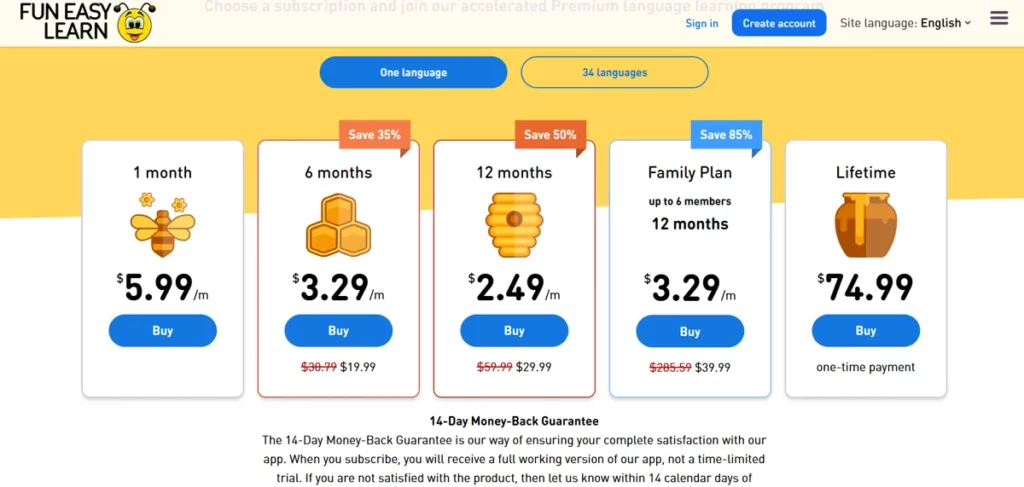
Pricing
Free trial
Refunds
First-hand review
Walk-through
Intro
Today I’m reviewing FunEasyLearn, a language learning app that promises to make learning Italian fun, interactive, and accessible for all levels. If you’ve been searching for a vocabulary-based app with gamified exercises and pronunciation tools, you’ve probably come across this one. So I decided to test it specifically for Italian and see how it actually feels in practice.
Setup
When I first opened FunEasyLearn, I was asked to select my age group, my native language, and my target language — in this case, Italian. I could also set a daily learning goal, choosing between 5, 10, 20, or 30 minutes per day, which I liked because it immediately gave the experience some structure.
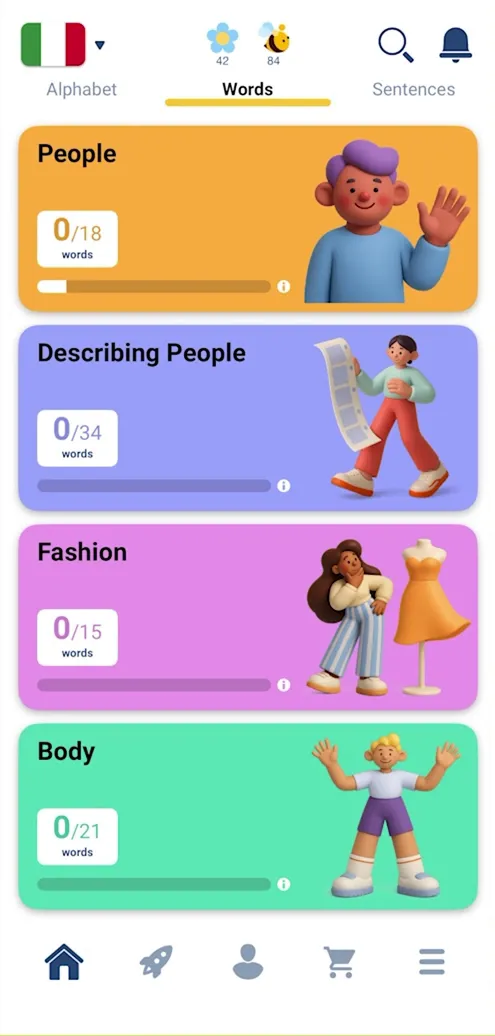
After that, I had the option to start as a beginner or take a level test. Once inside, I landed on the main learning screen, where everything is organized by categories — things like general conversation, describing people, travel, food, and more.
The interface is clean and colorful, with a bee mascot guiding the experience. Navigation felt intuitive, and I didn’t need much time to understand how things worked.
Features
The core of FunEasyLearn is vocabulary and short sentences. The full version includes thousands of Italian words and phrases, all grouped by topic.
Each new word comes with a picture, the written form, native speaker audio at normal and slower speeds, IPA phonetic transcription, and a speech recognition button so I can try pronouncing the word myself.
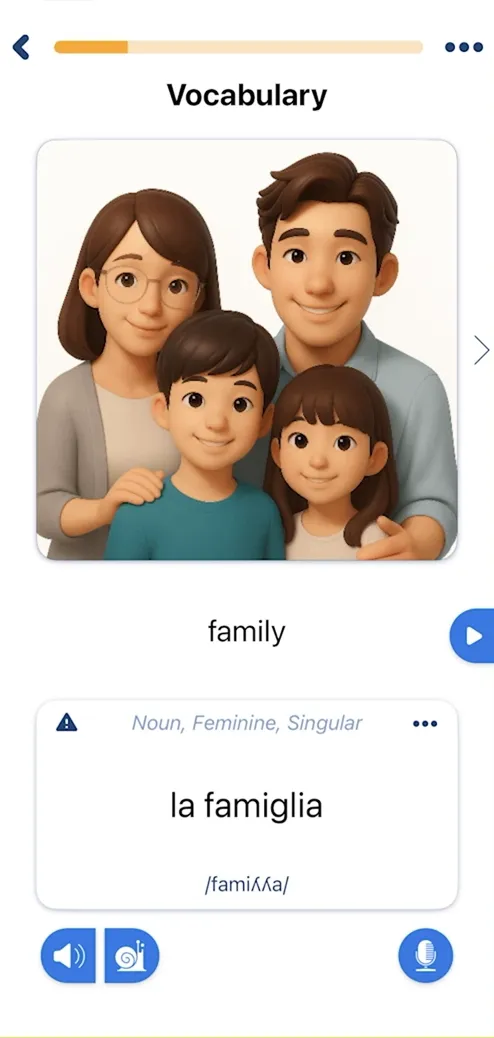
When I tapped the speech feature, I could see whether the system recognized what I said. The feedback is immediate, although it’s mostly right-or-wrong, without detailed correction.
After reviewing the flashcards, I moved into exercises. These include matching phrases, translating, listening and choosing the correct answer, filling in the blanks, writing words, and even finding mistakes in sentences. The exercises are short and repetitive, which makes them easy to complete in small study sessions.
One thing I noticed is that the app focuses heavily on vocabulary and sentence-level practice. I didn’t see much in terms of grammar explanations, longer texts, or real conversation practice. Most activities are based on recognition, repetition, and translation rather than open-ended speaking.
In terms of pronunciation, I appreciated being able to replay audio at a slower speed. That’s helpful for Italian, especially when paying attention to double consonants or vowel clarity. The phonetic transcription is also there, which can be useful if you’re familiar with IPA.
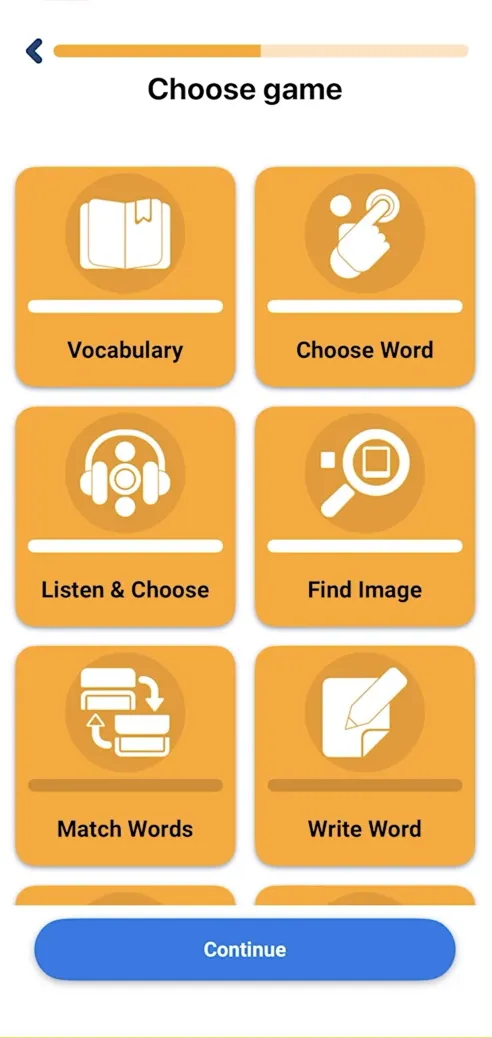
Gamification is a big part of the experience. I earned “flowers” for completing lessons, and there are daily challenges that feel similar to mini-games. It’s clearly designed to keep you engaged and motivated.
There’s also an offline mode in the premium version, progress tracking, and the ability to mark words as favorites for review later.
Overall Thoughts
After spending time with FunEasyLearn for Italian, I’d say it works well as a structured vocabulary builder. If I wanted to quickly expand my Italian word bank or review common phrases in short, focused sessions, this app makes that easy.
The pronunciation tools — especially the native audio and speech recognition — add value at the word level. However, I didn’t find much opportunity for spontaneous speaking or real communicative practice. The exercises are mostly controlled and repetitive, and grammar explanations are minimal.
For beginners, the clear structure and gamified format can feel motivating. For more advanced learners, the activities might start to feel less challenging over time.
Overall, FunEasyLearn feels like a vocabulary-driven, gamified tool for building foundational Italian words and phrases in short bursts.
Features
Spaced repetition
Does the app offer plenty of repetition to acquire vocab and grammar naturally?
Customization
Can users customize settings, interface, content, etc.?
Focus on learning
Is the interface and content focused on the course content instead of fluff and gamification?
Personalization
Are the materials automatically tailored to the user’s profile?
Sentence accuracy
Are sentences free from typos, grammar errors? Do they sound natural?
Sentence relevance
Are sentences realistic and useful?
Variety and depth
Is there enough variety of materials in terms of topics, formats and levels?
Audio quality
Are audio materials easy to listen to in terms of recording quality and speech rate?
Speaker's quality
Do speakers speak correctly, clearly and naturally?
Speaking practice
Does the app offer plenty of speaking practice?
Ease of use
Is the app easy to set up, use and navigate?
Interface and design
Is the user interface neat and visually appealing?
Performance
Does the app load fast? Is it free from glitches and crashes?
Grammar notes
Do the courses come with grammar notes?
Learning path
Do the courses follow a well defined path?
Speech recognition
Does the app recognize user speech?
User-generated courses
Can users actively generate materials from their interests?
Offline access
Are the courses available offline?
Conclusions
Would I take these courses?
I would use it as a vocabulary companion, but not as a main Italian learning tool due to limited depth.
How to get the most out of the app
Use it daily for vocabulary practice and combine it with a platform focused on speaking and grammar.
Alternatives
Think In Italian is better than FunEasyLearn to master Italian
Think In Italian is the only app that gets your to speak Italian all the time. It comes with hundreds of grammar lessons and readings to listen and repeat, plus an AI tutor to review the courses and practice conversation. See the full review.
FAQs
Is FunEasyLearn good for Italian beginners?
Yes, especially for vocabulary and basic phrases.
Does FunEasyLearn teach grammar?
Very limited grammar explanations.
Can I practice speaking Italian?
Only basic pronunciation with speech recognition.
Does it work offline?
Yes, with a premium subscription.
Is FunEasyLearn free?
Yes, but full content requires payment.
A better choice: Think In Italian
Create a free lifetime account to get access to all the free courses and other resources.
Rave Reviews
★★★★★
Rated 4.9/5 based on 170+ reviews